Tuesday, July 24, 2018

On Anniversaries - A Brigid Guest Post


Sometimes you think you can fly, only to be destined to drown.

And so we stay earthbound. "Should have". "Would have". Those are words in all of our hearts, at least once. We recall much of a life as each year passes, candles on another cake, warm breath against the flames. But what do you remember most, the best day of your life or your last regret?

The difference is profound.

I look at my Dad, and when my late brother's name is mentioned he gets this look of profound grief on his face, even as I've learned to get through the day as a stoic. He is a man who is not Time's trinket and for him, my brother's collapse and death on Good Friday as if it was yesterday.

But he'd not have given up the experience of adopting and raising him, both of us, for any happier ending.
I remember a few short years ago, when I thought my heart was in pieces, not likely to heal.  A fractured goodbye, and the realization that the person I had cared for, who had asked to meet my family and had done so, was a breathing ghost. I was left with just a rose, drying between two pages, the blood from an internal thorn tearing something loose inside, the print of nose against the glass of a skyscraper where I leaned into it so the tears couldn't be seen. Afterwards, I wondered if life was even worth living, there in that brief darkness before there is light.

But I didn't go down that path, the thought only one of brief self-pity, not intended to be action. I had a really good cry or two and a giant plate of Nachos and a beer or three with a six-foot pony-tailed blond, who has always been my rock among best friends. Then I met my gal friend M.C. and as we drove around a haunted landscape, I realized that although I hurt, I FELT, and that was a good thing.

Then, after a long night's sleep, I picked up the phone and called a guy friend, someone I had chatted online with for years, sometimes spending hours sharing geeky puns and jokes. I knew he would understand. My boyfriend and I broke up", was all I said, and he listened, as he always did while I talked it out, and tried to put it behind me.
It wasn't the first time my heart had broke, and wouldn't be the last, but the feeling peeled something from me, like skin from an onion, leaving nerves exposed to a cold that bit with weasel teeth. It brought back a memory of that first loss of someone I loved and a memory of how I handled it. For that first time my heart broke, I did what a lot of people do. I pushed everyone away, pushing my boundaries, sometimes hanging up high in the air, the g-forces on my body a distraction from the pain, the air parting like the Red Sea, my only need to move on at maximum risk to my body, and minimum risk to my soul.

I wanted nothing from the world but the ability to push through it without being touched.  I talked little to people but much to the sky, whispering to it my regrets as I rolled through 40 degrees of bank, taking counsel with that great blue solitude.
You think that cheating death like that would make me feel alive but for a time, it was a battle without passion, grey and colorless, with neither the urge to win or the fear to lose, played out before an arena with no audience.  I came within a few knots of a final pronouncement more than once and found that I had nothing left to say.

The only sound was the wings cleaving the air, a sound that is like all other sounds of profound mystery, the lap of a wave upon a shore, the echo of taps, the whispers of a voice that speaks to you in dreams from an eternity away, heard but not comprehensible.

I lost out on a lot of life during those brief years.
This time, I was a bit older, and a little scar tissue and I weren't strangers, having been through much worse than breaking up a budding relationship. This time I was going to open myself up to friends and get out and enjoy my life with the four legged friend who had taught me that lesson. With Barkley in tow, we got out and we talked and we learned to laugh again, and in fairly short order. There were whiskey and bacon and late nights with two good friends laughing as we compared the merits of Barry White versus William Shatner and Greensleeves or Zamfir and his Pan Flute as music to get lucky by. On one of the rare days I let that last heartache get the better of me, one of those friends said: "if you had to do it all again, knowing it would teach you how to feel again, would you"?  I looked at her and said "hell yes."

I didn't see my friend that I called that night for a few months, our talks continuing with the usual matters between people that share hobbies and books, even if they don't share the same generation. Then one night he mentioned a date with a ballerina, and I pictured them out, young, beautiful, laughing and felt something twist in my chest that had not been there for a while. But I didn't say anything, not then, not when Barkley and I would meet him for a coffee.
Then one day he called me after landing from a  long business trip overseas and asked me to an event we both loved, not a date, just a typical outing with friends someplace upstate.  I said yes and plans were made. After hanging out all that day, he asked if I wanted to get a bite to eat once we'd had a chance to get cleaned up (playing with steam engines all days can get a little dirty) and we located a couple quick burger places near our respective hotels.  He showed up at my door dressed in dress pants and a crisp shirt, and the burger joint I was expecting as planned, turned into an intimate, elegant bistro, a glass of wine, and a conversation about things much deeper than the night, things only hinted at, never said.
Halfway through the meal, I thought to myself "holy cow, this is a date".

That was seven years ago, on a warm, clear day.  That date is now my husband.

Because he asked.
How often do we stay silent, when we are searching, when we need help, when we are hurt?  How often do we shut ourselves away when we want a cool touch upon the brow or a hand that helps us up a steep slope. There is so much that can keep us from the truth of things, holding us in that toil of a heart's hesitation.

Sometimes it's pride, sometimes it's hurt. Sometimes it's history.  Often it's the fear of being rejected The safety stays on, the mouth stays closed and while we think we are protecting ourselves, we're merely closing a door on life, one that can be as fixed as one of a prison.  In doing so sometimes we lose a friend, we lose an opportunity or we lose on love- that improbable, inexplicable and sometimes bewildering thing that binds us together despite our blood, or through it.
A fellow I knew professionally, lamented to me in a moment of vulnerability after a very late night on the job that his old high school crush was marrying someone else.  I said "did you ever ask her out" and he said "no. . . I knew she would say no, she was beautiful and popular and I'm. . . . ", accepting the words as he uttered them with an almost eager fatalism. That which makes something its truth also makes its meaning.  I should have offered comfort, but I remained silent, not knowing what to say.

So he and I just continued to work, in silence, our untrammeled feet taking us to a place rendered quiet not by solitude, but by loss. We worked on, blind and deaf to any emotion but the gathering and I realized I should have said something, if only, "next time. . . ask" said with a smile, and a hug from a friend, not a colleague.
On a day when another birthday shortly looms,  I look at what is around me, and how I almost lost it, lost myself, simply by never taking the chance, listening to my fears, and not to my heart.  For the past does have a way of coming back to us.  You can fear in in silence, treating it as if you would an unwanted dream or you can learn from it, remembering it like a fine book, full of wonders and maybe occasional warfare, but as full of life as the landscape around you.

From what I've learned in 59 years on this planet, is the earth is simply a standing place and how you look at what is around you is your loss or your gain.
The sky and water weld together without joint, the sun descending down, touching the lake with a soundless hiss.  Soon, the moon would spread over this place with the thick sheen of silver. This is just one day in time, one day to be cataloged in memory.  The living trees, the flowers planted by another's hands, so still they appear to have been formed in stone, even to the smallest bud, the feather stroke of a tiny leaf.

I touch the porch railing of this old house, tracing it the way fingers trace a human backbone, there under the skin, in the silent perusal of that which becomes wonder. Another year older, another day wiser.  I could worry about, or as I did on that birthday not all that long ago where I could give my best friend and Partner a T-Shirt that says "I Can't Drive 55" and just laugh, a sound that will bend the trees and shake the fixed stars in the sky.  I turn towards the door, where there is a light on, waiting.

We are governed by Dumbasses

And when I call them "dumbasses", I must apologize to donkeys for any disaprobation due to being associated with these idiots:
The nation's top voting machine maker has admitted in a letter to a federal lawmaker that the company installed remote-access software on election-management systems it sold over a period of six years, raising questions about the security of those systems and the integrity of elections that were conducted with them. 
In a letter sent to Sen. Ron Wyden (D-OR) in April and obtained recently by Motherboard, Election Systems and Software acknowledged that it had "provided pcAnywhere remote connection software … to a small number of customers between 2000 and 2006," which was installed on the election-management system ES&S sold them.
Electronic voting has two computer components: the voting machines (where you cast your ballot) and the election management machines (where the ballots are counted).  The security of the voting machines themselves has been pretty much deplorable, and we've known this for a very long time.  But the saving grace is that to hack the election you need to hack a bunch of voting machines, and you need physical access to do so.  That hakes it hard - not impossible, but hard (read: expensive) and so the risk is mitigated by the real world (im)practicalities of the scenario.

But the election management systems, aye there's the rub.  The votes get dumped from the voting machines into the management systems where they get counted and tabulated.  And those machines were connected to the 'net.

Ooooooh kaaaaaay.  Good thinking.

So riddle me this, Voter Fraud Man.  If you wanted to change an election, would you try to gain physical access to maybe thousands of voting machines in key swing districts, using hundreds of accomplices who might get caught (or blab to the PoPo), or would you target a few dozen of remotely accessible (and poorly protected) election management computers where you just change the counted results by a few percent to swing the election your way?  After connecting from a jurisdiction that doesn't have an extradition treaty with the USA.

Take your time thinking about it, I'll be right here.

For extra credit, what do you think the password of the PCAnywhere remote access software was?


So we are governed by dumbasses.  No, not the idiots who designed and sold this bleeding turkey of a voting system.  The ones who bought this bleeding turkey of a voting system.


In a younger and more vigorous era of the Republic, the sellers (and buyers) of this smoking train wreck would have been horse whipped through the public square.  Alas, for the decline of the America.

We have to ban them for the Children!


I mean, c'mon - nobody needs that!

The Roman Deep State and Make Rome Great Again

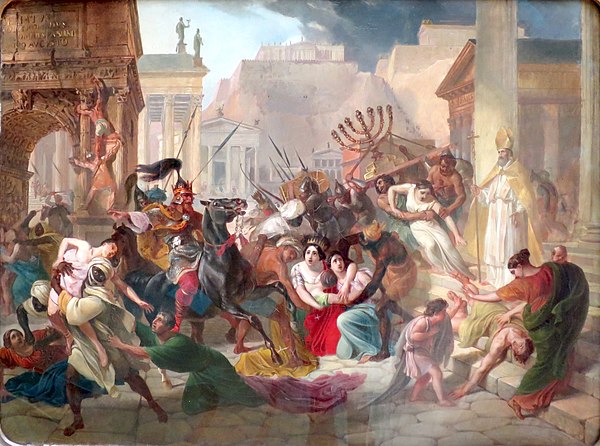
Things looked grim for the Roman Empire in 455 AD.  Much of the provinces of Gaul and Hispania had been essentially taken over by barbarian armies.  In May the Eternal City itself was sacked by the vandals.  This wasn't a mostly-extortion sacking like Odoacer did in 410, it was violent and destructive, stripping the capital of the ancient world of its accumulated treasures.  Not for nothing does the word "vandal" have its current meaning.

Genseric sacking Rome, by Karl Briullov
It looked like things were about to fall apart.  A series of weak Emperors had been dominated by barbarian generals serving as Roman commander in chief for most of the last 60 years.  Unexpectedly, Majorian donned the purple, vowing to make Rome great again.

He was energetic, intelligent, and a good leader of men.  He quickly gathered his troops and - unusually for an Emperor in those days - personally led them into Gaul.  Beating the Visigothic king who would later come to be known as Theodoric the Great, he forced the Goths to recognize the Emperor as overlord.  He then turned his attention to the barbarian Burgundians, storming their capital and making them rejoin the empire as well.

He then turned his attention - and his armies - south.  Since Theodoric had pledged his people's loyalty, Majorian gave them the chance to prove it, by attacking the barbarian Suebi who had taken over northwest Hispania.  They did.  Meanwhile, Majorian's own troops drove the Vandals from Spain.

By 460 AD, Majorian had been Emperor for a short three years and had nearly restored the Empire.

But he was an outsider.  A native of Gaul, he was never accepted by the Roman Senate and the Italian power structure.  The following year he was assassinated.  The Roman Deep State may have thought that they could handle things (they couldn't), or perhaps that it was better to reign in Hell than to serve in Heaven.  The next years would show how that wasn't all that it was cracked up to be as the last Emperor, the Little Augustus Romulus Augustulus was deposed in 476.  The Roman Deep State refused to serve an Emperor from Gaul and faound themselves under the yoke of a Barbarian king.
Majorian presents the welcome discovery of a great and heroic character, such as sometimes arise, in a degenerate age, to vindicate the honour of the human species.
- Edward Gibbon, The Decline And Fall Of The Roman Empire
Donald Trump in many ways finds himself in a similar situation to Majorian.  A series of disastrous trade agreements have gutted large parts of America, vandalizing a once thriving middle America.  You could call it a sacking and not be far off.  He, like Majorian, is a man of energy and intelligence, and has quickly achieved much more than most people thought possible.

But he, too, is an outsider, opposed by those who seem to prefer ruling in Hell over serving in Heaven.  Political violence is in the air.  An assassin shot a Congressman last year.  A political zealot assaulted and hospitalized a Senator.  We are surrounded by images of Trump with his head cut off.

As Trump increasingly succeeds in marginalizing a Deep State who thought that they alone were fit to rule, at what point can we expect a real plot to kill Caesar?  Because the Trump revolution is centered around the man himself - this is not an institution, it is a reflection of him as a force of nature.  Remove him, and you remove the force.  Vice President Pence is no Donald Trump, and likely would be made of the same material as the last few pathetic Roman boy Emperors.

But what happens then?  The forces rending the Republic will not be gone.  The forces that led to the election of Trump will not disappear.  Our Deep State will likely discover what the Roman Deep State found, that it would have been better to serve in Heaven than live in the Hell they unleashed.

Monday, July 23, 2018

Blogiversary

New Jovian Thunderbolt has been blogging eleven years.  That's like the neolithic age of the Blogosphere when he started.

Congrats, T-Bolt!

Saturday, July 21, 2018

Toots & The Maytals - Take Me Home Country Roads

The Queen Of The World and I are going to a Reggae festival today, but it's Saturday morning which means country music.  What to do, what to do ...

Toots & The Maytals has a reggae version of the old John Denver classic, with a couple changes.  Almost Heaven West Jamaica ...

Friday, July 20, 2018

Those who are ignorant of history are doomed to repeat it


Digging for Hitler

Wow.  This is more than a little creepy.  Tacitus thinks that he may have helped excavate a battlefield where Adolf Hitler served in World War I.  This is very thought provoking, and highly recommended.
The past isn't dead.  It isn't even past.
- William Faulkner

Thursday, July 19, 2018

Assassination chiq - Louis Armstrong "I'll Be Glad When You're Dead You Rascal You"

There has been a lot of buzz over the last couple years about someone killing Donald Trump.  CNN's Wolf Blitzer discussed what would happen if someone blew up the inauguration.  A Missouri state legislator said she hoped it would happen.  Twitter is (as you'd expect) a sewer of this sort of stuff.  Chuck Schumer said that Trump was "really dumb" for taking on the CIA because they had lots of ways to get back at him.

And everyone seems to have forgotten that someone actually tried to assassinate The Donald.

Ah, the rarified atmosphere of calm, intellectual debate.  More thoughts coming tomorrow, but in the meantime, here's Louis Armstrong with what was probably the first ever recorded assassination threat against Trump.


Around the blogs

Rather than having to actually, you know, think and work, I'll highlight some posts that struck me as important and well worth your time.

OldNFO posts about how College is a waste for many kids and they would be much better off financially learning a high paying trade.  The comments are all pack full of smart, too.

The Czar of Muscovy writes about how when an organization loudly trumpets what appears to be nothing short of lunacy, you should follow the money.

Speaking of lunacy, Lawrence Person writes on how the establishment simply can't get their heads around how Trump accomplishes what he does - even though it is as simple as simple.  Smartest kids in class, right there.

Peter writes disturbingly about how the lunacy is being dialed up past 11 to 12 or beyond, and that a coup or assassination may be the logical outcome.  Quite frankly, I don't expect the 50% of Americans who voted for Trump to go along quietly with this if it happens.

A comedic interlude

This made me chuckle.


Wednesday, July 18, 2018

The Dogs of War vs. ISIS Jihadis

Dog 1, ISIS 0:
The hero Alsatian was accompanying the troops on a training exercise in the north of the country when their convoy of four vehicles came under fire from extremist militants.

One of the SAS cars was destroyed by a homemade bomb and the outnumbered forces were forced to split up and take cover.

With the ISIS fighters pinning the British troops down using two heavy mounted machine guns, an American soldier who was with the group released the snarling dog.
That's like opening a can of whoop-ass, only furrier.
It charged at the attackers, dodging bullets before taking down one of the jihadis and ripping his neck and face.

It then turned its attention to another extremist, savaging his arms and legs in a frenzied assault.

The jihadis, who are thought to have never seen an Alsatian before, fled the scene screaming, allowing the SAS team to call in air support.
Good dog.
The team then made their way to safety with the dog, who is now being treated by the troops as a hero.
Ya think? Bravo Zulu Kilo Niner.
"A snarling Alsatian running at you is very frightening and probably not something the jihadis had encountered.

"The dog did its job and returned to its handler worth its tail wagging."
This made me laugh out loud.  I can just imagine what the dog was thinking in his doggie brain.  Didja see what I did?  Didja?  Didja?  Can I do it again?  At least, that's what Wolfgang would be thinking.


This moment of awesome is brought to you by a heads up from the Queen Of The World, who knows a thing or two about German Shepherds.

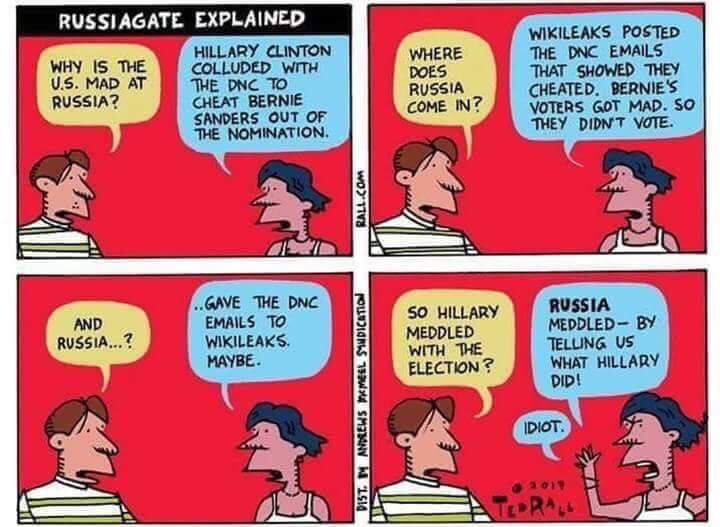
Russiagate, explained


It's funny because it's true.

John Stormer has died

Via Ann Althouse, we see that John Stormer is dead at 90:
John A. Stormer, whose self-published 1964 book, “None Dare Call It Treason,” became a right-wing favorite despite being attacked as inaccurate in promulgating the notion that American government and institutions were full of Communist sympathizers, died on July 10 in Troy, Mo. He was 90. 
... 
Mr. Stormer’s book, published by his own Liberty Bell Press, tapped into a vein of conservative alarm that was still very much present in the early 1960s, even though the Red-baiting era of Senator Joseph R. McCarthy had faded in the 1950s. 
The book landed in the year that the Republican Party nominated Barry M. Goldwater, the conservative Arizona senator, for the presidency, and Goldwater sympathizers latched onto it, buying up copies and distributing them at rallies and by other means. The far-right John Birch Society was among the groups spreading the book around.
I hadn't know this yesterday when I posted a link to this old post of mine.  In it, I excerpt what may be the finest summary of Stormer that I've seen:
Moldbug amplifies this battle, and then we'll get to the meat of the argument here:
It is not that the American left was the tool of Moscow. In fact, it was the other way around. From day one, the Soviet Union was the pet experiment of the bien-pensants. It was Looking Backward in Cyrillic. It was the client state to end all client states.

...

The theory of Russia as a client state of the American left helps us understand the behavior of the great Communist spies of the 1940s, Alger Hiss and Harry Dexter White. Essentially all significant institutions of today's transnational world community - the UN, the IMF, the World Bank - were designed by one of these gentlemen, whose role in passing American documents to Soviet military intelligence is now beyond dispute. John Stormer was right.

Or was he? The thing is that while, technically, Hiss and White were certainly Soviet agents, they hardly fit the profile of a traitor like Aldrich Ames. Hiss and White were at the top of their professions, respected and admired by everyone they knew. What motivation could they possibly have for treason? Why would men like these betray their country?

The obvious answer, in my opinion, is that they didn't see themselves as betraying their country. The idea that they were Russian tools would never have occurred to them. When you see a dog, a leash, and a man, your interpretation is that the man is walking the dog, even if the latter appears to be towing the former.

Hiss and White, in my opinion, believed - like many of their social and cultural background - that the US had nothing to fear from the Soviet Union. They saw themselves as using the Soviets, not the other way around, helping to induce the understandably paranoid Russian leadership to integrate themselves into the new global order.
So a Puritan drive towards the perfectibility of mankind drives the entire political establishment - including Presidents like Eisenhower and George H. W. Bush - to support what on the face would be far left wing policy positions.
This post may be the best introduction to the Dark Enlightenment that I've done.  You can, of course, read Moldbug directly, but he's pretty thick going.  My post (and the post I link to at Foseti) spend some time to digest Moldbug for you.

Or you can read Stormer yourself, as a free download from the Internet Archive.  The title comes from a very old quote: Treason doth never prosper. What's the reason? Why if it prosper, none dare call it treason.  Pretty clever, that.

Rest in Peace

Tuesday, July 17, 2018

Heavy Mental Music

This is a very different spin on "high and tight", but anything that has Bill Murray fixing martinis is a-OK in my book.  Srlsy.  And it is mid-July after all ...


Hey Bustah!

I gotcher "Russian Collusion" right here


Why NASA could never take us back to the Moon

ASM826's post yesterday looked back on the race to the Moon nostalgically, as a lost age of engineering and an opportunity squandered.  I'm not so sure.  The Moon race was an anomaly in American history, a massive engineering project divorced from financial return.  The great projects from the 19th and 20th centuries all were focused on profit and growth - the Erie canal, the transcontinental railroad, the Interstate Highway system.  Project Apollo stands out as the oddball.

There's no mystery about why we never went back.  I wrote about this nine years ago.

Monday, July 20, 2009

Jack Kennedy's Treasure Fleet

I was 11 years old, and it was late. We simply weren't allowed to stay up that late - after 11:00. But this was no normal day. We all huddled around that old Black-and-White television set, watching a terrible picture that showed the first man on the moon. Dad was in Paris finishing his PhD research, and watched it projected on a huge screen at the Place de la Concorde. This was maybe the last time that an American's money was no good in Paris.

We haven't been back, since Gene Cernan climbed back aboard the LEM in December, 1972. Some folks think this is a crying shame. I used to be one of them. Now I recognize that there could not have been any other outcome. We've seen this before.

Between 1405 and 1433, the Chinese Ming dynasty sent a series of exploration voyages to southeast Asia, India, and even Africa. While the Portuguese under Prince Henry struggled down the western coast of Africa in their tiny caravels, huge Chinese treasure ships sailed to Calicut and Mogadishu.

And then they were gone, as if they had never been. Why?

The historian David Landes spends considerable time on this question in his indispensable The Wealth And Poverty Of Nations. The Chinese voyages differed in one critical way from those of Diaz and Columbus: the Chinese voyages were motivated by a desire to glorify the Middle Kingdom, while the European ones were motivated by the desire for filthy lucre:
In the 1430s a new emperor reigned in Peking, one who "knew not Joseph." A new, Confucian crowd completed for influence, mandarins who scorned and distrusted commerce (for them, the only true source of wealth was agriculture) and detested the eunuchs who had planned and carried out the great voyages. For some decades, the two groups vied for influence, the balance shifting now one way, not the other. But fiscality and the higher Chinese morality were on the Confucian side. The maritime campaign had strained the empire's finances and weakened its authority over a population bled white by taxes and corvee levies.

[snip]

So, after some decades of tugging and hauling, of alternating celebration and commemoration on the one hand, of contumely and repudiation on the other, the decision was taken not only to cease from maritime exploration but to erase the very memory of what had gone before lest later generations be tempted to renew the folly.

[snip]

At the same time, [the Chinese] desire to overawe meant that costs far exceeded returns. These voyages reeked of extravagance. Whereas the first profits (the first whiff of pepper) and the promise of even greater ones to come were a powerful incentive to Western venturers, in China the pecuniary calculus said no.

[snip]

The vulnerability of the program - here today, gone tomorrow - was reinforced by its official character. In Europe, the opportunity of private initiative that characterized even such royal projects as the search for a sea route to the Indies was a source of participatory funding and an assurance of rationality. Nothing like that in China, where the Confucian state abhorred merchantile success.
So why did we leave the Moon, never to return? Why is NASA wandering in the wilderness? Let's update Landes, shall we?  In Europe America, the opportunity of private initiative that characterized even such royal Government projects as the search for a sea route to the Indies low-cost way to orbit was a source of participatory funding and an assurance of rationality. Oops - that's your problem, right there.

The heroism of the Astronaut corps doesn't change the fact that NASA will not - and can not - ever do what Columbus did. If they want to make a difference, to make it possible for people to live in Space, they should declare that they will purchase X kilograms of orbital launch delivery at $Y per kilo, and get out of the way. Unlike the X-Prize and Spaceship-One, NASA's pecuniary calculus will always be a football game.

Sunday, July 15, 2018

Jacques Duphly - La Forqueray

Yesterday was Bastille Day, France's national holiday that celebrates the storming of the notorious Bastille Day prison in Paris in 1789.  So what music for the day after Bastille Day?  As it turns out, there's a bit of a mystery surrounding today's composer.

Jacques Duphly was a virtuoso harpsichordist in France under the last of the kings.  One of his teachers seems to have been Jean-Jacques Rousseau himself, who later asked Duphly to contribute articles on harpsichord to Rousseau's Dictionary.  He published four folios of compositions, and was considered one of the best harpsichord teachers in Paris.

But he disappeared from public life in 1768, when his last folio was published.  Students even placed an advertisement in a newspaper asking if anyone knew where he was, but to no avail.  Duphly died alone among his music library the day after the Bastille was stormed.


Saturday, July 14, 2018

The state of politics


Asleep At The Wheel - I Want a New Drug

This is, well, unusual.  But it shows that crossover covers go back pretty far in Country music.

Friday, July 13, 2018

Now we see the gun laws that lefties object to

Specifically, felon in possession and firing a pistol at police:
BISMARCK, N.D. (AP) — A Denver woman accused of shooting at officers during protests in North Dakota against the Dakota Access oil pipeline was sentenced Wednesday to four years and nine months in federal prison. 
Red Fawn Fallis, 39, was accused of firing a handgun three times while resisting arrest on Oct. 27, 2016. No one was hurt. Fallis, a member of the Oglala Sioux tribe, denied intentionally trying to injure anyone and claimed not to remember firing the gun after being tackled by police.

She pleaded guilty Jan. 22 to civil disorder and illegal possession of a gun by a convicted felon.
But since she is a loony leftie environmentalist, she should go free or something:


All right, then.

Appropriate advice for Friday the 13th


The Pentagon is gonna Pentagon

Even if it will probably get a bunch of our guys killed.

Man, the Air Force will do anything to protect its dumb F-35.


Thursday, July 12, 2018

Quote of the Day: Russian oil edition

Miguel looks at Trump's comments about the Germans building a pipeline to Russia and snarks:
The last time Germany spent that much to get Russian oil, it cost them 3.5 million troops.
Heh.

New Taxidermist in town

LOL.  But that antelope must have been shot by ASM826.  I'm pretty east coast.

Although given all the deer around Castle Borepatch, maybe he could do a White Tail sporting an AR-15.  It is Maryland, after all!

Wednesday, July 11, 2018

A Borepatch political endorsement


It wouldn't be the only horse's ass in the "World's Greatest Debate Society".  The t-shirt (which is awesome and covered with awesomesauce) was made by the Queen Of The World.

Coexist

My kind, anyway.


Background on the printed pistols the Department of Justice just caved on

The big news in the shooting community is that the DoJ has caved on trying to restrict the dissemination of 3D printed firearms designs.  For those who are interested, here are some old posts that provide some background on this.

When I ran across one of these, and their creator at a security conference.  Interestingly, the Feds seem cooler with the technology than local politicians or law enforcement.

The futility of trying to keep the designs off the 'net.  You'd think that people would understand this by now, but people who groove on controlling other people have to try.

What was the underlying law (ITAR) all about anyway?  There's quite a history of this, and it shouldn't give confidence to the gun controllers.

The comments are all good in these posts as well.  If you want to know more about the issue than a lot of people (and more than 99% of the media and gun grabbers - but I repeat myself) then you might want to give these a read.


How to get Blogger to send email notifications for comments

This broke a month or two ago.  ChickenMom has the info on how to get it unbroken.

Tuesday, July 10, 2018

I think this is the only post I'll make about Trump's SCOTUS nominee

Well, about the idiotic reaction to it, at least.


For the three of you who don't get the background, there's this:


For anyone who *still* doesn't get it, my Potawatomi forebears would tell Senator Warren that she's a fake indian.  Unlike her, I have documentation from the Potawatomi Nation.

Did I miss National Punch-A-Hippie Day?

Damn.


The Age of Reform is upon us

It seems that the ancient Chinese did not have a curse, "May you live in interesting times".  Too bad, because there's a lot of truth in that expression.  We're finding this out right now as the entire West is engulfed in a massive reform era.  Consider:

  • The Republican Party has been in a civil war for 2 years.  The Chamber Of Commerce faction (call them the Optimates) is in a knife fight with the Trump wing (call them the Populares).  The rhetoric is ugly, a continual violation of Reagan's Eleventh Commandment.  This will feature prominently in the upcoming Supreme Court confirmation hearings, with center-left Republicans like Susan Collins possibly splitting and voting with the Democrats.  The Democrats have been watching with a mix of glee and horror, depending on whether the Trump wing wanes or waxes.
  • The Democratic Party looks like it has also descended into a civil war, with the establishment wing (Clinton, Schumer, Pelosi, Cuomo, Brown) arrayed against a nascent but growing socialist insurgency.  Hillary had to stack the deck to beat Bernie in 2016, and establishment bigwigs are getting knocked off in primaries.  Republicans grin and pass the popcorn, ignoring the fact that this is the first time in my lifetime that actual hard core socialists are on the ascendent in this Republic.
  • German Chancellor Angela Merkel looks to be hanging by a thread, with her "conservative" allies pulling the rug out from under her feet and forcing a humiliating change in policy.  We'll see if she survives politically but it looks like there's blood in the water.
  • UK Prime Minister Theresa May seems to be in the same cookpot as Merkel, only this time over Brexit.  Voters in Britain decided to leave the UK, but she seems to be trying to do a sneaky "leave but don't leave" swicheroo and is bleeding cabinet ministers because of it.  There is talk of a vote of no confidence which as far as I can remember hasn't happened since Margret Thatcher over two decades ago.
  • Italy (to great consternation in the European Parliament) has voted out its old center-left/center-right duopoly and voted in a Nationalist-left/Nationalist-right alliance.  There is talk about ITALEXIT, where Italy leaves the EU.  Whether it happens or not, this is a political earthquake.
Everywhere we look, the political establishment is being rejected.  Reform is in the air.

But the curse is funny because it's true: interesting times are uncomfortable times.  What if real Venezuella-style socialism comes to one of the 50 states?  [**cough** California **cough**]  What if bona fide fascists like Greece's Golden Dawn rise to power, driven by an militarily expansionist Turkey?  What if the US two party system splinters into a more European style four (or more) parties?

There has been an amazing era of stability in the West, dating back decades - certainly to 1980, and probably to 1950.  Everyone alive today, except for the very old, only remembers that stability.  The political churn that was the 1920s and 1930s is only known through dusty history books and flickering newsreels.  That was a reform era, too, as the old Imperial regimes crashed to the ground after the Great War.  Those were also interesting times.

POLITICS, n.  A strife of interests masquerading as a contest of principles. The conduct of public affairs for private advantage.
- Ambrose Bierce, The Devil's Dictionary

Monday, July 9, 2018

The Day the North almost lost the Civil War

154 years ago, a battle was fought in the northern approaches to Washington DC.  Due to incompetence at every level of command in the Army Of The Potomac, Confederate General Jubal Early had brought an entire army corps to within a day's march from an undefended capitol city.

Image via Amazon
Frequent commenter and buddy in real life Libertyman came for a visit to Castle Borepatch, and the Queen Of The World and I took him to the site of the battle.  Had Castle Borepatch existed 154 years ago, you could have heard the gunfire from the Castle parapets.  Libertyman kindly sent this book, Desperate Engagement which tells the story of that campaign.

By early summer in 1864, Robert Lee and the Army Of Northern Virginia was facing a siege at Richmond and Petersburg.  Ulysses Grant had attacked nonstop that spring, at the Wilderness through Cold Harbor, pushing Lee back to the gates of Richmond.  Grant was immune to casualty reports and had very nearly broken his army that spring even though he had gained territory.  Now he needed to replenish his forces for a final push to take the Confederate capitol.  To do this, he stripped the north of all available soldiers.

Lee saw an opportunity.  Perhaps the most successful general in history who could divide his forces in the face of a superior enemy, he asked Early to take his Corps up the Shenandoah valley, defeat the Union forces there, and cross into Maryland.  Lee's plan was that this would force Grant to detach significant forces from Richmond to protect Washington.  Early was Lee's most aggressive general, in many ways cut from the same cloth as Stonewall Jackson, and Early jumped at this chance to thrash the Yankees on their own turf.

The book lays out in astonishing detail how the Union high command simply missed the intelligence they received from the field: how Early routed the Union army in the Shenandoah, how Early's men kept marching north towards Maryland, how they had crossed the Potomac.  Somehow none of the generals up to and including Grant connected these dots, and they were simply ignorant that 20,000 confederates were marching on an undefended capitol.

1864 was an election year, and the war had been going badly that year.  Losses were enormous, and Lincoln's call for another half million men led to draft riots in New York City.  If the South had captured Washington, it is unlikely in the extreme that Lincoln would have won re-election, it's possible that England and/or France would have recognized the Confederacy, and the history of the New World would have been very different.

But not everyone was asleep.  B&O Railroad Co. President John Garrett alerted the commander of Union forces in Baltimore, Lew Wallace.  Wallace scraped together a few thousand men and - despite opposition and indifference from the Army high command - brought them to Monocacy Junction, a B&O station a couple miles south of Frederick, MD.  They dug in.

Although outnumbered 3 to 1, they fought hard.  It took Early's foot-sore men an entire day to break the resistance.  Then Early raced for Washington.  His troops arrived within sight of the Capitol dome, but were exhausted from the hard marching of the previous month - not to mention the battle.  It's a fascinating question what would have happened if he had pushed into town immediately.  The forts were guarded by militia and invalid soldiers who would not have stood a chance.  But his troops were at the end of their endurance, and a suddenly aware Grant had detached the 7th Corps by steamboat from Richmond, and they arrived at the city wharf at the same time Early's troops arrived outside the forts.  Early was famously aggressive, but seems to have thought that he risked the destruction of his army.  Instead, he withdrew to Virginia.

What is indisputable is that if Lew Wallace and his troops had not so stubbornly fought for so long, Early would have beat the steamships by a day.  The Capitol would have been burned, the Treasury looted, and Lincoln's (and likely the Union's) prospects would have gone up in smoke.

The Union high command showed continuing incompetence after the battle, looking around for a scapegoat and seizing on Wallace who was removed from his command.  Grant finally figured out that Wallace had saved the day and restored his command after a couple of weeks.  All in all, it was not the Army's finest moment.

Wallace, of course, went on after the war to write Ben Hur, which made his fortune.  He's known for that, but really should be known for saving his country.

Thanks to Libertyman for the book, which is a great read.

Sunday, July 8, 2018

Ennio Morricone - Theme from A Fistful of Dollars

Longtime reader (and buddy in real life) Libertyman sends this suggestion for Sunday morning classical music.  It's a very interesting orchestral interpretation of the theme from the great spaghetti western.  The Danish National Symphony Orchestra offers a superb performance.


And as an encore, here they are doing The Good, The Bad, and The Ugly.


Ennio Morricone has written much more for the silver screen, being nominated for six Academy Awards.  He's sold 70 million records (!) world wide, but I think it's safe to say that these are his two most widely recognized works.  He was a child prodigy, entering the Conservatory at age 12 for a 4 year program.  He completed it in 6 months.  He was creative in his scoring, too.  The budget for The Good, The Bad, and The Ugly was very tight, and Morricone didn't have the budget to hire an orchestra.  His solution was to score it for gunshots, cracking whips, whistling, and Fender guitar.

Saturday, July 7, 2018

I wasn't born for digging deep holes

A friend is putting in a fence and so Wolfgang and I went over to help him dig post holes.  Since Home Depot wanted $100 to rent a two man auger, we did it old school, with a posthole digger.  All in all, we knocked it out pretty well.  Wolfgang was, as you can imagine, a big help.  He somehow managed to drop his frisbee into one of the two foot holes.  He sure wanted that frisbee, because he stuck his head down the hole to get it.

Yeah, he's a big dog.  But while it's good to help a friend, it reminded me that I'm not 40 anymore.

Wes Cook Band - I Stand For the Flag

The Wes Cook Band is an up and coming young country band who last week found themselves thrust into the limelight in an unexpected way.  Their new patriotic song was banned by Facebook:
Members of a Nashville band claim Facebook is censoring its newest patriotic music video, claiming it is political in nature. 
The Wes Cook Band posted to its Facebook fan page that they tried to promote their latest music video, "I Stand For The Flag" with advertisements on Facebook. However, the band claims it was denied the opportunity to pay to promote the video for the Independence Day holiday. The group said Facebook claimed the video was political in nature. 
"Our paid FB ads were denied and our reach thereby censored because this video contains 'political content.'
Whoops.  After nation wide headlines, Facebook backed down:
Facebook has said it made an error after preventing the Nashville, Tennessee-based country band Wes Cook Band from advertising a new song because it was deemed political content.
It's always nice when someone who was wrong admits it. But we're all thinking the same thing, aren't we?
"It has to do with a level of political bias we feel that Facebook has within their algorithms," the band's fiddle player, Nathan Stoops, told Fox News.

"You know those are the tools that they use to determine whether content fits within certain parameters on their site, and if those algorithms are programmed to reject content like 'I Stand for the Flag,' then I think that would give a lot of Americans the right to be offended by that level of bias within a company that purports itself to be politically neutral."
Hard to argue with that.
On Friday morning, Facebook acknowledged that an "error" had occurred and said it was working to improve its policies.
Doubtless it will be a more subtle anti-American bias.  But baby steps.

Friday, July 6, 2018

Is the DEA in bed with the Sinaloa Cartel?

This seems really important.  And this seems really important:
If the US had wiped out the competition and then figuratively nuked the Sinaloa cartel, all the cartels would be gone and the border problems might conceivably drop to a small fraction of what we have now.  Solving problems, of course, is bad for the federal government and all entrenched bureaucracies.  They're going to be there in perpetuity, so there's no incentive to "work themselves out of a job".
RTWT.  That SiGraybeard guy is one smart cookie.

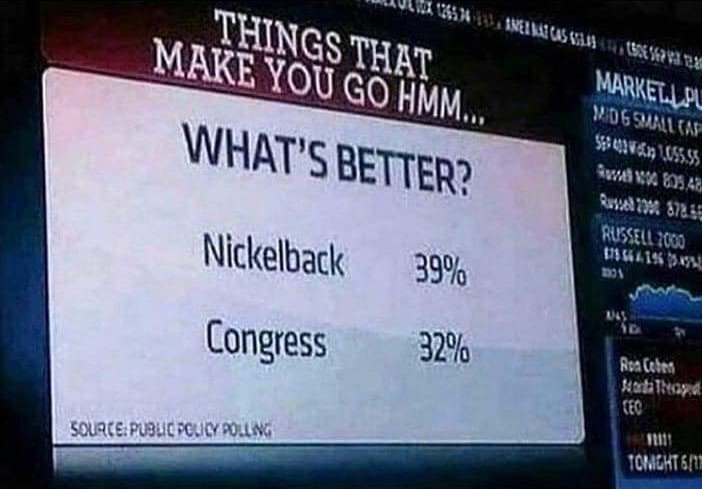
Now, I don't much care for Congress

But damn:


Thursday, July 5, 2018

By their works shall ye know them

Dr. Keith Briffa has died.  He was one of the most important climate scientists, specializing in tree ring climate reconstructions.  Here's a snippet from an obituary in the journal The Holocene:
Keith R. Briffa was one of the most influential palaeoclimatologists of the last 30 years. His primary research interests lay in Late-Holocene climate change with a geographical emphasis on northern Eurasia. His greatest impact was in the field of dendroclimatology, a field that he helped to shape. His contributions have been seminal to the development of sound methods for tree-ring analysis and in their proper application to allow the interpretation of climate variability from tree rings. This led to the development of many important records that allow us to understand natural climate variability on timescales from years to millennia and to set recent climatic trends in their historical context.
We are counseled to not speak ill of the dead, and so I will merely point out that we've seen Dr. Briffa's work critiqued here on this blog before:


Saturday, October 3, 2009


YAD061

The Science of Global Warming is settled. The next time you hear this, reply "YAD061".

Global Warming was a sensational story in the 1990s:
For decades the consensus view was that earth was very warm during the middle ages, got cold around the 17th century, and has been steadily warming since, to a level today probably a bit short of where we were in the Middle Ages. This was all flipped on its head by Michael Mann, who used tree ring studies to “prove” that the Medieval warm period, despite anecdotal evidence in the historic record (e.g. the name of Greenland) never existed, and that temperatures over the last 1000 years have been remarkably stable, shooting up only in the last 50 years to 1998 which he said was likely the hottest year of the last 1000 years. This is called the hockey stick analysis, for the shape of the curve.
Mann based his analysis on bristlecone tree rings, which acted as a proxy for temperatures in times before we had thermometers. You may remember the graph in Al Gore's film "An Inconvenient Truth" - it featured prominently in stories in the press. The message was clear and simple: the climate has started changing suddenly and drastically, it's all our fault for generating industrial amounts of Carbon Dioxide, and we will permanently change the climate if we don't stop Right NOW.

The problem is that Mann's analysis was deeply - fatally - flawed. His computer model had a bug that caused even random data to produce a hockey stick shape. His data set was one clearly marked as inappropriate for use as a temperature proxy, but he used it anyway. When asked for his computer code and data, he refused. Ultimately the truth did come out, which is why you don't hear about "Global Warming" or "Hockey Sticks" any more.

None of this is news for long term readers - my introduction to the topic is here.

This has put the scientists advocating for global warming in an odd position - they have been looking for new sources of temperature proxy records that show (at least in broad brush strokes) the same thing that Mann's study "showed". Recently, a fellow named Briffa published a study of Siberian tree ring cores from the Yamal peninsula that showed this same temperature curve. Well done, Briffa!

Except not so fast. Almost as soon as it was published, it started unraveling. There are now so many real scientists (not to mention intelligent laymen) skeptical of the theory of man-made global warming that many, many people started sifting through the report's data and methodology. As the Linux community likes to say about Open Source software quality, "Many eyeballs make bugs shallow."

The first problem turns out to be nothing short of astonishing. Briffa used cores from only ten trees. Ten.

The second is more subtle, but a picture is worth a thousand words. Of the ten cores, how many show variations more than what is obviously random? One.

That is tree #YAD061. Seems like an outlier, that should be discarded from the analysis, right? That's not what Bifra did. Keeping it in, the average of the group was raised a little. Just a little, but enough.

Remember, the whole "Climate is increasing catastrophically" discussion revolves around just a couple of degrees increase over a century. YAD061 varied from the group average by eightstandard deviations, which was enough to get that sudden, couple of degree rise for the group. (Look at the line highlighted in yellow).

We have a multi-trillion dollar proposed restructuring of society, based on tree #YAD061.

Back in the Dark Ages, when I was a wee lad at State U, I had to learn Ockham's Razor: entia non sunt multiplicanda praeter necessitatem* (yes, we had to learn it in Latin - this was history of science):
The simplest explanation is the best explanation.
Carl Sagan's story about an invisible, non-corporeal, flying dragon that spits heatless fire is an accessible demonstration of Ockham's Razor. Sure, a dragon like that could exist, but that's not where the Smart Money bets. The Smart Money bets on "the dragon doesn't exist", which explains the situation just as well, without introducing a lot of added, unproven hypotheses.

So let's think about this tree, YAD061. Maybe it sees massive global warming - 8 degrees in 70 years - when none of the others do. Maybe. Is there a simpler explanation, that doesn't require us to explain why the other 9 didn't see warming?

Yes there is, and you have each seen it with your own eyes:
YAD061 looks very much like a tree that grew up in the shade of its elders, and therefore grew slowly, until age or ice-storms or insects removed the elders and the shade. Then, with sunshine and the rotting remains of its elders to feed it, the tree could take off.
I have seen growth patterns much like YAD061 in the rings of many stumps in New Hampshire, and not once have I thought it showed a sign of global warming, or of increased levels of CO2 in the air. Rather the cause is far more simple: A childhood in the under-story, followed by a tree’s “day in the sun.”
Dr. Briffa should spend less time gazing at computer screens, and actually get out and associate with trees more.
Click through to RTWT.Tree rings are imperfect proxies for temperature. Things other than warmth can cause trees to grow faster, and things other than cold can cause them to grow more slowly. Duh.

So, we see a perfectly normal tree experiencing a perfectly normal arborial lifestyle. We see a scientist who uses such a pitifully small number of trees in his sample that YAD061's perfectly ordinary growth pattern throws off the group results, in a way that the scientist can use to justify his old Hockey Stick model.

Who are you going to believe, Dr. Briffa or your lieing eyes?

So the next time you hear those words the science is settled, tell them "Me and YAD061 say it ain't." And then ask them The Question: what's the difference between an invisible, flying, non-corporeal Hockey Stick that breathes heatless fire, and no Hockey Stick at all?

* OK, OK, it's usually translated as "entities should not be multiplied unnecessarily".

UPDATE 21 November 2009 13:42: Considerable background on Yamal at Bishop Hill.

UPDATE 10 December 2009 19:48: Welcome visitors from Newsbusters. I have a background on the science behind global warming here.

UPDATE 19 December 2009 14:39: A slideshow introduction to Global Warming is here.

James Woods: My Agent dropped me because of my politics

Another example of the closing of the Public Square:
James Woods is saying he has been dropped by his talent agent. 
The news was first revealed by the Emmy award winning actor himself on Twitter, who shared an email he received from his talent agent, Ken Kaplan. 
"It's the 4th of July and I'm feeling patriotic. I don't want to represent you anymore. I mean I could go on a rant but you know what I'd say," said Kaplan, who Woods described as a "political liberal"
Notice the smug tone: It's the 4th of July and I'm feeling patriotic.  Okay, then.


Kaplan also represents Wynona Ryder and Kristin Stewart.  It's the 5th of July and I'm feeling patriotic, and so I will not go to a movie staring either of those actresses.  Because Ken Kaplan logic.


This Cold Civil War is misnamed, just as the American Civil War was misnamed.  A civil war is a conflict between two factions, each of whom wants supremacy over the whole.  The southern states never wanted to take over the northern ones, they just wanted to go their own way and let bygones be bygones.  The northern states waged a war of conquest over the south.


We see this same thing today in the cultural and intellectual spheres.  Many people want to be able to speak their own mind, one of many in this e pluribus unum.  The other side is waging a cultural war of conquest over the first group.


Giordano Bruno was burned in the public square in Rome in 1600.  He was a heretic - actually a goofball who was spoiling for martyrdom - but the point of his auto da fe was not the stated "last try to save his soul" or even the more plausible removal of an annoying heretic.  Rather, it was to make an example for everyone else.  Don't do what he did or this might happen to you too.


The best argument that Progressivism is a religion is that it practices inquisitions.

Tuesday, July 3, 2018

Get ready to celebrate the 4th American Republic

I explain it at (ahem) typically Borepatchian length here.  Or the TL;DR version:


Happy Birthday to the Queen Of The World

My lovely bride is celebrating a birthday today.  If all y'all want to shoot off some fireworks to celebrate, that would be fine.

Monday, July 2, 2018

Sure, sure. Everyone will just turn in their guns.


Yup.  Great plan.

Has anyone ever heard of these?

You plug it into your car's computer port and use an app on your phone to download the Check Engine error codes.

They have some slick marketing, but that doesn't mean that the thing is very good.  If it is, then this seems like a pretty handy thing to have.

Here's there web site.

Sunday, July 1, 2018

Fourth of July Classical Music

This is a post I put up a long time ago, but which captures the sense of classical music for Independence Day pretty well.

--------------------------

Canons and Cannons

[Originally posted June 26, 2011]

Row, row, row your boat ...

Every American child knows this song by heart.  Technically, it's called a "round", where different groups start singing the same things at different times.  It's simple enough to get large groups of children to do it at school concerts - and well done!  Having been to my share of school concerts (as both performer and listener), this is A Very Good Thing Indeed for teaching our children the basics of music.  It's a very old music form, dating from the High Middle Ages.  Keep the Dream alive, everyone!

But what happens if you complicate things just a bit?  Say, by adding an extra (and new) melodic theme to the plain, old, boring Round?  You get this:


It's called a "Canon", and Johan Christoph Pachelbel created what is undoubtedly the most famous version, composed in the 17th Century. Surprisingly, it was lost, and only re-discovered after World War I. I say "surprisingly" because this piece is hugely popular today. You've probably heard it.

But "Canon" is not the same as "Cannon", which involve not a chamber quartet, but black powder, but may involve a repeated theme (shelling the enemy).  It took until the 19th Century and Tchaikovsky to write a piece for orchestra and Field Artillery, but this is a doozy.  It's another piece that you've almost certainly heard before, the 1812 Overture, written to celebrate the defeat by the Russian Empire of Napoleon's Grand Armeé in 1812.  Literally, it was scored for orchestra and field artillery.  In other words, cannons.


And so, a single character makes a difference, but you'll get great music whichever way you like to spell canon/cannon.  I kind of think that my High School music teachers would be appalled reading this, but it's true.

Oh, and for a very politically incorrect and a totally awesome version of Earth Shattering Kaboomdone to the 1812 Overture, here's nuclear detonations to replace the puny 105 mm cannons.


Smoke on the Water - A Brigid Guest Post

They showed up on the lake one night, visible in the morning, silent in the mist, their shapes nothing at all like what we'd seen before on this small body of water.  A few miles away was a large and swiftly flowing river, bringing with it goods from afar.  But this little lake was what we, as children, knew.  The water had seen canoes, and the occasional raft kids made out of a sheet of plywood and inner tubes, but these little paddle wheel boats were something new.

Dad, of course, wants to go for a ride on one, there at that park at the end of our block where he ran three miles every day after work. I didn’t want to go but I loved my Dad.  He and Mom adopted my brother and me late in life and he went out of his way to make life normal, now that Mom had cancer.

So I went with him, like most teenagers, secretly hoping that invisibility was an option but it was not to be. It was Fall, wood smoke from burning leaves drifts out over the little man-made lake in the city park, as people took advantage of the day to be out on the bike paths and walking trails. To make matters worse, he was waving at EVERYONE including other kids my age (invisibility now!) I pretended to be looking up at the birds in the trees, hoping the kids wouldn't notice me, but they did and pointed (forget invisibility, let's go for obliterating lightning bolt).  The ride couldn't end soon enough for me.

Had I been acting less like a teenager I would have noticed the stillness of the water before us, our legs propelling us forward as if in flight. I would have noticed how people reacted to my father, the love, and respect he got even as he gave it out.  I would have noticed  how he looked with an owners eye upon the water passing behind us like spent memory, the peace of the water ahead, at the simple of joy of muscle and motion powering past those things that weighed us down, disappearing in the joy of a simple evening with his child, like smoke on the water.

We were both quiet on the walk home, me because I wanted to be anywhere else, Dad for reasons I didn't understand quite yet. When we got back to the house, Mom was in bed, tears on her face.  I'd not seen her cry before and I don't think she expected me to, our arriving home early.  The tears encompassed more than pity or pain but rather that inarticulate recognition and despair of that cancer that blazed onto her inescapable earth, its fire, her ashes. I closed the door as he sat down next to her, the whisper of my bare feet on the floor, the only sound I could make

Years passed; the paddle boats disappeared as quietly as they came, with no mention of their passing.


Now, a lifetime later, I am the only family member remaining. As I leave to run an errand I realize that little has changed, but for me. Dad is the same man he was when I was a teen and so embarrassed to hang out with him, just as his home is the same, but for the ghosts that remain.

But I have changed, as I realize that his wishing to watch closely and guide, was not based on control.  Rather, it was his realizing that I was still light in the burden of the years, not yet possessing the weight of the wisdom that keeps one surefooted on an inescapable path.  It was pushing me past the mundane and the limiting, if only briefly, out of that shelter we make for ourselves in times of self-doubt or danger, hiding underneath it as if it's some armor we don without knowing the full extent of what it's protecting us from.

It was his simply wanting me to know joy, while he spent more time with me, even as time ticked its final moments for his first great love.

As I enter the house and he wakes, I ask him if he wants to go for a drive.  He does, but we don't go our usual route.  We drive on down to the lake where the paddle boats were docked long ago, walking carefully, he with his cane, down to a bench where we can see the water.

I look at him and say, “do you remember those paddle boats?” and he hugs me and we laugh.  From the trees the chirps of birds erupt into music, the steady staccato of their sound ticking down the hours of one more precious evening with Dad.