Showing posts with label Higher Education Bubble. Show all posts

Thursday, May 19, 2022

How to save public education

Kevin Baker - whose blog just celebrated its nineteenth blogoversary - has an uberpost about the dire state of education in this country.  You should go read the whole thing which lays out in detail (it's an uberpost, remember?) just how FUBAR'ed public education is on these shores.

It's an uberpost so it's impossible to excerpt, but Kevin's conclusion is what made me think:

The public school system cannot be reformed. I must be destroyed and the people in it must never have power over children again. 

Alas, destruction would be very difficult as there are too many vested interests at play here.  What we need to do it minimize the enemies our plan will make, and maximize the allies it will get.  I posted about this several years back, and still think that this plan has at least a fighting chance of getting through:

A modest proposal to prevent the fall of civilization

Every person has two educations, one which he receives from others, and one, more important, which he gives to himself.
― Edward Gibbon
The Silicon Graybeard muses on the fall of civilization:
Over the years, I've said (and more often hinted) that what I see in the future is not just the chance of an economic collapse due to the world's unsustainable debt levels. I see a real chance for another Dark Ages. The main driving force there is the Postmodernists in academia pushing the idea of "my truth and your truth"; the idea that there isn't anything other than our perceptions of things. That works fine for simple questions like, "what's your favorite color?" but is completely wrong for "what's the speed of light?", "will this virus survive in air?" or any interactions with the real world. VDH follows those trends to the conclusion a Dark Age may already be starting.
When civilization falls, it falls hard.  We hear mostly dry statistics about the collapse of civilization, things like the population of Rome in 100 AD was around a million people.  That's impossible to visualize.  Instead, we should look at this:

Immagine gentilmente concessa da Wikipedia
This is Monte Testaccio in Rome.  It is a hill made entirely of broken pottery, and it dates to the first and second centuries AD.  It's over 100 feet high, around a kilometer around, and historians think that it used to be much larger but has eroded over the last two millennia.  The Roman "bread and circuses" was a huge welfare project that fed much of the city's population, and which required huge imports of not just grain but also olive oil - over a million gallons of oil each year, every year, for hundreds of years.  The oil was shipped in big clay pots, but what do you do with the pots when you've distributed the oil?  The Romans were the best engineers until at least the eighteenth century, and so they came up with an engineering solution: they made a mountain out of broken up pots.

And then it all fell, and fell so far and hard that it was forgotten.  The Roman Forum itself - the political center of the Ancient World for centuries - became a cow field, the Campo Vaccino:

Modern Rome - Campo Vaccino by J.M.W. Turner, painted in 1839
It's been said that any system can survive only three generations before facing crisis. The first generation is the generation that created the system. They knew it intimately. The second generation saw the system being created, and so at least understood its main functions and how they worked. The third generation inherited the system. They may or may not know anything at all about how it works.

If this is a system created by the government - and remember that government is politics - then politics will be the main thing that we can expect the third generation to understand.  NASA is an excellent example of this dynamic: the generation that won World War II created it.  They landed a man on the Moon and returned him safely to the Earth, all in that decade.  The generation that followed watched that.  They were able to make a Space Shuttle and a Mars Rover.  Now NASA is in the third generation and the Space Launch System is pushing a decade late and $20B over budget, all while offering less capability than SpaceX at ten times the price.  But hey, a Senator is happy so it's all good, amirite?

This Republic has a population that is observably more stupid than when I wore a younger man's shoes. This isn't just get offa my lawn ranting, it's a measurable fact:
According to the National Assessment of Educational Progress (NAEP), test scores for 17 year olds have not improved since the early 1970s. That is, the average 17 year old in 2012 got about the same score in reading and math (287 and 306, respectively) as a 17 year old in 1971 or 1973 did (285 and 304, respectively). 
The response from professional educators?
Carr argues that flat scores aren’t terrible. “It’s a good thing that they’re not going down,” she said.
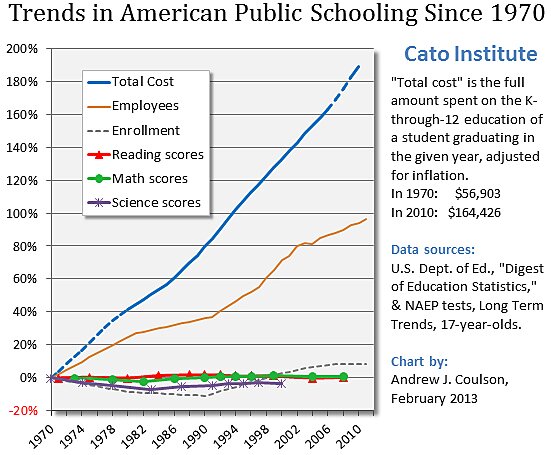
Well okay, then.  This is the same time period when per-pupil spending on K-12 education has skyrocketed:

If anything, this understates the scope of the problem: there is lots of discussion about how incoming college students can't read or do math very well, and so they have to take remedial course (and take on student debt while doing so) before they can start what would otherwise be their studies.

Note that this discussion has been about the portion of the public education system that is arguably working; it doesn't work at all in the inner cities.  None of Baltimore's schools graduate students who can do mathematics, and Atlanta's school system had a huge scandal where test scores were massively manipulated so that administrators could get their incentive bonus.  People went to jail for that, but the system is no better almost a decade later.

In short, the more government has gotten itself into education, the dumber the population has gotten - and at fabulous expense.  The system is broken, and since it's a government system (in which politics is uber alles) it will not reform itself.  Further, the public education system is generally popular throughout the land, so the normal political process will be useless for reform.

And so the Republic slouches towards the Campo Vaccino.  The third generation will lead to a fourth, and as Graybeard fears, a new Dark Age approaches.

Immodestly, I believe that there is a solution.  It's one that will improve performance, reduce costs, and be politically acceptable to large portions of the voters.  The Department of Education can issue a rule saying that if a public school system does not issue vouchers allowing parents to send their children to the school of their choice, that the Department will withhold education grants to that school system equal to the average per-pupil cost in that district.  The Department will then issue an Income Tax credit to the parents for that amount.  The Department will provide a free home schooling curriculum and teaching materials for free with the tax credit.

Simples.  No fuss, no muss.  It may even be that the Education Department can do this without any action of Congress.  I Am Not A Lawyer, but Congress has granted a huge amount of authority to the Regulatory State.

So why do I think that this is politically possible when the Teacher's Unions and Democratic Party (but I repeat myself) will fight this to the death?  Consider:

  • Vouchers are popular among blacks and hispanics and have been for a long time.  This makes sense, as its their kids who are locked into failing school districts.  You don't get much more White Privilege than mandatory public schools.
  • Tax Credits allow stay-at-home Moms to school their kids if they want.  Home schooling three kids at an average tax credit of around $12,000 per kid is the equivalent of a pre-tax job paying around $50,000/year.  Politically, this will play very well with women.
  • We can expect this to be especially popular with black and hispanic women.  No doubt some upper middle class white women will complain that these women of color cannot be trusted to educate their children but we can dismiss this as veiled racism, and the women certainly can't do any worse than the current inner-city schools are doing.  At the very worst, the money wouldn't be going to an impenetrable education bureaucracy but rather directly to voters.
  • Public schools will have to do a better job, at a lower cost.  Competition will focus on results, rather than on a politicized curriculum.

Now what's interesting about this is that politically this would hurt democrats and help republicans.  However, the people who think that politics doesn't enter into the public education system shouldn't concern themselves about, well, politics entering into the public education system.  And anyway, since government is politics, a better  description of "public education" is "government education", leading to "political education".

This is no panacea against the New Dark Age.  However, it puts resources in the hands of parents who presumably care more about their kids than a set of bureaucrats.  Eliminating all the nonsense permeating the schools (hello, Critical Race Theory!) will let teachers and parents focus on reading and math and you know, education.

Tuesday, February 8, 2022

Who needs College?

Aesop links to John Wilder writing about life paths, and adds his own thoughts.  This part from Aesop's post seems key:

A high school classmate, solid C student, nice guy, was a total gearhead. Not college material in any way, shape, or form, and he knew it. But a good guy, and good with transmissions and engines. Three years out of high school, he bought his boss's shop. Ten years out, he owned ten auto shops. Was married, paid-off house, and worth $1M. Before age 30. Never even bothered with the SAT. Knew what he liked, did what he wanted. None of the college grads (which was 95% of my class) could touch that at the 10-year reunion.

A guy fixing air conditioners, transmissions, or furnaces and water heaters is going to make a good living anywhere but Trashcanistan, and the entry requirement is a GED, aptitude, and a work ethic.

Mike Rowe annually pounds the drum that Caterpillar every year has unfilled openings for people willing to learn how to repair bulldozers, cranes, and graders, has a full apprenticeship program, and that in 2 years, you'll graduate with zero debt, and skill that can take you worldwide, and pay $100K a year within a couple of years after graduating, and can't be shipped overseas, unless that's where the broken bulldozer is. And they go begging for applicants, because people would rather mortgage their entire future and not get their fingernails dirty.

Same with the Electric Unions.  They'll train you for little/no cost and then get you an apprenticeship.  That's a job that simply can't get outsourced.

I've written for almost a decade about how you can teach yourself everything you need to pass basic Cisco network certification.  Starting salary is $50,000+ and you can keep repeating the exact same process until you have their Security cert at which point you will be making six figures.  If you're a young guy I should point out that SecureWorks has a Security Operations Center in Myrtle Beach, so you can ride your Harley to work at the beach.

The cost?  $30 for a book, your time, and the cost to take the cert (couple hundred bucks).  My posts are here, just keep scrolling.

The key point here (my posts, Aesop's, and John's) is that the University Marketing departments have done an excellent job of selling short-term social status, not long term Return On Investment.  If you're independently wealthy then that's fine, but their pitch of "you'll make a million dollars more if you get our degree" simply isn't true for most students.

College is expensive.  People need to look very closely at the expected return on their investment if they're considering going.  Social status doesn't put dinner on the table.

There are a lot of alternative paths that High School Guidance Counsellors won't tell them about.  Most of those alternatives pay as well or better than a University degree.  Caveat Emptor.

Thursday, January 2, 2020

Tom Nichols is an insufferable elitist prick

Tom Nichols is back in the news, talking about how gun owners:
The “experts” do not have expertise based on an analysis of the empirical evidence.  They have their prejudices reinforced from inside their elite echo chambers.
The public has come to realize that and doesn’t want to listen to these idiots and assholes anymore.
Case in point, his opinion on CCW:
Even when I was a Republican, I never understood people who measure freedom by how many of us walk around with guns. This is a cultural change, the spreading of the gun culture from a corner of the GOP to the entire conservative moment. /1
The spread of gun worship is conservative virtue-signaling. Never liked it when I was among my old tribe, and it’s gotten worse as “conservatives” try to figure out new markers for what makes them “patriots” now that they’ve had to sell out so much actual patriotism to Trump.
As I was reading all the righteous smackdown aimed his way, something was tickling my memory cells.  Hadn't I posted about Nichols, Back In The Day?  Why yes, I had:
I could go on, but by now you've noticed the Learned Expert's habit of setting up straw men.  No, anger at the NSA's spying program isn't founded in a feeling that it's unconstitutional and damaging to America's economy and security, it's because we disrespect Mr. Schindler's advanced education.  No, we do not question Expert Foreign Policy opinions on Russia because of spectacular failures of past Russian Policy Experts (c.f. the CIA's assessment that the USSR was the world's 3rd largest economy in 1988), it's because we don't appreciate his PhD.  No, we don't question the research from the current Academic Establishment because it has produced oddball policy recommendations regarding Global Warming and Keynesian Economics - it's because we don't even understand what a PhD means.

Oooooh kaaaaaay.

My take is that Tom Nichols is a very smart guy who needs to get out more often.  In particular, he needs to hear more people voicing (legitimate) complaints about the Elite's lack of transparency, accountability, and propensity to game the system in pursuit of tenure and grant funding.
I guess we can add "paying gigs moonlighting for The Atlantic" to that list.  Oh, and the post title?  "Elitist bemoans declining popularity of elitism".  That was six years ago.

So pay no attention to this guy.  He's an elitist prick writing for other elitist pricks whose days are passing away.  He's perpetually butt hurt that people are judging the value of his credentials and expertise by the results produced by people with the same credentials and expertise, and taking a hard pass on his advice.

Tuesday, October 15, 2019

A modest proposal to prevent the fall of civilization

Every person has two educations, one which he receives from others, and one, more important, which he gives to himself.
― Edward Gibbon
The Silicon Graybeard muses on the fall of civilization:
Over the years, I've said (and more often hinted) that what I see in the future is not just the chance of an economic collapse due to the world's unsustainable debt levels. I see a real chance for another Dark Ages. The main driving force there is the Postmodernists in academia pushing the idea of "my truth and your truth"; the idea that there isn't anything other than our perceptions of things. That works fine for simple questions like, "what's your favorite color?" but is completely wrong for "what's the speed of light?", "will this virus survive in air?" or any interactions with the real world. VDH follows those trends to the conclusion a Dark Age may already be starting.
When civilization falls, it falls hard.  We hear mostly dry statistics about the collapse of civilization, things like the population of Rome in 100 AD was around a million people.  That's impossible to visualize.  Instead, we should look at this:

Immagine gentilmente concessa da Wikipedia
This is Monte Testaccio in Rome.  It is a hill made entirely of broken pottery, and it dates to the first and second centuries AD.  It's over 100 feet high, around a kilometer around, and historians think that it used to be much larger but has eroded over the last two millennia.  The Roman "bread and circuses" was a huge welfare project that fed much of the city's population, and which required huge imports of not just grain but also olive oil - over a million gallons of oil each year, every year, for hundreds of years.  The oil was shipped in big clay pots, but what do you do with the pots when you've distributed the oil?  The Romans were the best engineers until at least the eighteenth century, and so they came up with an engineering solution: they made a mountain out of broken up pots.

And then it all fell, and fell so far and hard that it was forgotten.  The Roman Forum itself - the political center of the Ancient World for four centuries or more - became a cow field, the Campo Vaccino:

Modern Rome - Campo Vaccino by J.M.W. Turner, painted in 1839
It's been said that any system can survive only three generations before facing crisis.  The first generation is the generation that created the system.  They knew it intimately.  The second generation saw the system being created, and so at least understood its main functions and how they worked.  The third generation inherited the system.  They may or may not know anything at all about how it works.

If this is a system created by the government - and remember that government is politics - then politics will be the main thing that we can expect the third generation to understand.  NASA is an excellent example of this dynamic: the generation that won World War II created it.  They landed a man on the Moon and returned him safely to the Earth, all in that decade.  The generation that followed watched that.  They were able to make a Space Shuttle and a Mars Rover.  Now NASA is in the third generation and the Space Launch System is pushing a decade late and $20B over budget, all while offering less capability than SpaceX at quadruple the price.  But hey, a Senator is happy so it's all good, amirite?

This Republic has a population that is observably more stupid than when I wore a younger man's shoes. This isn't just get offa my lawn ranting, it's a measurable fact:
According to the National Assessment of Educational Progress (NAEP), test scores for 17 year olds have not improved since the early 1970s. That is, the average 17 year old in 2012 got about the same score in reading and math (287 and 306, respectively) as a 17 year old in 1971 or 1973 did (285 and 304, respectively). 
The response from professional educators?
Carr argues that flat scores aren’t terrible. “It’s a good thing that they’re not going down,” she said.
Well okay, then.  This is the same time period when per-pupil spending on K-12 education has skyrocketed:

If anything, this understates the scope of the problem: there is lots of discussion about how incoming college students can't read or do math very well, and so they have to take remedial course (and take on student debt while doing so) before they can start what would otherwise be their studies.

Note that this discussion has been about the portion of the public education system that is arguably working; it doesn't work at all in the inner cities.  None of Baltimore's schools graduate students who can do mathematics, and Atlanta's school system had a huge scandal where test scores were massively manipulated so that administrators could get their incentive bonus.  People went to jail for that, but the system is no better five years later.

In short, the more government has gotten itself into education, the dumber the population has gotten - and at fabulous expense.  The system is broken, and since it's a government system (in which politics is uber alles) it will not reform itself.  Further, the public education system is generally popular throughout the land, so the normal political process will be useless for reform.

And so the Republic slouches towards the Campo Vaccino.  The third generation will lead to a fourth, and as Graybeard fears, a new Dark Age approaches.

Immodestly, I believe that there is a solution.  It's one that will improve performance, reduce costs, and be politically acceptable to large portions of the voters.  The Department of Education can issue a rule saying that if a public school system does not issue vouchers allowing parents to send their children to the school of their choice, that the Department will withhold education grants to that school system equal to the average per-pupil cost in that district.  The Department will then issue an Income Tax credit to the parents for that amount.  The Department will provide a free home schooling curriculum and teaching materials for free with the tax credit.

Simples.  No fuss, no muss.  It may even be that the Education Department can do this without any action of Congress.  I Am Not A Lawyer, but Congress has granted a huge amount of authority to the Regulatory State.

So why do I think that this is politically possible when the Teacher's Unions and Democratic Party (but I repeat myself) will fight this to the death?  Consider:

  • Vouchers are popular among blacks and hispanics and have been for a long time.  This makes sense, as its their kids who are locked into failing school districts.  You don't get much more White Privilege than mandatory public schools.
  • Tax Credits allow stay-at-home Moms to school their kids if they want.  Home schooling three kids at an average tax credit of around $12,000 per kid is the equivalent of a pre-tax job paying around $50,000/year.  Politically, this will play very well with women.
  • We can expect this to be especially popular with black and hispanic women.  No doubt some upper middle class white women will complain that these women of color cannot be trusted to educate their children but we can dismiss this as veiled racism, and the women certainly can't do any worse than the current inner-city schools are doing.  At the very worst, the money wouldn't be going to an impenetrable education bureaucracy but rather directly to voters.
  • Public schools will have to do a better job, at a lower cost.  Competition will focus on results, rather than on a politicized curriculum.

Now what's interesting about this is that politically this would hurt democrats and help Donald Trump.  However, the people who think that politics doesn't enter into the public education system shouldn't concern themselves about, well, politics entering into the public education system.  And anyway, since government is politics, a better  description of "public education" is "government education", leading to "political education".

This is no panacea against the New Dark Age.  However, it puts resources in the hands of parents who presumably care more about their kids than a set of bureaucrats.  Eliminating all the nonsense permeating the schools (hello, Common Core) will let teachers and parents focus on reading and math and you know, education.

I'll deal with Higher Education in a future post.  Turning that around will be harder in some ways and easier in some.

Wednesday, January 9, 2019

Tab clearing

Here's a grab bag of items that are only related by the fact that they're in this grab bag.

B alerts us to the fact that a huge amount of what is reported as "Science" is in fact a scam.  The Iron Law of Bureaucracy applies to Department Heads and University Presidents as much (or maybe more) as any bureaucrat.  I would go so far as to say that today's scientific bureaucracy essentially ensures that there will be a crisis of reproduceability.

I don't almost ever go on Facebook, because they're simply evil - they sell your data to anyone who will pony up.  So what, you say?  Here's what:
A lot of people probably don’t care if Netflix or Microsoft have access to their “private” messages. But technology companies aren’t the only kids on the block with big bucks. Do you really want your health insurance company having access to your “private” messages? That medical issue that grandma messaged you about may be hereditary and the fact that you might face it at some point may convince your health insurance company to up your premium. Would Facebook provide access to your “private” messages to health insurance companies? You have no way of knowing.
Related: this cannot be said often enough:


Reality is starting to catch up to (and overwhelm) the hype about self-driving cars.  It's about time, but this quote from the article is pretty pathetic:
"I've been seeing an increasing recognition from everybody—OEMs down to various startups—that this is all a lot tougher than anybody anticipated two or three years ago," industry analyst Sam Abuelsamid told Ars. "The farther along they get in the process, the more they learn how much they don't understand."
We have Top Men working on it.  Top.  Men.  They obviously don't read this blog because I've been talking about this for years.

Once again I must point out that the cyber security job market is red hot and you don't need a college degree to get in to it.  You can study on your own and take certification tests for small money (a few grand, max) and find yourself making big bucks without a huge amount of college debt - and without all the Snowflake indoctrination that goes with it.  Some companies even offer scholarships.  If you are (or know) a young man who's smart and has some get up and go, this might be their ticket.

Philip emails in response to my post about Sidecarcross racing (Motocross with sidecars):
If you think dirt bike side car racing is as mad as a box of frogs, try looking at some Isle of Man TT side car road racing. 150 MPH at times on a flat platform with no hand holds and not strapped in is a bit too hirsute for me to do, methinks!
I'm with him 100%.  In my 20s I might have thought that Sidecarcross was cool enough to try out (heck I did dirt biking, so it's just a short step from that).  But even the 22 year old me would never have tried this - which as he says is indeed madder than a box of frogs:

Monday, December 31, 2018

Who needs a University?

Santa brought me a Go-Pro knockoff for Christmas.  I'd been thinking about mounting one to the dash of the Harley for some motor madness riding shots.  Now I'm reconsidering.

Aesop is in the running for the real Most Interesting Man In The World, and has a must-read post for amateur videographers on how to make a video that isn't terrible.  He writes hilariously but to the point on the subject:
Shakespeare died in 1616. It's a f**king VIDEO. So don't tell me, SHOW me. 
If you don't get this, and TV looks easy to you, trust me when I tell you: it's because you're a retard. GTFO of the Internet forever. 
When Peter Falk tells pre-pubescent Fred Savage in The Princess Bride "Back when I was your age, television was called books", it's witheringly funny. But nota bene, Gentle Reader, that neither consummate director Rob Reiner, nor maestro screenplay author William Goldman then proceeded to give us nothing but Peter Falk droning on from the book for the next two hours. Because it's a frickin' MOVIE!!
Aesop gives you a 5 minute education in how to make a film, and recommends a book for you to read on the subject.  He's been in that business professionally for a long time and so he knows of what he speaks.  If you make (or want to make) videos, you should go read this RIGHT NOW, or bad things will happen to you:
Read it, learn it, live it, love it. Or else die. Of dick cancer. In a pool of hungry crocodiles. With frickin' laser beams on their heads.
It's a funny post and you'll learn a lot, but what really caught my eye was he used an old TV clip from James Burke to illustrate the "don't tell me; SHOW me" rule.  I've blogged before about James Burke who made some of the best TV I remember seeing, although I preferred his "The Day The Universe Changed" to "Connections".  But the clip that Aesop chose was very well chosen indeed to illustrate his point, and the selection put him right up near the top of the "Bloggers I'd like to have a beer with someday" list.

But this got me thinking about the decline of popular culture in the West over the course of my lifetime.  There used to be a thriving genre that was called "Mid-brow": not high brow, not low brow, but which assumed that the viewer was smart and curious and could sit still for longer than 5 minutes without having to take Ritalin.  I grew up with a lot of these on the TV: The Ascent Of Man, Civilization, and Burke's shows.  There's a real education that you can get - for free at the video section of your local library.

I spoke recently with co-blogger and brother-from-another-mother ASM826, and one of the things we chatted about were podcasts which are perhaps the current day's mid-brow infotainment.  I listen to podcasts while walking Wolfgang, and there's quite a lot of blog fodder I get from them that you get subjected to here.  For example, the recent post on why Christmas is on December 25th.

I think I've posted links to some of my favorites before but a fairly involved search isn't turning anything up.  Instead, I'll just post some recommendations again:

The History Of Rome podcast is one of the most listened to history podcasts.   Mike Duncan tells the story of the Eternal City from its founding to its fall in 476AD with a lot of wit.  It's pretty much straight forward narrative, and it takes him a number of episodes to find is podcasting feet, but he takes you through what used to be part of an educated man's education.

The History of Byzantium podcast takes up where Duncan leaves off, covering the history of the eastern half of the Roman Empire that survived another 1000 years after the fall of the west.  Podcaster Robin Pierson is less flamboyant than Duncan but covers the narrative in detail and without getting bogged down.  If all you remember about the Eastern Empire is Gibbon's rather scathing assessment, this will be new and interesting ground for you.

The Fall Of Rome Podcast is the closest to history as taught in a classroom.  Patrick Wyman is a PhD historian and rather than presenting a chronological narrative breaks the subject matter into topics like Just How Messed Up Was The Late Roman Empire?  It allows him to go into depth about just how different the Roman economy was from anything before or after (up until the 1700s, anyway) and just what a catastrophe the fall was for the populations - and how it was worse for some than for others.

Tides Of History is Wyman's current podcast which ranges much more broadly than just Rome.  His episode on how the Black Death led to the freedom of the serfs in Western Europe was particularly interesting, but there's really something there for everyone.

Revolutions is Mike Duncan's current podcast which covers the major political revolutions that have happened since around 1650.  A lot of this is very poorly covered in school - the episodes on the English Civil War are really important to understanding the later episodes on the American Revolution, for example.  The French Revolution is almost always glossed over, but is maybe the most important single event in understanding today's political world.

These, along with the James Burke videos on Youtube will take a while to take in but in the end you'll be better educated than 99% of people today.  And they're free.  Who needs a University when you have all this?

Friday, August 31, 2018

Quote of the Day: Get offa my lawn edition

The Queen Of The World posted on the Book of Faces:
This week we went to play our usual Monday night Trivia, but this time it was a bit disturbing. The emcee that night was a young lady who, among many other examples, did not know how to spell or pronounce ‘colonel’, had never heard and had no idea what the word ‘fickle’ meant, had never heard of the ‘Pulitzer Prize’ and could not pronounce it, could not pronounce and did not know the meaning of the word ‘synonym’. Ordinarily I wouldn’t have thought too much about these (and the many other) knowledge gaps she displayed, or the fact that she had difficulty reading the questions, but it was especially disturbing when she announced her day job. 
She’s a teacher in the public school system! 
Questions abound:
  • How did she graduate from high school?
  • How did she graduate from college?
  • But first and foremost - how is she even remotely capable of teaching ANYONE???
We knew many schools are ditching cursive, ditching basic math, ditching phonics and grammar, and many teachers are spewing their own personal political beliefs in place of expected teachings, but what a scary eye-opening to learn they’re now ditching intelligence too! This woman actually landed a teaching job! I have to wonder what motivated a school to hire this person as a teacher. 
Parents beware - get to know your teachers, get to know your schools, do whatever you have to, but please ensure your children’s education is a good one!! The future of our world depends on it! 
(P.S. This was not a case of nerves. She has been doing this job for quite awhile and was quite comfortable)
Word.

And as a footnote, the county spends over $13,000 per student per year.  For a class of 20, that's over a quarter of a mil.  And for that quarter mil, the citizens get this.

Wednesday, July 25, 2018

Not understanding your opponents goes both ways

It's clear that the Left does not understand Donald Trump or how he works.  As a result, he is able to keep them focused on whatever his tweet-du-jour is, rather than what he's working to accomplish.  He's racked up a fair record of wins so far doing this, and will continue to do so as long as his opponents refuse to take him seriously on his own terms.

But that applies to us as well.  Peter points out the latest idiocy du jour from the Left, and idiotic it is:
Yet another example of the blithering idiocy that has overtaken so much of academe in this country is provided by an organization calling itself "the BABEL working group", which earns our Doofus award today.
A prominent association of medieval studies scholars has pledged to boycott the discipline’s largest annual conference over a lack of social justice programming.
The first reaction is: the stupid, it burns!  But that's reacting to the BABEL Working Group the same way that the Media reacts to Donald Trump.  If we look at these people from their own perspective, we find something rational (and sinister):
The letter, which has been signed by more than 600 people as of press time, argues that by rejecting workshops such as “How to Be a White Ally in Medieval Studies 101,” “Toxic Medievalisms,” and “Intersectionality and the Medieval Romance,” the ICMS organizers are hurting scholars of color and excluding their perspectives.

“The rejection of multiple sessions co-sponsored by Medievalists of Color (MOC) in particular minimizes the intellectual guidance that scholars of color would provide at the conference, when these scholars are already severely underrepresented in the field,” the letter protests.
They have a rational goal - get more leftie/Social Justice Warrior representation in this academic field.  Their goal isn't scholarship, it's power.  And they mean business.

Quite frankly, the biggest knock against conservatives is not that they are standing athwart the march of history yelling "stop", but that they don't  analyze demands from the left in terms of power.  The idea that the GOP establishment is basically in favor of open borders is a great example of this.  Their donors want cheap illegal workers who can be bossed around without making much of a fuss, but the Democrats want voters.  It's about power.

And so when you see something that looks idiotic, consider that the Left is doing to you what Trump does to them.  Don't look at what they say, look at what they want to do.

So my (hopefully gentle) disagreement with Peter is that these aren't doofuses.  They are serious, and mean to do exactly what they say because it gets power for them.

Thursday, April 26, 2018

The failure of the Public Schools

Even NPR is noticing that a lot of kids don't need to go to College, and can do very well by not going to College:
Like most other American high school students, Garret Morgan had it drummed into him constantly: Go to college. Get a bachelor's degree. 
"All through my life it was, 'if you don't go to college you're going to end up on the streets,' " Morgan said. "Everybody's so gung-ho about going to college." 
So he tried it for a while. Then he quit and started training as an ironworker, which is what he is doing on a weekday morning in a nondescript high-ceilinged building with a concrete floor in an industrial park near the Seattle-Tacoma International Airport. 
... 
Morgan, who is 20, is already working on a job site when he isn't at the Pacific Northwest Ironworkers shop. He gets benefits, including a pension, from employers at the job sites where he is training. And he is earning $28.36 an hour, or more than $50,000 a year, which is almost certain to steadily increase.
 His attitude towards his College bound High School friends?
As for his friends from high school, "they're still in college," he said with a wry grin. "Someday maybe they'll make as much as me."
LULZ.

The Public Education system is selling education to students.  It's terribly expensive - destructively expensive - education, but why not?  After all, that's what they sell to the students' parents.  You need to invest in your kid's education.

It's a scam.  Caveat emptor.

You hear a lot about how much more college graduates make compared to their non-college graduate peers, but it's funny how Colleges don't break that down by major, or compare it to non-College work by industry and job classification.  Gosh, I wonder why they don't do that.  /sarc

If you have a High School age kid, get them a copy of this:


Monday, April 24, 2017

How many people really need to go to college?

Maybe only 15%.

This is really interesting.  I've written at length that you don't even need to graduate from High School to get a job in tech (yeah, yeah - it's better if you do).  Instead of expensive college, (free) self-study towards a Cisco CCNA certification will open the doors to a $40k + entry level networking job.  Add in a CCIE certification and ASA Firewall/IPS specialization and you're looking at six figures.

All without a degree.

But most other jobs don't really require a sheepskin, either.  The implication, then, is that the higher education lobby/interest group will continue to push "free college" and laws that mandate degrees (I hadn't known until I read the link above that Washington DC just passed a law saying you can't be a child care worker if you haven't graduated from college; this simply boggles the mind, and is right up there with the 100 hours of training and licensing to braid hair).

But as more people realize that a college degree has been devalued over the last 30 years, we can expect to see more of these laws as campus bureaucrats try increasingly desperately to use the law to extract money from lower income people.

The discussion of the hypocrisy of people who proudly claim to be lefties using the law to screw over the poor is best summed up here.

Friday, September 9, 2016

Thursday, June 30, 2016

No, we don't need more STEM majors in Universities

Peter has an interesting post up about IQ and field of study in College.  Unsurprisingly, the STEM fields skew towards higher IQ.  Queue the old joke: Math is hard, mkay?

But the implication that College should encourage more STEM (Science, Technology, Engineering, and Math) students is not just wrong, but is actively bad for the students.  Several reasons come to bear here:

1. The population of high IQ students seems to be a fixed proportion of the population.  If STEM enrollment increases, it can only happen by bringing in less intelligent students.  These students will be less able to successfully complete the curriculum: I believe from my own experience as an Engineering student that the IQ is high because there's a high wash-out rate from students who can't hack the complexity.  Bringing in more students who can't hack the work won't increase the graduation rate, but will increase the number of students who drop out after running up a bunch of student loans that they can't pay off.

2. You don't need a college degree to get a job as a computer programmer.  What you need to be able to do is code.  If you know a kid who likes to do this sort of thing, point him towards Code Academy.  This is free online training that employers recognize as valuable instruction (I know this from conversations with hiring managers).  Did I mention that it's free?

3.  I've posted often about how you can teach yourself the fundamentals of network security, leading to a six figure salary.  It's free as well.

Neither of these are rocket science - it's just putting in the time to study and do the work.  If a kid can't do this then they don't need College, they need a baby sitter.

4. We have too many scientists doing too much bad science.  The incredible pressure to get (government) grants and to publish (something, anything) is what's led to sites like Retraction Watch. Eisenhower warned about this in the same speech he warned about the Military Industrial Complex - the "professionalization" of the scientific world has led to a scientific bureaucracy that increasingly isn't making scientific advances anymore.

At this point I need to admit that my items #2 and #3 select for both intelligence and self-motivation. Guilty as charged.  However, that combination will lead to success, and these paths will avoid tens of thousands of dollars of student debt for those who complete the work.  And quite frankly, it will avoid the debt for those who don't complete the work.

And this is what I think about STEM fields.  Imagine my opinion of the rest ....

It's quite odd for the son of a University Professor to write a jeremiad against The Academy, but quite frankly it's pretty worthless these days.  For a lot of students, it has a negative impact on their lifetime earnings (certainly for those who drop out after running up student debt; perhaps for those who major in the "Grievance Studies" who I wouldn't hire if you paid me).


Wednesday, June 15, 2016

Internet Security employment is booming - get you some of that

I've written a lot about how an alternative to College is to study Internet security.  The pay is good, you can work wherever you like, and the problem is getting worse - this field will be booming for a while.

Cisco has just jumped into the arena here, with a $10M security scholarship program and an security add-on to their CCNA program.

This isn't a College scholarship.  It is instruction at a Cisco authorized training center, but quite frankly in this field nobody cares where (or even if) you went to College.   The entry requirements for the program don't mention University at all:
Basic competency (one or more of the following):
  • Cisco certification (Cisco CCENT certification or higher) 
  • Relevant industry certification [(ISC)2, CompTIA Security+, EC-Council, GIAC, ISACA] 
  • Cisco Networking Academy letter of completion (CCNA 1 and CCNA 2)
  • At least three years of combined experience in approved U.S. military job roles
  • Windows expertise: Microsoft (Microsoft Specialist, MCSA, MCSE), CompTIA (A+, Network+, Server+).
  • Linux expertise: CompTIA (Linux+), Linux Professional Institute (LPI) certification, Linux Foundation (LCFS, LCFE), Red Hat (RHCSA, RHCE, RHCA), Oracle Linux (OCA, OCP)
If you're young and looking for a change of direction (or if you have a kid who is), you might want to check into this.

Tuesday, June 7, 2016

So what will happen when Bernie makes College free?

Ignore for a moment that "free" certainly doesn't mean, you know, free.  South Korea has nearly 100% college enrollment.  What do they see?
A 2013 McKinsey study found that lifetime earnings for graduates of Korean private colleges were less than for workers with just a high-school diploma. The unemployment rate for new graduates has topped 30 percent.
Huh.  It's like the whole thing is some bizarre mix of Cargo Cult sociology along with a generous dose of "high paying jobs for Democrats".

Friday, July 25, 2014

Cheap technical education

#1 Son is almost all the way through his Cisco CCNA book, and we're getting ready for him to actually take the exam.  He still has a little trouble with subnetting/route aggregation, but that means he's not converting the IP addresses into binary (everything becomes simple then).

But as a reminder to my readers who may be looking to break into an industry that has high pay, if you are a bit technical this is something that you can do, too.  No need for fancy College (or the tuition for same).

Here are some posts I've done on the subject:

Why and how to teach yourself security

Free Technical Education

I, nerd

Monday, June 23, 2014

Quote of the Day: Higher Education edition

Read it and weep, Progressives:
If ego were marketable, all Ph.D. graduates would get tenure.
RTWT.  Srlsy.  And how is it that I don't have a tag for Hippy Tears?  I really am slacking off.

Wednesday, March 26, 2014

The case against STEM

Captain Capitalism argues (correctly) that STEM majors are better investments than liberal arts.  There is a case to be made against STEM, though - STEM stinks for cyber security:
I am getting fed up with the clamor on the part of policy makers for more degrees in Science, Technology, Engineering, and Math (STEM) as the path to success in the United States, especially in cybersecurity. The numbers don’t add up, and the problem of not having enough cybersecurity workers will not be solved in the short term by ramping up four year degree programs in cybersecurity.

...


Yes, we still need degreed engineers, scientists, and mathematicians. But those degrees and the people who earn them are the promise of the future, not the present.

What we need in every state is a vibrant VoTech education system while simultaneously working to remove the onus from not having a four year degree.
Yup.  I'd go so far as to say that you don't need college at all, but that's if you're self-motivated.
Mike Rowe of Dirty Jobs fame has a lot to say about four year degrees and debt. He founded the mikeroweWORKS Foundation to address these problems. Watch the video in this report.
Here is my prescription for creating a cyber security VoTech, extracted from a proposal I helped put together for the State of Michigan.
“In addition to working with the various certificate organizations we will work with security vendors to teach and award certifications in major security tools. This is the fastest road to creating a work force that will have immediate marketability.”
Notice that phrase: "immediate marketability".  STEM has a better ROI than liberal arts, but a two year certification will have a better ROI than STEM.  And six months of self-study followed by a certification will blow that ROI.

I know that the Captain visits here sometimes.  If he does an update of Worthless, he might want to add a chapter on this.

Tuesday, May 28, 2013

Cyber security: the enemy isn't at the gates

They're inside the gates:
"We've got North Korea with ICBMs and we've got Iran developing an atomic bomb, but that's not our biggest problem," Brocade Communications chairman David House said at a future-forcasting panel during the Ethernet Innovation Summit this week in Mountain View, California. "Our biggest problem is cyber security."

...

The way that we've architected our networks has exacerbated the privacy problem, House argues. "We've been spending the last 40 years abstracting up from the piece of wire to higher and higher levels," he said, "and virtualizatIon and software-defined networks are just another layer of abstraction that we're putting into the environment."

All that abstraction is providing more and more ways for hackers to break into networks. "Every one of these layers is a tunnel that people can go through to access things that they shouldn't have access to," he warned.

At another Summit session, a gaggle of security execs expressed equally pessimistic concerns. For example, Alan Kessler, CEO of data-security company Vormetric, has given up on traditional security measures. "Building a fortress around you network no longer works," he said. "The bad guys are already inside. They already have access to your network – in fact, you may have hired them."

Kessler also is of the opinion that the advent of cloud computing has brought with it another threat layer. "Even if you're confident that you're running your data center, you can trust your people, what if your data is in someone else's cloud? How do you know whether the systems administrator who's managing that server is someone you can trust?"
I've been saying this sort of thing for a while, that the game seems to be pretty much over and the interesting question isn't whether the infrastructure is vulnerable but rather how much of the infrastructure is already pwn3d.

I think that this is an opportunity for people looking for higher paying jobs.  Pick up one of the Cisco CCNA study guides and go through it.  Find some Youtube videos on the topics in the guide.  Maybe (maybe) take a Community College class on the subject.  Take and pass the certification.  Because this is the pull quote from the article I linked above:
But no security scheme will work unless a company has well-trained network-security techs on its payroll – and there aren't that many of them to go around.
It may be a bit perverse to simultaneously say that the battle is lost and that you can make good coin by enlisting the the CyberCommand, but that's what it looks like.  Nobody cares what your degree is if you have CCNA/CCIE/CISSP certifications.

Higher Education Bubble, indeed.

Bootnote: Not everyone agrees, at least the Cisco stuff.  Don't think he'd disagree with me on CISSP, though.