Showing posts with label Planet Borepatch. Show all posts

Thursday, July 7, 2022

Obsolete from the beginning

One classic problem with weapons systems is that the march of technology renders them obsolete, and the faster the technology advances the shorter the useful life of the system.  Via a wikiwander I have found perhaps the ultimate example of this: the SMS Hessen.


The German Kaisar was a big naval enthusiast and so built up a fleet of cutting edge battleships (including the Hessen).  Then the Royal Navy introduced the HMS Dreadnought which completely changed the game.  All existing battleships were instantly obsolete - including the Hessen which had only been commissioned a year previously.

Interestingly, the SMS Hessen remained in one form of service or another in the German fleet and then later in the Soviet fleet until 1960 when it was scrapped.  That is 55 years of obsolescence embodied in one warship.  That has got to be some sort of record.

There's some interesting stuff on the Wiki page for WWII Battleships.  One that caught my eye was a ship with an even longer life than the Hessen: the Turkish battleship Turgut Reis which began its service as the German battleship SMS Weissenberg in 1894 which was sold to Turkey in 1910 but wasn't scrapped until 1957 - 63 years later.  At least the Weissenberg wasn't obsolete for the first 12 years of its service.

To close out this post, Glen Filthie found a lego stop motion video of the hunt for the Bismark.  Recommended.

Tuesday, February 4, 2020

Planet Borepatch

Ten years ago I put up what may have been the strangest post I've ever written.  What's funny (both funny ha ha and funny weird) is that it ended up as a reference on a Wikipedia page (!).  And it got a comment from early blogger Steven den Beste (fanboi squeee!).

Automatic pistols, the Burgess Shale, and the evolution of design

Warning: this is a strange post, probably the strangest I've ever written. In a way, it's a transmission direct from Planet Borepatch. Don't say I didn't warn you.

In the beginning, nobody knows how something "should" work. When a new opportunity to do something differently comes around, you typically see a lot of different things get tried. This applies to people, when a newfangled way of doing something gets proposed. This also applies to nature, where a major ecological shift opens up new evolutionary pathways.

Paleontologists call this Adaptive Radiation followed by Decimation, and is best illustrated by the sudden appearance of almost all modern animal families in the Cambrian Explosion (ca 540 M years ago), followed by the extinction of many other animal families soon after. Many of these extinct organisms are captured in the Burgess Shale, probably the most important fossil field ever discovered. The definitive work on the subject is Steven Jay Gould's Wonderful Life.

The Burgess Shale is important for two reasons: first, it's very, very old, dating back almost all the way to the Cambrian Explosion itself. It gives a record of the animals alive only ten or twenty million years after the beginning of the Cambrian period. Second, it preserved as fossil not only hard shell and skeleton remains, but soft tissue as well. This is incredibly unusual, and the combination gives us an extremely detailed record of life in the Early Cambrian, when modern animal forms had only just emerged.

But there were strange forms as well, ones that have not been seen since. You might think of them as experimental designs that were briefly viable but which were out-competed. Designs unrelated to any living species. Designs like Hallucigenia, where scientists aren't sure if the blob on the end is the head:

And Opabinia, where different scientists have proposed very different reconstructions of the animal. This is one:

And Anomalocaris, originally thought to be three different creatures, from the fragments of its very different body parts:
All initially viable designs in the Brave New Multicellular World, but soon gone in the subsequent Decimation.

We see this when evolution is driven not by mutation but by human ingenuity, and weeding not via Natural Selection but via the Market. Automatic pistol designs exhibit a very similar "radiate and decimate" pattern.

Autoloading pistols also appeared suddenly, with a flurry of experimentation in the 1880s and 1890s. The "Cambrian Explosion" event seems to have been Hiram Maxim's invention of the recoil-operated machine gun, which set tinkering minds to work on a miniaturized design suitable for a pistol. What we saw was an explosion of initial designs (including from Maxim himself), rapidly followed by a decimation to the remaining pistol families we see today.

But some of those early designs are as wild as Hallucigenia.


The Webley-Fosbery Automatic Revolver, with one foot in the old and one in the new. The top of the revolver recoiled backwards on a track in the top of the base; a pin mounted on the bottom caused the revolver to rotate, as it moved in the groove in the cylinder.

Schonberger-Lauman 1892, the precursor to the Schonberger 1893, the first commercially sold automatic pistol. The late Ian Hogg describes it in his Illustrated Encyclopedia of FirearmsThe mechanism is absolutely unique in pistol design, since it relies upon the setback of the cartridge cap due to the explosion pressure in the case. The bolt is locked by a cam surface on a forked arm; when the pistol is fired, the cap sets back about 0.18 of an inch, imparting movement to the heavy striker before the cap is stopped by the face of the bolt. This slight movement is sufficient to cause a lug on the striker to disengage the locking cam, so leaving the bolt free to recoil, swinging the forked arm back against a spring ready to close the bolt once more.

Schwarzlose 1908 Blow Forward design. The breech block was part of the pistol's frame; firing the cartridge caused the barrel to run forward. There is no slide - rather, the pressure of the expanding gas and the friction of the bullet drove the barrel forward against a spring. The expended case was ejected, a new cartridge was loaded, and the spring pushed the barrel back into place ready for the next shot.

The Pieper 1907had a tip-down barrel, below the recoil spring unit housed in a tunnel on the top of the pistol. The design was unique for how slender the final product was, which resulted in a continuing popularity despite its very high manufacturing costs.

Both the fauna of the Burgess Shale and the early automatic pistols went through a Decimation phase, where a large number of designs were weeded out. The Burgess fauna converged on the major phila that we see today - arthropods, chordates, gastropods, etc. The automatic pistols market was revolutionized first by the Luger, and even more so by the 1911. Why?

Steven den Beste wrote about the Burgess Shale years back, in the Pleistocene Age of the Blogosphere. I found his conclusion to be more compelling than Gould's, who said that it was pretty much luck that determined which survived and which died out. den Beste thought there was more to it:
There's a deeper reason, and it is the thesis here. It's a natural switch from non-zero-sum to zero-sum competition. At the time of the Burgess Shale, that switch hadn't yet taken place, and in the non-zero-sum "Expansion" phase, things are more forgiving. Once you switch to the zero-sum "Competition" phase, creatures which were viable before cease to be, and will die out.
This sounds right, and seems to apply to pistols as well. Initially production runs are small and the novelty is itself a selling point. But eventually customers begin to figure out how to discriminate more effectively. Some designs were too expensive to be competitive (Pieper), some too cumbersome (Webley-Fosbery), fragile (Luger), or requiring bizarre and hard to find ammunition (Schoenberger). We're not sure why the Burgess fauna suffered so many extinctions, but the reasons could very well be similar: some bred more slowly (like today's tigers), or ate specialized food (like today's Koalas), or were too fragile to deal with evolving predators (in particular, this may have been Anomalocaris' fate).

In the long run, designs rapidly converged on what has been proven to be long-term stable. Tam comments (in a different context):
Materials science moves on and yes, we're living in The Future, but as it turns out, round is still a good shape for a wheel and rubber makes pretty good tires.
Ingenious design is a marvel to behold, but a pistol's business is serious work. Reliability, ease of maintenance, availability of ammunition all provide incremental but (over time) irresistible pressure towards what works. Even an advantage of a few percent in efficiency can be enough for a species to win out over thousands of generations of evolution, or for a pistol to guarantee Great War contracts.

A note to anyone who actually read this far: there is an excellent Web site that deserves your attention. The Corps of the Royal Electrical and Mechanical Engineers in Reading, UK has an outstanding collection of historic weapons, automatic pistols among them. I wish I had know about their museum back when I lived in Blighty. To any UK readers, this might be worth a journey.


Monday, December 24, 2018

Why we celebrate Christmas on December 25

A lot of people know that this goes all the way back to the Roman Empire - not surprising when you think that the Emperor Constantine made Christianity the state religion of the Emperors in the 320s AD.  But a lot of people mistakenly think that the date for Christmas was chosen to coincide with the old Roman holiday of Saturnalia, a goofy end of year celebration where slaves were given the opportunity to act as masters for a day (as long as they really didn't try to).  No, it was something different, and more important for the development of the early Church, something that grew out of one of the most difficult times in the Empire's history and came from one of their very greatest Emperors.

The third century AD was a terrible time for the Empire, with a succession of generals usurping the Imperial crown and the empire assaulted by external enemies like the great Persian king Sharpur II.  Things got so bad that the Empire split into three pieces - a "Gallic Empire" in the West comprising Britain, France, and Spain; the rich eastern provinces of Egypt and Syria falling under the domination of Queen Zenobia's oasis city state of Palmyra, and a rump Empire of Italy and Africa.  It was really possible for a moment that the Roman Empire would simply dissolve - the bonds holding it together looked too weak to hold.

A gold coin from Aurelian's reign
But the Empire was saved by emperor Aurelian, who brought the whole thing back together.  A grateful Senate awarded him the title "Restitutor Orbis" - Restorer of the World.  Mike Duncan in his great History Of Rome Podcast describes Aurelian as the Sandy Koufax of Roman Emperors - he didn't have the longest career or the most strikeouts or wins, but while he played he was simply unhittable - Left Hand Of God.  You really should listen to the first couple minutes of this podcast episode as it is Mike Duncan at his very best.

So in five short years Aurelian restored the Roman world.  But he wasn't just one of the best generals in Roman history, he was also a great statesman.  He turned his mind to why the Empire was so fragile; if he could knit it more tightly together he might be able to prevent a repeat breakup.  Aurelian believed that a big problem was that the Empire was a collection of diverse peoples - Gauls and Britons and Egyptians and Syrians who all had different cultures and beliefs.  In short, they had little in common other than the Emperor of the day and everyone had just seen how that had worked out.

And so Aurelian tried to overlay some commonality on his peoples.  Each worshiped their own local gods, but most of these religious systems were fairly flexible.  Aurelian introduced an Empire-wide cult, thinking that having some similarities would help create a common sense of Roman-ness.  Aurelian chose a cult that was popular with the Army since the closest thing that the Empire had to a single common institution throughout the Empire was the Army.

Sol Invictus was popular with the troops, the Unconquered Sun god.  Most parts of the Empire adopted this seamlessly as one of the many gods, although it seems that Aurelian seemed to believe that Sol Invictus was the only god who took many forms which were interpreted as the local deities. This was an emergent idea in the Ancient world and an expression in the chronicles say the one wax takes many moulds.

Aurelian introduced his cult on December 25, 274 AD and it became really the first Empire-wide holiday.   He succeeded in founding a common belief across the Empire, perhaps succeeded more than even he hoped.  Because the idea stuck: Emperor Constantine didn't just introduce Christianity. It's from him that we get the word Sunday, since he decreed that across the Empire the weekly day of rest would be the day of rest - the dies Solis.

And so the early Church had a challenge from a popular cult, but this was also an opportunity for them. Sol Invictus was the first half step towards monotheism and identifying Jesus Christ with the unconquered sun didn't actually turn out to be all that hard for the early Church Fathers.  Indeed, what is Easter if not the celebration of the Unconquered Son?  December 25 stuck in the calendar.  It's been celebrated all the way down through the ages - ever since 274 AD.

It wasn't the silliness of Saturnalia that had to be co-opted, it was the Feast of the Nativity of the Unconquered Son.  May tomorrow's feast day be festive indeed.  You might even want to offer a toast to Aurelian Restitutor Orbis.

Tuesday, October 25, 2016

R.I.P. Steven Den Beste

He was one of the first blogs that I followed.  I've been around a lot of smart people in my life, but he set that bar high.  Very occasionally, his style inspired some of my posts.  It was quite a thrill when he stopped by and left a comment to this one.

Rest in peace, Steven.

Wednesday, August 17, 2016

The Tomb of Scipio

Image from Archeology News Network
Scipio Africanus was one of Rome's greatest soldiers, beating the great Hannibal himself in a stand up, toe-to-toe slug fest at Zama, ending a half century of Superpower war in the ancient world.

Even more, he was an honorable man, gracious to his foes.  For many years he tried even to protect Hannibal from a blood thirsty Roman Senate eager for vengeance.  When his troops captured the fiancee of a Nubian war chief, he had her restored to him, her (and his) honor intact.

Naturally, he had a legion of enemies in Rome.  Disgusted with the degenerate and vicious politics of his day, he left Rome for good.  His family tomb is shown here, but his own is a bit of a mystery - it is said that he asked that his be inscribed with his own epitaph:
Ingrata patria, ne ossa quidem habebis. (Ungrateful fatherland, you will not even have my bones).

He was followed by a viper's nest, one that ultimately broke the Republic through increasingly divided and violent political division.  It got so bad that 150 years after his death, a grateful Rome welcomed Augustus as Imperator simply because it meant the end of the incessant blood letting.

An honorable - if flawed - man, followed by the contemptible.

Comrade Misfit looks on the corruption in which this Republic finds itself mired.  It feels like an "end of the Roman Republic" time.  Sophisticates can compete to show their, well, sophistication in comparing various recent Presidents to Scipio (flawed but honorable men), and the current crop of rogues to those who followed Scipio - each competing for most corrupt, venal, and destructive to the res publica.


Friday, July 8, 2016

Understanding the Trump Juggernaut

Things haven't been looking great for Donald Trump the last couple of weeks, if you listen to the Talking Heads and read The Polls.  It doesn't matter - I've been saying for months that Trump will win in a landslide, and the world of October 8 will look very different than the world of July 8.

To understand why, you need to spend some time at the most interesting blog that I've seen in a long, long time - certainly over a year, maybe the most interesting I've found in 4 or 5.

It started with a Google search for the term "Crisis of governmental legitimacy" and it led me to a 2012 post at The Archdruid Report.  I didn't notice that he had over 3,000 followers because when I read this I was hooked:
Political power’s a remarkable thing. Though Mao Zedong was quite correct to point out that it grows out of the barrel of a gun, it has to be transplanted into more fertile soil in short order or it will soon wither and die. A successful political system of any kind quickly establishes, in the minds of the people it rules, a set of beliefs and attitudes that define the political system as the normal, appropriate, and acceptable form of government for that people.  That sense of legitimacy is the foundation on which any enduring government must build, for when people see their government as legitimate, no matter how appalling it appears to outsiders, they will far more often than not put up with its excesses and follow its orders. 

It probably needs to be said here that legitimacy is not a rational matter and has nothing to do with morality or competence; great nations all through history have calmly accepted the legitimacy of governments run by thieves, tyrants, madmen and fools. Still, a government that has long held popular legitimacy can still lose it, and can do so in a remarkably short time.  Those of my readers who are old enough to have watched the collapse of the Soviet Union and its Warsaw Pact satellites will recall the speed with which the rulers of several Communist nations saw the entire apparatus of their government dissolve around them as the people they claimed the right to rule stopped cooperating.
At this point, those of you who have been following the voting in the UK are nodding your heads.  That wasn't actually the part that had me fixed to my chair, that was just the set up.  This is what has made me add The Archdruid to the blogroll here:
It’s all too common for the political class of a troubled nation to lose track of the fact that, after all, its power depends on the willingness of a great many people outside the political class to do what they’re told. In Paris in 1789, in St. Petersburg in 1917, and in a great many other places and times, the people who thought that they held the levers of power and repression discovered to their shock that the only power they actually had was the power to issue orders, and those who were supposed to carry those orders out could, when matters came to a head, decide that their own interests lay elsewhere.  In today’s America, equally, it’s not the crisply dressed executives, politicians, and bureaucrats who currently hold power who would be in a position to enforce that power in a crisis; it’s the hundreds of thousands of soldiers, police officers and Homeland Security personnel, who are by and large poorly paid, poorly treated, and poorly equipped, and who have not necessarily been given convincing reasons to support the interests of a political class that most of them privately despise, against the interests of the classes to which they themselves belong.
Some of you have been wondering where Donald Trump comes into this, but that paragraph should lay out the landscape.  Fast forward to the beginning of this year, when the Archdruid called the election for Trump:
Broadly speaking—there are exceptions, which I’ll get to in a moment—it’s from one of four sources: returns on investment, a monthly salary, an hourly wage, or a government welfare check. People who get most of their income from one of those four things have a great many interests in common, so much so that it’s meaningful to speak of the American people as divided into an investment class, a salary class, a wage class, and a welfare class.
[blink] [blink]

I must say that I find it gratifying when people link to me using terms like "wicked smaht bahstid", but damn - I wish I had thought of that.  It is a conceptual framework that predicts a lot about what's going on politically - both here and in Europe.  And it keeps on going:
Just as the four classes can be identified by way of a very simple question, the political dynamite that’s driving the blowback mentioned earlier can be seen by way of another simple question: over the last half century or so, how have the four classes fared? 

The answer, of course, is that three of the four have remained roughly where they were. The investment class has actually had a bit of a rough time, as many of the investment vehicles that used to provide it with stable incomes—certificates of deposit, government bonds, and so on—have seen interest rates drop through the floor.  Still, alternative investments and frantic government manipulations of stock market prices have allowed most people in the investment class to keep up their accustomed lifestyles. 

The salary class, similarly, has maintained its familiar privileges and perks through a half century of convulsive change. Outside of a few coastal urban areas currently in the grip of speculative bubbles, people whose income comes mostly from salaries can generally afford to own their homes, buy new cars every few years, leave town for annual vacations, and so on. On the other end of the spectrum, the welfare class has continued to scrape by pretty much as before, dealing with the same bleak realities of grinding poverty, intrusive government bureacracy, and a galaxy of direct and indirect barriers to full participation in the national life, as their equivalents did back in 1966. 

And the wage class? Over the last half century, the wage class has been destroyed.
[blink] [blink]

This is so simply and elegantly stated as to be almost crystalline in beauty.  And you can see where this is going viz a viz Mr. Trump:
It’s worth noting, along these same lines, that every remedy that’s been offered to the wage class by the salary class has benefited the salary class at the expense of the wage class. Consider the loud claims of the last couple of decades that people left unemployed by the disappearance of wage-paying jobs could get back on board the bandwagon of prosperity by going to college and getting job training. That didn’t work out well for the people who signed up for the student loans and took the classes—getting job training, after all, isn’t particularly helpful if the jobs for which you’re being trained don’t exist, and so a great many former wage earners finished their college careers with no better job prospects than they had before, and hundreds of thousands of dollars of student loan debt burdening them into the bargain. For the banks and colleges that pushed the loans and taught the classes, though, these programs were a cash cow of impressive scale, and the people who work for banks and colleges are mostly salary class. 

Attempts by people in the wage class to mount any kind of effective challenge to the changes that have gutted their economic prospects and consigned them to a third-rate future have done very little so far ...

There’s a further barrier, though, and that’s the response of the salary class across the board—left, right, middle, you name it—to any attempt by the wage class to bring up the issues that matter to it. On the rare occasions when this happens in the public sphere, the spokespeople of the wage class get shouted down with a double helping of the sneering mockery I discussed toward the beginning of this post. The same thing happens on a different scale on those occasions when the same thing happens in private. If you doubt this—and you probably do, if you belong to the salary class—try this experiment: get a bunch of your salary class friends together in some casual context and get them talking about ordinary American working guys. What you’ll hear will range from crude caricatures and one-dimensional stereotypes right on up to bona fide hate speech. People in the wage class are aware of this; they’ve heard it all; they’ve been called stupid, ignorant, etc., ad nauseam for failing to agree with whatever bit of self-serving dogma some representative of the salary class tried to push on them.
Is everyone thinking about Trump right now?  The Powers That Be keep feeding the Beast that is his support:
... he knows that every time some privileged buffoon in the media or on the internet trots out another round of insults directed at his failure to conform to salary class ideas of fashion, another hundred thousand wage class voters recall the endless sneering putdowns they’ve experienced from the salary class and think, “Trump’s one of us.”

And now we come to where the Archdruid closed the deal with me, in his analysis of the mindset of the Powers That Be:
The result in both countries was a political climate in which the only policies up for discussion were those that favored the interests of the affluent at the expense of the working classes and the poor. That point has been muddied so often, and in so many highly imaginative ways, that it’s probably necessary to detail it here. Rising real estate prices, for example, benefit those who own real estate, since their properties end up worth more, but it penalizes those who must rent their homes, since they have to pay more of their income for rent. Similarly, cutting social-welfare benefits for the disabled favors those who pay taxes at the expense of those who need those benefits to survive. 

In the same way, encouraging unrestricted immigration into a country that already has millions of people permanently out of work, and encouraging the offshoring of industrial jobs so that the jobless are left to compete for an ever-shrinking pool of jobs, benefit the affluent at the expense of everyone else. The law of supply and demand applies to labor just as it does to everything else:  increase the supply of workers and decrease the demand for their services, and wages will be driven down. The affluent benefit from this, since they pay less for the services they want, but the working poor and the jobless are harmed by it, since they receive less income if they can find jobs at all.
Again, this is the setup, which is more or less impossible to argue against.  The close is this:
The enduring symbol of the resulting disconnect is the famous Hall of Mirrors at Versailles, where the last three French kings before the Revolution secluded themselves from an increasingly troubled and impoverished nation in order to gaze admiringly at their own resplendent reflections. While Marie Antoinette apparently never said the famous sentence attributed to her—“Let them eat cake”—the cluelessness about the realities of life outside the Hall of Mirrors that utterance suggests was certainly present as France stumbled toward ruin, and a growing number of ordinary Frenchmen and Frenchwomen turned their backs on their supposed leaders and went looking for new options.

...

Fast forward to the Brexit campaign. In polite society in today’s Britain, any attempt to point out the massive problems with allowing unrestricted immigration onto an already overcrowded island, which can’t provide adequate jobs, housing, or social services for the people it’s got already, is dismissed out of hand as racism. Thus it’s not surprising that quite a few Britons, many of them nominally Labour voters, mumbled the approved sound bites in public and voted for Brexit in private—and again, the pollsters and the pundits were blindsided. That’s one of the downsides of the schism between the dominant minority and the internal proletariat; once the dominant minority loses the loyalty of the masses by failing to deal with the needs of those outside the circles of affluence and privilege, sullen outward conformity and secret revolt replace the mutual trust that’s needed to make a society function. 

The EU, in turn, made a perfect target for disaffected voters among the working class and the poor because it’s entirely a creature of the same consensus of the affluent as the Labour party after Tony Blair and the Democratic Party after Bill Clinton. Its economic policies are guided from top to bottom by the neoliberal economics that came into power with Thatcher and Reagan; its unwavering support of unrestricted immigration and capital movement is calculated to force down wages and move jobs away from countries such as Britain; its subsidies inevitably end up in the pockets of big corporations and the well-to-do, while its regulatory burdens land heaviest on small businesses and local economies. 

This isn’t particularly hard find out—in fact, it takes an effort to avoid noticing it.  Listen to people bemoaning the consequences of Brexit in the latest reports from the British media, and you’ll hear a long list of privileges mostly relevant to the affluent that the speakers worry will be taken from them ... If they were willing to talk, though, I suspect you’d hear a long list of burdens that have mostly landed on the ordinary working people so many of the affluent so obviously despise. 

... 

Meanwhile, a very similar revolt is under way in the United States, with Donald Trump as the beneficiary. As I noted in an earlier post here, Trump’s meteoric rise from long-shot fringe candidate to Republican nominee was fueled entirely by his willingness to put himself in opposition to the consensus of the affluent described earlier. Where all the acceptable candidates were on board with the neoliberal economics and neoconservative politics of the last thirty years—lavish handouts for the rich, punitive austerity for the poor, malign neglect of our infrastructure at home and a monomaniacal pursuit of military confrontation overseas—he broke with that, and the more stridently the pundits and politicians denounced him, the more states he won and the faster his poll numbers rose.
The Establishment in the UK took the "Let Them Eat Cake, the damned racists" strategy to the extreme.  People noticed.  That dynamic is alive and well here on this side of the Pond.
It has apparently not occurred to those who parade up and down the Hall of Mirrors that there are many more people outside those gates than there are within. It has seemingly not entered their darkest dreams that shouting down an inconvenient point of view, and flinging insults at anyone who pauses to consider it, is not an effective way of convincing anyone not already on their side. Maybe the outcome of the Brexit vote will be enough to jar America’s chattering classes out of their stupor, and force them to notice that the people who’ve been hurt by the policies they prefer have finally lost patience with the endless droning insistence that no other policies are thinkable.  Maybe—but I doubt it.
There was a huge Bradley Effect in the Brexit vote: the polls were off by maybe 10% - even the bookies didn't see the private repudiation of the Political Class that was building.  The same dynamic of what is allowed to be said means that there is a Bradley Effect in play here as well.  Whether that effect is huge or yooge remains to be seen.  Me, I think that the combination of the working class overwhelmingly voting for one of their own and people like me who are sick of the existing political hypocrisy means that this will be a yooge win for Trump, one that will be as big a surprise to the chattering classes as Brexit was.

This post is already far too long, so I will end by saying that The Archdruid is the most interesting and intellectually challenging blog that I've seen since Moldbug, only without all the opaque terminology and am I serious or not sub theme.  It's been two or three years since I've been intellectually excited about blogging something.  Highly, highly recommended.

And blogrolled.  Did I mention this is recommended?  So why are you still here?  Go read all the posts.

Friday, January 3, 2014

This guy writes like I do

I ran across a blogger who writes like I do (I didn't think that was even possible).  Here's a taste:
Obama politically resembles Hannibal, Napoleon, and Hitler, in the nature of his coalition. Their coalitions are strong, united in adoration of a strong man, and hatred of their enemy. For Hannibal, the Gauls, Iberian Celts, Numidians, along with Greeks and his own Carthaginians, all hated Rome and wanted it destroyed. But being disparate and squabbling, though united in the hatred, they lacked initiative, resourcefulness, and the ability to above all, find or transport FOOD. Those were the weakness of Napoleon and Hitler, who also desperately needed warm clothing for the brutal Russian Winter, and arms and ammunition, and in Hitler’s case, gas and diesel fuel as well.

The famous line chart showing the temperature and size of Napoleon’s armies as they advanced and retreated from Moscow at the top of this post is telling. All of Napoleon’s skill as a general, and the poor state of Russian military men and generalship, could not fight against Winter.
 I made an explicit comparison between Napoleon and Obama here.  Compare and contrast.

If you like the strange posts you find here, you should wander on over to Whiskey's Place.  You'll like what you find.

Tuesday, December 31, 2013

St. Zeno the Hermit and the last days of the American Republic

(via)
The Battle of Adrinople was the beginning of the end of the Western Roman Empire.  A vast army of barbarians - an entire people, really - had entered the Eastern Roman Empire.  The Emperor Valens decided to exterminate them, in the finest Roman tradition.  He is, after all, called The Last True Roman.

But his army was not the army of Scipio, or Augustus Caesar, or Trajan.  The Goths had those new-fangled stirrups for their cavalry and rode the Emeror's army (and the Emeror himself) down.  The Goths tossed a coin - assault the impregnable Constantinople, or set their sights on Rome itself and a helpless Italia?  It actually was the easiest decision that a barbarian horde ever had to make.

Sic transit gloria mundi.

St. Zeno the Hermit was an aide de camp to the Emperor Valens, and survived the catastrophe.  The ruins of the Empire's political system caused him to turn his face to the desert, and so he went into the wilderness to live a solitary life of asceticism, meditation, and prayer.  He, like many in the end days of the Roman Empire, chose to unplug.

We are seeing that today, in what sometimes seem to be the end days of the American Experiment.  Clark from Popehat say to burn the Eternal City to the ground.  The Internet Security community says burn the Tech Companies to the ground.  Joel says that Zeno had it right, and turns his face from the Last Days to face the desert in silence:
Really, whose fault is it that I’m doing that? It’s not George Bush’s fault. It’s not Nancy Pelosi’s fault. They don’t know me from Adam and wouldn’t care if they did. The only person who is actively doing destructive things to me is me, and I’m welcome to stop. Hating on the great omnipotent “they” – and calling that a struggle for freedom – has never gotten me anywhere. It’s like bitching about the weather: Great fun, but not as useful as fixing my own roof and insulating my own walls. The weather itself won’t change just to suit me.

While passively waiting for the world to change, I’d been ignoring the one person who could have a positive effect on my life.

And so I dropped back out. To the extent possible I live as though the State doesn’t exist. It’s a greater extent than some other people might manage, because I’m happily willing to accept personal limitations that would drive normal people completely over the wall. I have the luxury of living completely alone, and thus free of compromise, and I have friends who get a kick out of being enablers. Some of them read this blog. I also have finally made a virtue of the fact that I am genuinely a maladjusted, antisocial hermit type person who has never done well in groups. If you needed somebody to climb into a space capsule and make a solo trip to the moons of Saturn with some expectation of arriving there sane, I could do that. Silence and solitude do not bother me in the slightest way. People actually pay me to be out here by myself, so I can watch their stuff.

But while hermitage is a common fantasy, it really isn’t a particularly healthy lifestyle for most people and that’s why I never proselytize. This is my kind of freedom. You go find your own***.
We see two reactions to this End Of Days: Heros and Saints.  Neither of those is easy, and so most people check out.  Better the panem et circenses than the hard, lonely slog.

But Joel is right.  Each must find his or her own freedom, even if it is as with the Knights of the troubador epics: entering the dark forest where no path leads, and where no man has made a trail.
You enter the forest
at the darkest point,
where there is no path.

Where there is a way or path,
it is someone else's path.

You are not on your own path. 
- Joseph Campbell
 Or opt for the circus.  The bread is free.

Tuesday, December 10, 2013

Anarcho-Capitalism 2.0

One of the big tech buzz phrases lately is "the Internet of Things".  Moore's Law has suggested that computing power and memory roughly double ever 18 months.  It's gotten to the point where your cell phone doesn't just have more computing power than the systems that plotted the Moon landing, it has millions of times more power than that.  The trajectory is smaller, faster, cheaper, less power draw.

I myself have been playing this tech game for so long that I remember the ROACH chip - the Router On A CHip.  That's so pedestrian now as to be all quaint and retro.  A smartphone is only possible because all the myriad components (and their connecting communications busses) have long since collapsed into a single flake of silicon.

And so to the Internet Of Things.  What happens when computers appear in anything?  Camp Borepatch has six (!) heating/cooling zones, with smart thermostats that talk to each other over internal wiring.  The last owner put all that in, and the technology is likely nearly ten years old.  Your car has dozens of computers.  The IPv6 address space has billions and billions of unique addresses, so all of these can be Internet enabled, allowing them to talk to each other and work cooperatively to solve problems that nobody has thought of before, because positing a solution would have seemed absurd on its face.

Silicon Valley in general (and Cisco in particular) are all over this as the Next Big Thing.

The problem is that current Operating Systems stink.  More specifically, they were designed for the Apollo era - even Linux dates back to Unix which first got its stirrings in the 1960s.  The network is a marvel of redundancy and resiliency (as indeed DARPA had designed it to be, again, back in the '60s), but networks go down and we're quite a long way from applications that gracefully handle network outages.  The problem is that error handling is at the application level, which means that you have to write it for each of the apps on the system.  Every. Single. App.  It's like having to handle network addressing at the app level, rather than at the OS.  Actually, it's worse.

The current computing paradigm is broken when you think of it scaling to billions of processors distributed randomly around the world.  Too bad for the Internet Of Things.

Or is it?  Clark at Popehat has a very interesting (and a pretty technical) overview of Urbit, which shows the promise of shattering the data center into a billion shiny computing shards:
Nock programs are tree structures.


This is not unprecedented – Lisp ("The greatest single programming language ever designed.") does too.

And here – suddenly – the conceptual Legos start clicking together.

Because a Nock program is functional, it operates without caring what machine its on, what time it is, what the phase of the moon is.

Every Nock program is a tree, or a pyramid. Every subsection of the tree is also a tree. Meaning that each subsection of a Nock program is a smaller Nock program that can operate on any machine in the world, at any time, without caring what the phase of the moon is. Meaning that a Nock program can be sliced up with a high carbon steel blade, tossed to the winds, and the partial results reassembled when they arrive back wafted on the wings of unreliable data transport.

Nock programs – and parts of programs – operate without side effects. You can calculate something a thousand times without changing the state of the world. Meaning that if you're unsure if you've got good network connectivity, you can delegate this chunk of your program not just to one other machine, but to a thousand other machines and wait for any one of them to succeed.
Moore's Law says that all of these billions of network node devices will be smarter in 18 months - twice as smart.  As people replace (say) smart light bulbs in 5 years, that's 3 generations of performance improvement.  There will be 8 times the computing power available in the Internet Of Things - and Urbit/Nock let you harness that.

It actually lets anyone harness that:
Nock supports and assumes full encryption of data channels, so not only can you spread computation across the three machines in your home office, you can spread it across three thousand machines across the world.

The list goes on and on.

Envisioning and defining Nock took a stroke of genius. Implementing it, and Hoon, and Urbit, will be a long road.

But once it's all done, it will function like an amazingly solid, square, and robust foundation. All sorts of things that are hard now, because we have built our modern computational civilization on a foundation of sand will become easy. We have vast industries based around doing really hard work fixing problems that modern computing has but a Nock infrastructure would not – Akamai, for example, pulls in $1.6 billion per year by solving the problem that modern URLs don't work like BitTorrent / Urbit URLs.

When an idea, properly implemented, can destroy multiple different ten-billion-dollar-a-year-industries as a side effect it is, I assert, worth thinking about.
I imagine that some of you have been following the "Anarcho" part of all of this and wondering where the "Capitalism" part comes in.  That's it, right there.  With a billion networked computers all more powerful than the computer you're reading this on right now, computing ceases to be a scarce commodity.  This quite frankly turns the field of computer security on its head - while I don't know that this doesn't solve the problem of Denial Of Service, I don't know that it won't.  After all, if your computer (whatever that means in an Urbit world) is DDoS'ed, why couldn't your Nock programs just run somewhere else?

You can see why Cisco is pushing this so hard - the network essentially becomes the computer (as the old Sun Microsystems advert put it).  It makes Cisco's networking gear more valuable.

And now to the really subversive part.  Clark again:
Back in the early days of the internet when Usenet was cutting edge, there was a gent by the name of Timothy C May who formed the cypherpunk mailing list.
His signature block at the time read
Timothy C. May, Crypto Anarchy: encryption, digital money, anonymous networks, digital pseudonyms, zero knowledge, reputations, information markets, black markets, collapse of government.
I bring up his sig block because in list form it functions like an avalanche. The first few nouns are obvious and unimportant – a few grains of snow sliding. The next few are derived from the first in a strict syllogism-like fashion, and then the train / avalanche / whatever gains speed, and finally we've got black markets, and soon after that we've got the collapse of government. And it all started with a single snowflake landing at the beginning of the sig block.

Timothy C May saw Bitcoin. He saw Tor. He didn't know the name that Anonymous would take, and he didn't know that the Dread Pirate Roberts would run Silkroad, and he didn't know that Chelsea Manning would release those documents. …but he knew that something like that would happen. And, make no mistake, we're still only seeing small patches of hillside snow give way. Despite the ominous slippages of snowbanks, Timothy C May's real avalanche hasn't even started.

I suggest that Urbit may very well have a similar trajectory. Functional programming language. Small core. Decentralization.

First someone will rewrite Tor in it – a trivial exercise. Then some silly toy-like web browser and maybe a matching web server. They won't get much traction. Then someone will write something cool – a decentralized jukebox that leverages Urbit's privileges, delegation and neo-feudalist access control lists to give permissions to one's own friends and family and uses the built in cryptography to hide the files from the MPAA. Or maybe someone will code a MMORPG that does amazingly detailed rendering of algorithmically created dungeons by using spare cycles on the machines of game players (actually delegating the gaming firms core servers out onto customer hardware).

Probably it will be something I haven't imagined.
Will this happen?  Who knows?  But Silicon Valley is pushing this because it (rightly) sees a paradigm shift.  The folks at the Fed.Gov are clueless, shambling dinosaurs (otherwise they'd work in Silicon Valley, duh - yes, that sounds arrogant; yes, it's true).  And so, if this happens, the Fed.Gov won't realize it until it's already happened.  Until the paradigm toothpaste has shifted out of the tube.

And the punch line?  Imagine how much metadata the NSA will have to analyze with 2 orders of magnitude more computers each doing 3 orders of magnitude encrypted, randomized network connections?  They will need 100,000 times the compute and storage capacity within a decade.  And more importantly, the imagination to know how to make this work.  And they'll need a further 100,000 times the power ten years further out.

Let us know how that works for ya, Ft. Meade.  There's no way that the NSA has increased their computing power by a factor of ten billion in the last 20 years.  They won't do that in the next 20, either.

The world is far less predictable, and far less controllable than anyone thinks.  It's very probably less predictable and controllable than anyone can imagine - at the very time that Progressives think that they can lock down control over the populations and institute the New Jerusalem.  Let us know how that works for ya, Progs.
It is our task, both in science and in society at large, to prove the conventional wisdom wrong and to make our unpredictable dreams come true.
- Freeman Dyson
Bootnote: What is the man behind Urbit?  His name is Curtis Yarvin, and he works in Silicon Valley.  He also goes by the nom de blog of Mencius Moldbug. We've seen him before here.  Clark addresses this obliquely in the comments to his post:
The neo-reactionary stuff on Urbit that seems to be decoration is not. It is the whole point.
If Yarvin (and Cisco, and Silicon Valley) can pull this off, this is Big, big stuff.  RTWT, including the comments which are packed full of smart.

Wednesday, December 4, 2013

Writing philosophy like a Boss

We tend to scoff at philosophers these days, seeing them less as deep thinkers than as whiners.  That misses the great thrust of history, when philosophers were generally much more highly regarded.  They may have been wrong, but until recently, they at least had logic on their side.

But what about the Bad Ass Philosophers?  You know, the ones who could speak a Killing Word?  Not such a bunch of nancy boys, eh?  OK, here's the annotated Borepatch list of Bad Ass Philosophers.

Friedrich Nietzsche

The Ubermensch, "God is Dead", and death in an Insane Asylum. He inspired this:


It wasn't always a cliche.  And neither was he.

Arthur Schopenhauer

He inspired Nietzsche, along with essentially every philosopher in Europe.  And Albert Einstein.  And Hitler (see the "will to live").  And he inspired Eugenics, which is really ironic since he thought that compassion was the center of all ethics.  Sort of a Ghandi meets Mussolini kind of thing which, while certainly really really wrong is totally badass.

Baruch Spinoza

Dude, what do you have to do to get excommunicated by the Rabbis of Amsterdam and have your books banned by the Catholic Church?  Write philosophy like a Boss, that's what.  Oh, and Hegel thought you either understood Spinoza or you didn't know jack about Philosophy.  I heard that Hegel would rough you up if you couldn't cite Spinoza, and so there.

Badass Philosophers Blog

Yeah, you heard me right.  Hope they shoot.  If they're philosophical, they reload their spent brass and do it again.  I shoot, therefore I am.

Diogenes

The first hipster.  He dissed the Great Alexander to his face:
While Diogenes was relaxing in the sunlight in the morning, Alexander, thrilled to meet the famous philosopher, asked if there was any favour he might do for him. Diogenes replied, “Yes, stand out of my sunlight”. 
Dude dissed Alexander the freakin' Great.  Know what Alex said?
Alexander then declared, “If I were not Alexander, then I should wish to be Diogenes.”
Badass of the Ancient World, right there.  Err, except for this one:


The most badass Philosopher of all time: Marcus Aurelius

Dude was Roman Emperor, and so he could have you crucified and everything, including Alexander.  How badass was he?  Well, he was known to be a philosopher as well as an Emperor.  And he still wrote crap like this:
Through not observing what is in the mind of another a man has seldom been seen to be unhappy; but those who do not observe the movements of their own minds must of necessity be unhappy.
So how come nobody ever told him Dude, you write like a fortune cookie?  Because he was a damn Roman Emperor and could have you like all crucified and stuff.  And so it was all like Golf Clap and stuff.

If anyone wonders why I'm not a student of Philosophy, here ends the lesson.  Yes, I'm weird.  If you've read this far, I seem to be in good company.
Hast thou reason? I have.- Why then dost not thou use it?

- Marcus Aurelius, Meditations, Book IV

Err, blogius ergo sum?

Wednesday, October 30, 2013

A Borepatch blog post from 1983

My favorite class as an Electrical Engineering student was Physical Measurements Lab.  It was nothing but lab work: plasma discharge, nuclear-magnetic resonance, and my favorite experiment of all time measuring the speed of light.  The professor gave us a cardboard box with a laser, a beam splitter, a rotating mirror, and a few clamps, suggested the basement of the Physics Building would be the darkest room we might find, and told us to scram - and not to come back until we'd measured the speed of light.

Last night #2 Son was doing a project for school, and in the course of looking for 3 ring binder clear plastic page holders I stumbled across my lab report from 1983.  It was a real waltz down memory lane.

Our measured value of the speed of light was high by 3.7%.  Not bad for clamping lasers and mirrors to any old railing in the basement.  I was surprised to see that I only got a B on the lab report, and some of the red pen comments were a lot harsher than I'd remembered ("This is NOT a conclusion!" about my conclusion; "Too wordy" which is sadly true today).  The report was typed (yes, on a typewriter) with hand-drawn diagrams much neater than I'd likely do today.

But what struck me was the cheekiness of my young self.  At the end of the report was a three page dissertation related to the experiment, a history lesson of sorts.  I reproduce it here as it strikes me as what may have been my first blog post, from February 3, 1983.  I see from reading it that I had a nose for junk science, even back then.  And a taste for snark, hard as that may be to believe (the seventh paragraph illustrates both of these).
APPENDIX: THE EXPERIMENT THAT FAILED

In the beginning (as it is often said), we may suppose that people thought that the speed of light was infinite - when they ever thought about it at all.  The first person to try to experimentally measure this (as far as we know) was Galileo.  In his experiment, he stood on a hilltop one evening with a darkened lantern.  His assistant stood on a hill a mile away with another - also darkened - lantern.  Galileo would uncover his lantern; the assistant, upon seeing the light, would uncover his own, and Galileo would count the time from when he shown his lantern to when he saw his assistant's.  Unfortunately, the time elapsed was the time it took his assistant to think, "Hey, there's the old man's light."  The experiment was inconclusive, but did convince Galileo that the speed of light was very great indeed.

A half century later, a Danish astronomer by the name of Claus Roemer was working at the Paris observatory, observing the orbits of Jupiter's satellites.  Their periods of revolution had been carefully measured, and it was thought that the exact time of their eclipse behind the planet could be predicted; this, in fact, had been done.  Although the calculations seemed flawless, Roemer discovered that the satellites were disappearing at the wrong time.  He further noted that they were early when the Earth was approaching Jupiter and late when the two planets were moving apart.  He reasoned that the difference was the time it took the light to travel the extra distance.  The maximum distance was when the two planets were on the opposite sides of the sun, and was equal to the diameter of the Earth's orbit.  Using the best estimate of the diameter of the Earth's orbit, Roemer calculated the speed of light to be 138,000miles per second.  He announced this result, but it was burried under a storm of controversy and forgotten.

Fifty years later, in the 1720's, a British astronomer named James Bradley was hot on the trail of the stellar parallax.  This was an old dispute between Copernicus and the older Ptolemians, where the latter said that if the Earth revolved around the Sun, the stars should be seen to move; they don't, so Q.E.D.  Not so, replied Copernicus, for the motions of the stars (parallax) would be very small.  Bradley did not resolve this argument, but he did discover what is called the "aberration of light," and used it to calculate the speed of light.  His value was 188,500 miles per second, only 1.2 percent too high.

In 1849, a Frenchman by the name of Armand Hippolyte Louis Fizeau decided that the speed of light could be measured in the laboratory.  He returned to Galileo's expiment, but made some major improvements: the assistant was replaced with a mirror, and the light made to pass through a rapidly rotating toothed disk.  If the disk could be made to rotate at just the right speed, Fizeau reasoned, then a ray of light would return just as a blank space opened up on the wheel. If the speed of rotation was known, the speed of light could be measured.  Fizeau's experiment was not of high precision - only within about five percent - but it was a great success for a first try.  His assistant, Jean Bernard Leon Foucault improved Fizeau's method by replacing the disk with a rotating mirror (this was the experiment we repeated).  His accuracy was much better, and he even proved that light travels more slowly through water than through air.  This finally put to rest the particle theory of light.

The Fizeau-Foucault experiment was further improved by and American,Albert Abraham Michelson.  Michelson added some ingenious improvements to Foucault's apparatus, and measured the speed of light to within a fraction of a percent.  The importance of his experiment, however lies elsewhere, the story of which begins two centuries previously.

Sir Isaac Newton, back in the seventeenth century was firmly convinced in the particle theory of light.  He reasoned that a wave could not travel through a vacuum, such as the one above out atmosphere.  Unfortunately, light was shown to have definite wave properties very early on.  Newton struggled for the rest of his life with this problem, and almost united the two theories centuries before Maxwell.  Still, he failed, and the problem was ignored.

Later, it was shown conclusively that light was a wave.  Furthermore, it was shown that it had to be a transverse wave (by experiments with Iceland spar).  This was a terrible blow to the Physicists of the day who had postulated a medium - the "luminiferous ether" - to conduct the waves which pervaded all space.  Unfortunately, it was calculated that the ether had to be more rigid than steel to conduct the wave at that known velocity.  Nevertheless, the concept of a massless, frictionless medium, indistinguishable from vacuum yet rigid as steel was explained away by the slick, snake-oil experimenters, and became the prevalent theory (the above is, of course, not very charitable, but it does stretch the imagination to understand how the scientists who pulled down the Ptolemaic view of the cosmos for being top heavy and cumbersome could turn around and erect one of their own).

Michelson decided to try to measure the motion of the Earth through the ether (the so called "Ether Wind").  He reasoned that if the ether were motionless, then the motion of the Earth through it would be, while small, detectable.  With Edward Williams Morley, he spent a considerable amount of time and effort to eliminate all external vibration from his equipment.  When he finally measured the ether wind he found nothing.  After eliminating all possible errors, he was left with not a thing.  The experiment was a complete failure.

The results caused a world-wide furor. Some of the greatest minds in science, such as Lord Kelvin and George Gabriel Stokes, tried heroically to explain it away.  The game was up, however, and it was shown that no ether wind was detected because there was no ether.

The explanation had to wait until Max Planl in 1900 and Albert Einstein in 1905 showed the complete lack of ether which saved the day.

Michelson's experiment had failed so spectacularly that he won the Nobel Prize in 1907, the first American to win a prize in the sciences.
Too wordy.  Yes, it needed polishing, but was typed on a mechanical typewriter, not tapped into a blog text editor.  But even to this day there's sometimes a whispering about my posts, This is NOT a conclusion!

I was a pretty weird student.

Sunday, July 21, 2013

Jean-Féry Rebel - Baroque Violin Sonatas

OK, so I'm buying a Honda Rebel motorcycle.  What, you might well ask, does that have to do with Classical Music?

Image via Wikipedia
Actually, if you ask that you clearly haven't been reading here very long.  There's always a connection here, just because.  The connection, of course, is that motorcycles are awesome, and baroque music is awesome.  And both the bike and the composer are named "Rebel".  Quod Erat Demonstrandum.

But M. Rebel (pronounced reBEL) is a pretty interesting dude, even if he didn't have (presumably) Harley-Davidson tattoos.  Or even Honda ones.  Instead, he was born into the court of le Roi Soleil himself, Louis XIV.  His father was a musicial in the Court, and young Jean-Féry soon showed himself to be a violin prodigy.

"Soon" meaning "by age eight".  It was a precocious era.

Such was his reputation throughout Europe that no less than Handel himself conducted these works (originally composed in 1695) in the very heart of Perfidious Albion.  Which leads us to a great realization of Baroque music and Honda motorcycles: if it ain't baroque, there's no need to fix it. [ducks]


And so you have it: the Grand Unified Theory of Baroque music and reliable motorcycles.  Sure it's weird.  You knew that when you came here, right?

Sunday, March 24, 2013

Johann Sebastian Bach - the Brandenburg concerti

Image via Wikipedia
292 years ago today, J.S. Bach dedicated these six concerti to Christian Ludwig, Margrave of Brandenburg-Schwedt.  And there begins a rather amazing tale.

The Margrave was a Prince of the house of Hohenzollern, half-brother of King Frederick of Prussia.  But Margrave was a title that came with no land, and so in 1721 Christian Ludwig was basically a hanger-onat the court of his nephew King Frederick William I.  The new King was a military martinet, creating the army that Frederick der Große would use to fight off most of Europe, and had fired all the court musicians to fund the army.

There weren't enough musicians in Berlin to perform the new works, and so the scores were filed away in the Margrave's desk.  There they stayed - unperformed - until his death more than a decade later.  His heirs sold the score (containing Bach's handwritten dedication) for 25 silver Groschen  (groats: about $22 in today's money).  Then they descended into historical shadow - we simply don't know where they were for the next century or more, only being discovered in the Brandenburg archives in 1849.

This is astonishing because these concerti are quite simply the apex of baroque music.  Other compositions may approach them, but none surpass them.  And they were unperformed for the first 129 years after they were written.

But unperformed no more.  Their musical importance is demonstrated that Youtube suspended their no more than 10 minutes in a video rule for this performance of all six of the Brandenburg concerti.  Here's 90 minutes of the greatest of the baroque, thanks to Youtube, Bach, and a simply amazing sequence of lucky breaks that kept these from being lost forever.


Concerto I - BWV 1046: 1) 00:10 2) Adagio 04:12 3) Allegro 07:55 4) Menuetto (Trio I, Polacca, Trio II) 12:03 ;
Concerto II -BWV 1047: 1) 19:21 2) Andante 24:17 3) Allegro assai 27:56 ;
Concerto III -BWV 1048: 1) 30:43 2) Adagio36:17 3) Allegro 36:31 ;
Concerto IV -BWV 1049: 1) Allegro 41:22 2) Andante 48:22 3) Presto 52:19 ;
Concerto V -BWV 1050: 1) Allegro 57:07 2) Affettuoso 1:06:03 3) Allegro 1:11:51 ;
Concerto VI -BWV 1051: 1) 1:16:49 2) Adagio ma non tanto 1:22:14 3) Allegro 1:26:41

Bootnote: Bach is often described as "mathematical" in his composition style, and the workings of the music have since his day been compared to clockwork.  Today turns out to also be the birthday of John Harrison, the discoverer of the Longitude and the most important clockmaker who ever lived - born this day in 1693.  In a stroke of coincidence no less astonishing than the circuitous route that Bach's concerti took on their way to the concert hall, and perhaps appropriate for a man who ordered and measured time as none before, Harrison also died on this day in 1776.

Tuesday, December 11, 2012

Imperial nicknames

Nobody did them like the Byzantines.  That rump of the Roman Empire traditionally dates to Constantine* the Great (there's a nickname for you, although his given name of Gaius Flavius Valerius Aurelius Constantinus is pretty impressive just by itself).  But Magnus as a nickname is boring, dating back to Alexander, and so the Byzantines soon kicked it into high gear:

Leo I "The Butcher" began as a puppet of the barbarian Goths, but ended by taking real power into his own hands.  Extra credit for those who guess how he dealt with his Gothic "allies".

Leo II "The Little".  Six years old, reigned for a few months.  The Byzantine court has been described as a snake pit.  Little Leo could tell you why.

Justinian II "The Slit-Nosed".  The Byzantines loved to mutilate their enemies - castration, blinding, cutting the nose.  Justinian II didn't have the ability of his namesake (Justinian the Great).  Got to rock a very unusual nickname, though.

Constantine V "The Dung-Named".  Nicknames don't come any better than this.  You can think of him as the Richard III of the Byzantine Empire, someone who had his enemies write the history after he died.

Michael II "The Stammerer".  Best known for, well, you know.

Michael III "The Drunkard".  Best known for, well, you know.

And that doesn't even take us to A.D. 900 - there was another half millennium of Byzantine Autocrats to follow.  What strikes me is the incredibly disrespectful tone.  Constantine I Magnus would have had them all thrown to the lions or something.

This post is apropos nothing, bou can get even more on Wikipedia

* It's odd that only 40 years after Constantine, the Emperor Valens was killed by the Barbarians at Adrianople.  It was a violent age, and nor a lot of Imperators died peacefully in their beds.

Wednesday, November 7, 2012

The difficulty of reform

My favorite Roman Emperor is Flavius Claudius Julianus, better know to posterity as Julian the Apostate.  He was a reformer who took a run at unscrewing the Roman Empire in the Fourth Century.

Constantine the Great normalized Christianity in 303 A.D., and Emperors had all been Christian for decades before Julian assumed the throne 360.  Julian was a throwback to older, more traditional (i.e. pagan) Roman virtues.  He saw himself as explicitly trying to restore the Empire of Marcus Aurelius.  Think of him as a late Empire Ron Paul.

Except he was a Ron Paul who was Princeps - he used the Emperor's  formidable powers to prune large chunks of the bureaucracy.  He just eliminated the posts and stopped paying the officials.  He de-centralized much Imperial power, bypassing local governors and returning authority to cities. He set the Army (well, the Magister Militum, sort of a Commander-in-Chief) on corrupt high officials and had several put to death.  He had definite ideas about how to bring back the old Roman vigor, and wrote over a dozen pieces explaining his philosophy.

He was, needless to say, wildly unpopular with the Establishment.  The Church in particular never forgave him for returning to the old pagan Gods; thus his nickname down through the ages.

He failed, of course.  He blazed brightly, but ruled only two years before dieing in battle on the Eastern Front against the Sassanid Empire.  His reforms died with him.  Doubtless he would have failed had he lived, for the Empire was encrusted with 150 years of barnacles and other bureaucratic flora and fauna.

Yesterday's election made me think on Julian.  I must have a soft spot in my heart for noble lost causes.  Not that I think that our cause is lost, but as a meditation on the task of reform.

Monday, June 25, 2012

Weeping from the saddle

The most annoying thing about the Intellectual "Elite" is that they're ignorant of history.  You'd think that history would thrive in the Ivy League liberal arts, but I guess not.  Because this is a Full Service blog, let me offer up a history lesson to Progressives who find themselves unexpectedly washed up on these shores of Al Gore's Internet.

Image source
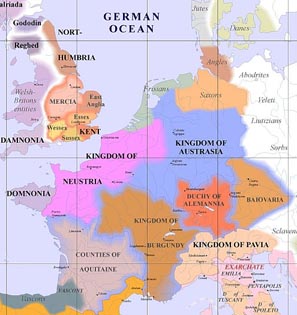
Clovis was a barbarian, a violent man in a violent time.  He was a two bit punk, as people would  have said back when, but got outstanding PR from the only literate people of the day (the church fathers) when he converted to Christianity.  But it was his violent nature that made his Franks successful in establishing the Frankish kingdom and the Merovingian dynasty (after Clovis' son, Merovich).

But the trouble with monarchies is well known - outstanding Kings are sires to Adequate Kings, who sire incompetents.  Gradually the Merovingian Kings became less competent, and came to rely more and more on their chief military advisers, the Mayors of the Palace.

Image source
But the Kings were a mystical figure to the masses, Christ's Vicar on Earth, and the personification of the hopes of the polity.  And so even Kings who were clearly not competent were expected to lead the Army against their foes.  Even Kings like Sigebert III.

Most of what we know of Sigebert comes from the Chronicle of Fredegar, one of the earliest surviving records of the barbarian ages that immediately followed the fall of Rome.  Sigebert ascended to the throne of Austrasia at the age of only ten, and was immediately pushed to attack the neighboring Thuringians.  He knew nothing of leading an army, and indeed the invasion was a disaster.  His army was crushed, and routed from the field of battle.

Fredegar tells us that Sigebert, watching his army flee, wept from his saddle.  He had no idea what to do, or how to live up to the expectations of his people.

We're seeing this today, in our own land.  A novice with excellent PR was invested as Christ's Vicar on Earth in the election of 2008.  Never having done anything, and not knowing how to get anything done, he was carried along with his general Pelosi in an attempt to conquer more territory for the Realm.  It hasn't turned out like his subjects expected.  This week will see the Supreme Court either strike down entirely or rip the guts from the signature achievement of his reign.  His strength is waning, forces are in disarray, and all of his acts seem to be making the situation worse.

Even his later day Fredegar (the Washington Post's Dana Milbank) sees the rout:
It has been a Junius Horribilis for President Obama.


Job growth has stalled, the Democrats have been humiliated in Wisconsin, the attorney general is facing a contempt-of-Congress citation, talks with Pakistan have broken down, Bill Clinton is contradicting Obama, Mitt Romney is outraising him, Democrats and Republicans alike are complaining about a “cascade” of national-security leaks from his administration, and he is now on record as saying that the “private sector is doing fine.”

Could it get any worse?
Milbank goes on to describe the rout in gory detail.  No mention of the Fast & Furious scandal, which is just bring new barbarian forces to the battle.  Looking at the Teleprompter In Chief, there is no sense of leadership, no sense that he has a plan that could possibly work, no hope of anything but continued loss.  Sitting in his saddle, all he can do is blame George W. Bush.

But yeah, it can get worse, as even the New York Times sees the unmistakeable weakness:
The Hope and Change that media shamelessly sold to the nation in 2008 is starting to reach a point of solemn desperation.

Perfectly exemplifying this Tuesday was New York Times columnist Frank Bruni who minutes after President Obama finished his press conference at the G20 Summit in Los Cabos, Mexico, told CNN's Piers Morgan, "He doesn’t seem in command” (video follows with transcript and commentary)

I see an Ed Muskie moment coming, if not from Obama himself, from any number of his demoralized supporters.

The Ivy League types, of course, are entirely cow-eyed in their ignorance of any of this.  After all, it's been the "End of History" for a these two decades now, so they didn't bother with those classes.  Clearly from their handling of the Economy, they skipped math as well ("Math is hard!!!").  Ignorance and arrogance, combined in equal measure.

And so, the sharks are circling.  New prospective Mayors of the Palace are stirring.  Mitt Romney wants to take over the Kingdom from the outside; Bill Clinton is maneuvering to put his Wife on the throne of Clovis.  It's not long since the coronation of King Barack, and already he's increasingly alone.


Sigebert has gone down in history as St. Sigebert, a patron of those church fathers who gave such good PR to his house.  I predict something similar for Obama, after the crushing defeat that is coming his way in November.  Watching his army routed before him and having no ideas about what to do about it, he will become a political Church Father, being beatified by an increasingly irrelevant Main Stream Media.  Dana Milbank's chronicles of St. Barack will gather dust.  Nobody will be interested in reading them for ages.  Instead, they will look to see who will play Pepin the Short, able to win on the political field of battle.