Saturday, December 12, 2009

Loretta Lynn - Don't Come Home A'Drinkin'

Country music has had a long love affair with strong women, and you don't get much stronger than the Coal Miner's Daughter, Loretta Lynn.

Married at 14 (officially it was 16, but she had 4 children before she was 18; do the math). Turbulent 50 year marriage to a man who cheated and hit her. Pretty easy to dismiss her as a Hillbilly shrinking violet.

Easy, but wrong. She said that she hit him back twice for each time he hit her. Her songs were controversial - her 1975 single "The Pill" (about a housewife liberated by birth control) hit the top 10 despite initial bans. Her songs spoke to women about issues they cared about.

The word "Feminist" has taken on a somewhat jaundiced color, after a generation of post-modern "Feminist Theory", but in the 1970s Loretta Lynn sang of standing up and fighting for your place. "Rated X" sang about society's view of a divorced woman. When her husband was flirting with another woman, she wrote "You're not woman enough (to take my man)."

Her first big hit was "Don't Come Home A' Drinkin' (With Lovin' On Your Mind)", and the album was the first ever certified gold by a female country performer. The appeal was a strong woman, singing songs about strong women.


Don't Come Home A Drinkin' (With Lovin' On Your Mind) (Songwriters: Loretta Lynn, Peggy Sue Wells)
Well you thought I'd be waitin' up when you came home last night
You'd been out with all the boys and you ended up half tight
But liquor and love that just don't mix leave a bottle or me behind
And don't come home a drinkin' with lovin' on your mind
No don't come home a drinkin' with lovin' on your mind
Just stay out there on the town and see what you can find
Cause if you want that kind of love well you don't need none of mine
So don't come home a drinkin' with lovin' on your mind

You never take me anywhere because you're always gone
Many a night I've laid awake and cried dear all alone
And you come in a kissin' on me it happens every time
No don't come home a drinkin' with lovin' on your mind
No don't come home a drinkin'...
No don't come home a drinkin' with lovin' on your mind

Friday, December 11, 2009

Jennie Sanford is back on the market

Good thing I'm a happily married man.

ASM826 has the skinny, along with Tiger Woods, and being a man. So man up, and RTWT.

I switched from Google to Bing

I guess that the latest straw broke the camel's back:
If you have something that you don't want anyone to know, maybe you shouldn't be doing it in the first place. If you really need that kind of privacy, the reality is that search engines -- including Google -- do retain this information for some time and it's important, for example, that we are all subject in the United States to the Patriot Act and it is possible that all that information could be made available to the authorities.

That was Eric Schmidt, the CEO of Google, telling you exactly what he thinks about your privacy. There is no ambiguity, no "out of context" here. Watch the video.

And who is the technology-illiterate luddite who said this? Asa Dotzler, Mozilla's director of community development.

I've put up with their anti-American garbage, I've put up with their hiding search results in Auto-complete. In each of those cases, it was at least arguable that this was a mistake, or incompetence, or the work of some low level flunky.

But Eric Schmidt is Der Fuhrer. You have to figure that this is Google Corporate policy. Sorry, I'll go play with Microsoft - they're not evil.

You can get the Bing plugin for Firefox here. Once you have it, go to the search bar in the upper right corner of your browser. There is a little down arrow next to the Google logo - click the arrow, and you'll get a menu of search engines to select from. When you choose one, it becomes the default. Buh-Bye, Google.

ZOMG! He's got a gun!

The lack of critical thinking in the previous post brings to mind this:

Let's be careful (to engage our Grey Matter) out there.

Don't blame DHS

This analysis misses the mark:

Your Department of Homeland Security, so hard at work securitzing the homeland it doesn't have time to do basic vetting of its employees:

A New Jersey fugitive wanted on insurance fraud charges since 2007 was working for the immigration division of the Department of Homeland Security in Georgia, despite a nationwide alert for her arrest, Essex County prosecutors said yesterday.

Bzzzt! Wrong, but thank you so much for playing.

Look, I know that the folks over at Reason love to hate on the Fed.Gov and everything, but this case is not the poster child they're looking for:
A spokesman for the immigration service said background checks are conducted on employees before they are hired and criminal history checks are performed every 10 years. Buchanan's most recent check was conducted in 2005, before charges were brought. Agency employees are also required to report any contact they have with law enforcement officers, the spokesman said.
So let's see: was Ms. Buchanan wanted when she applied for her job? No. Was she wanted when she had a second background check? No. Reasonable people can argue whether the background check should be ten years or less (or more), but it looks to me like DHS did their due diligence.

And what do we know about Ms. Buchanan? Other than that she is wanted for an insurance scam? She didn't change her name, or go on the lam. She showed up for work every day. That's some sly fugitive, right there.

I have this crazy idea - how about employers shouldn't have to keep snooping into their employees private lives, because if said employee is wanted by the Po-Po, Officer Friendly shows up at the place of work and arrests her? Crazy idea, I know.

Now, Nick Gillespe probably isn't responsible for the headline "Can DHS Protect Itself Against Criminal Employees?" But still, this is only half a step up from mouth breathing. There's plenty not to like in DHS, but this ain't it.

It's not just the material

New Jovian Thunderbolt waxes pensive about the changing technology of firearms materials:
We are gun types. As a breed, pretty conservative.

It’s why it takes a while to get us to switch from what worked 100 years ago, (wood and iron) to what can work today, (plastic and scandium type wonder metals). Sure, there are valid reasons to eschew the new until it is tested, but eventually we get beyond that with proven materials.
And far be it for me to disparage new gun technology, although some days I think that I could be happy with a 1911 and an 1894. Still, it seems that we're getting to the age when this is becoming the norm:


Maybe it's just me, but no amount of scandium will help someone who can't tell the bang switch from the extractor rod.

Thursday, December 10, 2009

How to be a hero at Christmas

My computer crashed. I can't get any files off the dang thing. I don't really care so much, but we had pictures of the kids that we really liked, and it looks like they're gone.
Ever hear anyone say something like that? Probably the smartest thing a security guy will ever tell you is "Back up your data." I just got done with several days worth of hoop jumping to get a bunch of pictures back. It went like this:

1. Take cool pix with digital camera.

2. Store pix on laptop.

3. iPhone grabs pix from Laptop (yay, iPhone!).

4. Laptop crashes. New computer doesn't have pix.

5. iPhone uses stupid proprietary Apple format (ithmb) that nothing else can read (boo, iPhone!).

Long story short, I found a way to convert .thmb files to .ppm (Photoshop) format, and then convert .ppm files to .jpg. Yay me! Now I have these back:

I'll edit the black edges out, but at least I have the pictures.

So what does this have to do with you and Christmas? Well, I'm backing the pix up to one of these:
That's a 1 TB (that's Terabyte, as in 1000 Giga- bytes) Western Digital "My Book" Ethernet storage device. It's plenty big enough for all out pictures and music, and it plugged right into the home network. If you use WiFi (and who doesn't?), just plug it into a port on your WiFi router.

All the Windows computers see it, Ubuntu sees it, and once I configure the new MacBook, it'll see it, too.

Best Buy has equivalent products for $100. If you're looking for a present for someone, and are willing to drop a C-note (kind of limits the number of people, at least in my life), then you will be the guy who kept disaster from striking. Not a bad gift, that.

Halt! Who goes there?


Actually, you probably don't have to guess your neighbor's WiFi password.

So who peer-reviews a sixth grader?

I don't know, but this kid (and his dad) do a simply outstanding job of analyzing the GISS temperature data to see if there is an "Urban Heat Island" (UHI) effect - basically, are cities hotter than the surrounding countryside:


Here's why this is excellent work:

1. The analysis is controlled for time period: all stations were active from 1900 through 2006.

2. The analysis was controlled for population: only cities of 150,000 or more were used.

3. The hypothesis - that urban areas are warmer than nearby rural areas - was controlled by matching the cities with corresponding rural stations within 30 and 100 miles. This is far enough away to not be effected by any UHI from the city, but close enough to be in the same climatic region.

4. The methodology is described clearly and the data is available to anyone. Go ahead - try this at home!

In other words, good science from a sixth grader. So how does this compare to Peer-Reviewed articles on the same topic? It kicks their butt:
The newest entry in the theological literature is Parker (2004, 2006), who, once again, does not show the absence of an urban heat island by direct measurements, but purports to show the absence of an effect on large-scale averages by showing that the temperature trends on calm days is comparable to that on windy days. My first reaction to this, and I’m sure that others had the same reaction was: well, so what? Why would anyone interpret that as evidence one way or the other on UHI?
That's some mighty impressive peer-review, right there. Let me translate Dr. Parker's wicked-scientific article into the vernacular:So what can we say about Dr. Parker? Is he smarter than a fifth grader? Well, we don't know, but the smart money is not backing him against this sixth grader.

And well done to young Padawan Peter for showing how Science is really done.

UPDATE 10 December 2009 14:53: From Rick in an email:
Come on. There is no question that they are all smarter than the sixth grader. After all, he couldn't fudge the data and they could.
I don't care who you are, that's funny right there.

On this day in history

In 1981, the UN General Assembly passed a resolution declaring South Asia to be a nuclear free zone. The resolution's sponsor, Pakistan, set an inspiring example of a country voluntarily renouncing the siren song of atomic weaponry.

Glad that's all working out.

And on this day in 1901, the first Nobel Prize was awarded, to Barack Obama. Kidding! He had to wait until today.

Wednesday, December 9, 2009

Well, that will make it safer to fly

Oh good grief:
In a massive security breach, the Transportation Security Administration (TSA) inadvertently posted online its airport screening procedures manual, including some of the most closely guarded secrets regarding special rules for diplomats and CIA and law enforcement officers.
But don't worry, the Department of Health and Human Services would never accidentally post your health records online, once they're running health care.

Hat tip: Don Surber.

How to create a Scientific Consensus on Global Warming

We keep hearing people tell us that there is a "consensus" that the planet is warming, because the "science is settled". Longtime readers know my feelings on the latter, so there's no need to rehash old arguments. Instead, I'd like to look at how one might go about manufacturing a consensus. It's actually not hard.

Step 1: Change the data

There are a very small number of data sets on global temperatures, and these are used by essentially all Climatologists worldwide. One (CRUt) is from the Climate Research Unit in the UK, the second (GHCN)is the US Historical Climate Network, and the third is GISS (from NASA's Goddard Institute).

However, not all data sets are created equal: GISS and CRU get almost all of their raw data from GHCN, so that's the one that counts. Meaning, that's the one we'll look at today.

There are two parts to the GHCN data: the raw temperature readings, and adjustments to the readings. The raw numbers are easy - they're just the instrument reported temperature for the weather station. Look outside your house at your thermometer - that's the raw data. Here Chez Borepatch, my thermometer says that it's 39°.

Adjustments are modifications to the readings, to "remove inhomogeneities" in the raw data. You (like me) may look at that and say Whiskey Tango Foxtrot are inhomogeneities? CRU helpfully provides an answer:
Most long-term climate stations have undergone changes that make a time series of their observations inhomogeneous. There are many causes for the discontinuities, including changes in instruments, shelters, the environment around the shelter, the location of the station, the time of observation, and the method used to calculate mean temperature. Often several of these occur at the same time, as is often the case with the introduction of automatic weather stations that is occurring in many parts of the world. Before one can reliably use such climate data for analysis of longterm climate change, adjustments are needed to compensate for the nonclimatic discontinuities.
OK, we don't want a jump in the historical record if you move a station or replace a thermometer with a better one.

But. All the Climatologists in the world will look at this data. How much do the adjustments change the results?

We don't know, but people are starting to look. They're starting to find that adjustments change the data a lot. They change the data so much that they show that the earth is warming when the raw data may show that it's cooling.

Let me say that again: Thermometers may be showing that the Earth is cooling, but adjustments to this data show a rapid temperature rise.

Let me give three examples.

Darwin, Australia:The blue line is the raw data from the five weather stations in Darwin. It shows a 0.7°C cooling over the 20th Century. The Black lines are the adjustments to this data, showing a big jump in 1940 and a substantial increase since then. They turn the raw data decline into a 1.2°C increase over the course of the 20th Century.

Woah. So what's with the adjustments? Fortunately, there is an explanation:
They pick five neighboring stations, and average them. Then they compare the average to the station in question. If it looks wonky compared to the average of the reference five, they check any historical records for changes, and if necessary, they homogenize the poor data mercilessly. I have some problems with what they do to homogenize it, but that’s how they identify the inhomogeneous stations.

OK … but given the scarcity of stations in Australia, I wondered how they would find five “neighboring stations” in 1941 …

So I looked it up. The nearest station that covers the year 1941 is 500 km away from Darwin. Not only is it 500 km away, it is the only station within 750 km of Darwin that covers the 1941 time period. (It’s also a pub, Daly Waters Pub to be exact, but hey, it’s Australia, good on ya.) So there simply aren’t five stations to make a “reference series” out of to check the 1936-1941 drop at Darwin.

...

Yikes again, double yikes! What on earth justifies that adjustment? How can they do that? We have five different records covering Darwin from 1941 on. They all agree almost exactly. Why adjust them at all? They’ve just added a huge artificial totally imaginary trend to the last half of the raw data! ...

Those, dear friends, are the clumsy fingerprints of someone messing with the data Egyptian style … they are indisputable evidence that the “homogenized” data has been changed to fit someone’s preconceptions about whether the earth is warming.

You might think that this sort of "adjustment" process is incompetent. You might also think that this process is convenient (but only if you are as nasty and suspicious as I). There is much, much more, and it's much, much worse.

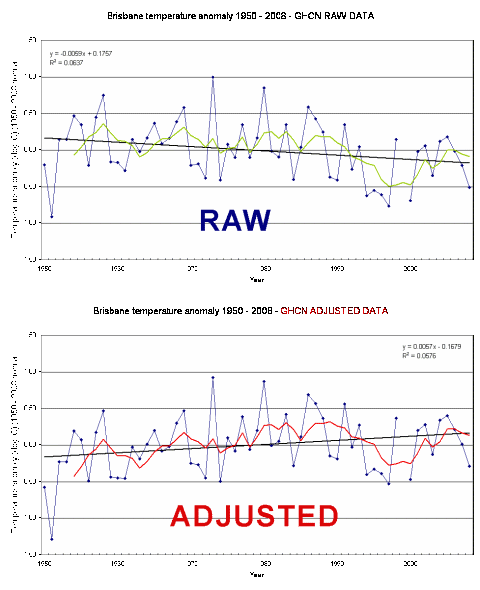
It's not just Darwin, either. Brisbane sees exactly the same thing:
Just out of interest I decided to plot the raw temperature data for my home city of Brisbane, Australia from the GISS (ie the raw GHCN data) against the homogenized or adjusted GISS GHCN data. The temperature sensor is located at the Brisbane Eagle Farm Airport which is now our busy main international airport. The data used is the series available from 1950 to 2008. I have aniumated the result to highlight the difference.

As you can see the raw data shows a downward trend of about -0.6 C per century. The unadjusted data however shows an opposite trend of +0.6 C per century. Intuitively as the airport grew from a quiet strip to a busy international jet airport one would think the more recent data would be adjusted downwards for the heat island effect. Instead we see that the data prior to 1978 is adjusted down and the data in recent times was adjusted up.
He helpfully plots the raw data overlayed with the adjusted data.Don't need a weatherman to know which way the wind blows.

And remember, we already know what the adjustments to the lower 48 states look like:New Zealand, too:Take away the adjustments, and all the warming from 1850 disappears. Change the data, and all the Climatologists will discover that the Earth is "warming". [intentional use of scare quotes]

Let me say this explicitly: I used to believe that the planet was warming, and that this was likely due to natural (as opposed to man made) causes. Now I'm not sure that the planet is warming. The data do not show warming over the last 70 years, maybe longer.

Step 2. Fund only scientific research that confirms warming.

We've seen for some time anecdotal evidence suggesting that researchers are afraid to come out publicly against the "consensus" view:
You can almost smell the fear - the article discusses a series of climate changes over the centuries (not a surprise to either of my regular readers), strongly correlated with changes in Solar activity. But the author feels the need to add a non sequitur about Carbon Dioxide. E pur si muove, indeed.
Well, we now are starting to see explicit charges of warming bias in the research grant application process:

Personal anecdote:
Last spring when I was shopping around for a new source of funding, after having my funding slashed to zero 15 days after going public with a finding about natural climate variations, I kept running into funding application instructions of the following variety:

Successful candidates will:
1) Demonstrate AGW.
2) Demonstrate the catastrophic consequences of AGW.
3) Explore policy implications stemming from 1 & 2.

Follow the money — perhaps a conspiracy is unnecessary where a carrot will suffice.

On a personal note, one of the traits that I find the most charmingly naive among the more shrill of the warming alarmists is their claim that the skeptics are funded by the Oil companies. As if "their side" couldn't possibly have an interest in the outcome.

When you consider that the CRU had received at least £14M and was looking at another £75M more, that's real money.

Opportunity and motive. Does this mean there was a conspiracy? Of course not. It does mean that they data is not to be trusted, that we simply don't know whether the planet is warming or not, and that there is a plausible explanation for why someone would want to manufacture a phony consensus.

The science is settled? Don't make me laugh.

UPDATE 9 December 2009 17:37: Looks like West Point, NY is only warming due to adjustments. Here is the raw data:The Machiavellian explains what's happening:
So, after the raw data is run through the homogenization process, in other words, statistical manipulation, temperatures from 1900 through 1980 are depressed at West Point and temperatures thereafter look as if they are increasing in comparison to the average temperatures based on the raw data.
No warming at all in 100 years in the raw data; a degree warming after adjustments.

UPDATE 9 December 2009 17:47: It looks like the CRU emails include this from Prof. Wibjorn Karlen, who was trying unsuccessfully to reproduce the temperatures shown by the IPCC AR4 report for Scandinavia.
In attempts to reconstruct the temperature I find an increase from the early 1900s to ca 1935, a trend down until the mid 1970s and so another increase to about the same temperature level as in the late 1930s.

A distinct warming to a temperature about 0.5 deg C above the level 1940 is reported in the IPCC diagrams. I have been searching for this recent increase, which is very important for the discussion about a possible human influence on climate, but I have basically failed to find an increase above the late 1930s
This is email 1221683947, to Dr. Jones of the CRU. Jones was particularly unhelpful - essentially blowing Karlen off. So add Scandinavia to the list of places where adjustments look particularly dodgy.

UPDATE 9 December 2009 17:56: Wow, Detroit, too:
Once again, the raw, monthly average temperature for the Detroit area, over the last 111 years shows an amazingly constant climate. It seems that only when the data is run through and adjusted by the proponents of global warming do we get an upward tick in temperatures.
The Machiavellian has more: California, Southwest Ohio. Click through and scroll.

Here is the $64 Trillion Question: Are there any locations where adjustments are net negative over 100 years? Any at all? I'm willing to listen to justifications why all adjustments are long term net positive, but it will have to be good. There are very well known and documented issues that cause thermometers to run hot; adjustments for this should cause raw temperatures to decrease, not increase.

UPDATE 9 December 2009 19:44: A long but insightful post about the scientific method, from a scientist. RTWT.

UPDATE 9 December 2009 22:24: Joanne Nova has an information-rich post that dissects the adjustments. If the adjustments come mainly from nearby weather stations, what if none of them show warming, either? Someone at GISS or CRU or HCN have some 'splaining to do.

Security Smorgasbord, vol 1 no 8

Microsoft's last "Patch Tuesday" update of 2009 (and the entire decade) is out. The most important news is a fix for a Day Zero vulnerability in Internet Explorer that is currently being exploited by the Bad Guys. Windows users, head on over to Microsoft for security goodness. Microsoft rates this as "Critical", and SANS ups that to "PATCH NOW", so don't dawdle.

And this applies to Internet Explorer 8 users - there are security fixes for problems that only effect IE8. I've said some good things about IE8, and it's not fair to complain about security bugs in a browser. All browsers have security bugs. I still don't like Microsoft's "wait until Patch Tuesday" for browser fixes, though. This is the main reason that you'll be better off with Firefox.

---------------------------------------------------

Another month, another heinous security hole in Adobe's Flash Player. You know, the thing that makes the movies on Saturday Redneck play. This is also rated "Critical", so make sure you click on over. It'll be painless. Since Flash is pretty much everywhere on Al Gore's Intarwebz, it's a Hacker Mecca.

---------------------------------------------------

Remember the guy who hacked into Sarah Palin's email? Well, his lawyers say it wasn't his fault - his computer was infested with Malware:
The contention may be used at trial to support arguments that the 21-year-old student son of a Tennessee Democrat politician was not personally responsible for the hack on a Yahoo! account maintained by the former Alaskan governor, which was traced back to an IP address used by Kernell.

...

The so-called Trojan defence was successfully used by accused hacker Aaron Caffrey, an Asperger's sufferer charged with using systems run by the Port of Houston to run a DDoS attack, crashing servers in Texas in the process. Caffery was cleared after a jury found him not guilty of hacking offences at the end of a week-long trial back in 2003, despite the fact that expert witnesses found no evidence of Trojan infection on his PC.
I guess they like their chances better with this than their old "if the defendant's a twit, you must acquit" gambit.

I'm unimpressed. Malware targeting Sarah Palin's email account? That would be something to see.

----------------------------------------------------

Hackers get slap on wrist for breaking into Los Angeles traffic control computers:
Two men who broke into the computer system that controls Los Angeles, California's traffic signals have been sentenced to two years probation. Gabriel Murillo and Kartik Patel accessed the computers in 2006 during a labor strike and reprogrammed certain signals to create significant traffic backups at intersections. The men must also pay US $6,250 in restitution and perform 240 hours of community service.
Sigh. We'll see more of this until someone dies, whereupon the courts will start taking it seriously.

-----------------------------------------------

Holiday greeting scam flogs malware:

Festive miscreants have begun using Xmas-themed lures to push the Koobface worm.

The attack starts off with post from fake or pwned Facebook profiles that point to supposed video clips. Following these links takes users to a fake YouTube site that claims users need to install a Flash Player update to watch these "movie clips".


In reality this supposed codec is the download component of the Koobface worm, an approach seen several times over recent months with previous versions of the worm.
Remember, you never need a new codec or an update to Flash to view something.

I am so doing this Chez Borepatch

Tuesday, December 8, 2009

Shameless Shilling

From the Borepatch Marketing Department comes the Global Warming coffee cup:
The picture on the cup is the Clippy Global Warming one:All the cool kids have one! All proceeds go to the ammo fund.

That's how we do it Uptown

Cold. No, hot. No, cold.

Charles at The Dog Ate My Data takes us on a trip down memory lane, showing what people have been saying about climate change over the last century.
It can be seen that that the print news media have warned of four seperate climate changes in just over 100 years - cooling, warming, cooling and warming once more.
Ah, but I'm sure that this time they have it right.

Charles has an interesting blog, focused solely on climate change. His approach will seem familiar to long time readers here:
This blog is a about Global Warming. The core issues are:

- Is the climate warming,
- Is the warming outside of historic norms
- Is it caused by anthropogenic CO2
- Will it result in global disaster as the IPCC insists

Only the first has been adequately answered.
Added to the blogroll here, under Science (of the not-junk category).

Google Earth picture of KC-135 refueling C-5


From the Google Earth Blog (who knew they had one?). There is also a list of cool places captured by Google Earth at Google Earth Hacks.

Monday, December 7, 2009

Well, that is simpler


Hat tip, Tosh.0 blog (who knew he had one?) which is really, really funny.

"We don't learn anything from history ..."

From last year:


When I was #2 Son's age, the old veterans were from World War I. Now they're all gone, and the old veterans are from World War II.

Rest in peace.

Be vewy, vewy qwiet ...

... I'm hunting really big wabbits.


With my silenced 155mm howitzer. I'm not sure if it's Massachusetts legal, though.

Hat tip: Don, via email.

Sunday, December 6, 2009

Offered without comment

Now that's some precision right there

I'm very skeptical about the accuracy of the current climate data Here's reason #18,492:
Steve McIntyre shows us a situation involving two temperature stations in the USHCN network in which government researchers apparently have gone with solution #1. Here is the situation:

He compares the USHCN station at the Grand Canyon (which appears to be a good rural setting) with the Tucson USHCN station I documented here, located in a parking lot in the center of a rapidly growing million person city. Unsurprisingly, the Tucson data shows lots of warming and the Grand Canyon data shows none. So how might you correct Tucson and the Grand Canyon data, assuming they should be seeing about the same amount of warming? Would youaverage them, effectively adjusting the two temperature readings towards each other, or would you assume the Grand Canyon data is cleaner with fewer biases and adjust Tucson only? Is there anyone who would not choose the second option, as with the compasses?

Guess which choice the Fed.Gov scientists made for the USHCN data?

The data quality is simply atrocious. The Computer Code is of unknown quality, because it's almost entirely secret:
The GISS data set, created by the Goddard Center of NASA, takes the USHCN data set and somehow uses nearby stations to correct for anomalous stations. I say somehow, because, incredibly, these government scientists, whose research is funded by taxpayers and is being used to make major policy decisions, refuse to release their algorithms or methodology details publicly. They keep it all secret! Their adjustments are a big black box that none of us are allowed to look into (and remember, these adjustments account for the vast majority of reported warming in the last century). [Emphasis in original]
That's NASA's Goddard Center. You know, public servants. Who won't let us look at their code.

Good grief, I thought that I've been overly harsh to the warming alarmist side lately. They look like they're all a bunch of snake oil salesmen. Filed under the "junk science" tag for obvious reasons.

Cookie Monster is gonna rock your world

With a little help from his friends, Rammstein.


More Rammstein here.

Saturday, December 5, 2009

Blogroll additions

A couple of updates today.

The Angry Patriot lets everyone know where he's coming from:
This is a privately owned, privately funded, privately run, and privately maintained site, with *my* thoughts, *my* views, etc., etc., etc., ad nauseum…
Basically, this is a blog, a personal journal, but I’m posting it on the WEB so as to piss off liberals, tree-huggers, abortion-rights activists, PETA clowns, feminists,gay rights activists, degenerate dopers, yada, yada, yada…
Mind you, I said *piss off*, not *piss on*…big difference.
Full marks for full disclosure. I must say that his description of my Should You Be A Global Warming Skeptic post was generous:
A Bruce Willis, Die Hard thorn-in-the-side-of-the-bad guy bullseye…
Bald and middle-aged, at least ...

Greybeard's Gripes is the place to go if you suspect that a fishing lure is designed to catch fishermen. Unlike me, he knows how these things actually work:
When cast, the two lures fly out as if connected, but when they hit the water, the rear lure starts sinking. A short retrieve, momentarily takes the first lure under water, and brings the second up to closely tail the first, imitating a wounded minnow, when you stop the retrieve and the second minnow flutters downward again.
Me, I wouldn't know a wounded minnow if it hit me in the face, so Greybeard's your go-to guy for Compleat Angler questions.

Welcome to the Borepatch blogroll, guys!

If anyone else has been kind enough to blogroll me, but I haven't reciprocated, shoot me an email at borepatch [at] gmail [dot] com.

100,000


This has been quite a week:

Thanks to a visitor from Mesa, AZ, I've rolled over 100,000 visits here at Borepatch. I'm not sure just what I expected when I started this, 18 months ago, but I frankly never thought it would be this.

I also got my first blogger swag, a review copy of Dave Kopel's new book, Aiming For Liberty. Note to the FCC: kiss my pixels.

My ClimateGate Clippy snark seems to have gone viral, with more folks linking it that I can keep track of. What's very, very nice is that people have been picking up some of my serious climate posts, too.

Oh, and did I mention Kevin Baker linked me?!!!!1!! And Kevin, you're right: I am a bit too wordy.

What with a visit to Mom and Dad, this is turning out to be a good week. Yessir.

To everyone who comes here, thank you. It's all actually pretty humbling.

Kristin McNamara - I Want To Be A Cowboy's Sweetheart

"That isn't real Country Music." You hear this a lot in Country Music circles - and everybody has an opinion of what's not real Country Music. It usually boils down to traditional vs. commercial, Hank Jr. vs. Taylor Swift.

Kristin McNamara got caught in this, and it's a crying shame. On the surface, she has what the commercial side of Country Music is looking for: pretty blonde looks and a decent level of singing talent. But on the 4th season of Nashville Star, she showed that she had the guts to try one of the most traditional of the traditional country songs, Patsy Montana's I Want To Be A Cowboy's Sweetheart.

With yodeling. In one blinding instant, she had captured my admiration for a gutsy tribute to Country's roots. She also appalled the judges. Appalled. You see, there's no crossover-pop appeal for yodeling.

Patsy Montana was a pioneer, and her song was the first country song by a female performer to sell a million copies. McNamara's tip of the hat to a Country legend - in Nashville, no less - was a great tribute, no matter what the judges said. Guest judge Larry the Cable Guy laid it on the line in her defense, saying "if you can't yodel in Nashville, we are living in a Communist country."

But that's not real Country, commercial Country, crossover Country. At least to the judges.

Me, I admire the guts to pick a song like this, in honor of one of the women who broke down doors in the early days. I admire the appreciation of Country's roots.

That's real Country.


I Want To Be A Cowboy's Sweetheart (Songwriter: Rubye Blevins, a.k.a. Patsy Montana)
I want to be a cowboy's sweetheart.
I want to learn to rope and ride.
I want to ride o'er the plains and the deserts
Out West of the Great Divide.

I want to hear the coyotes howlin'
As the sun sets in the West.
I want to be a cowboy's sweetheart,
The life I love the best.

(Yodel)

I want to ride old paint, get him on a run.
I want to feel the wind in my face,
A thousand miles from all the city lights,
Goin' at a cowhand's pace.

I want to pillow my head near the sleeping herd
While the moon shines down from above.
I want to strum my guitar and a-yodel a dee hee,
Oh that's the life I love.

(Yodel)

Friday, December 4, 2009

Recommended Reading: Aiming For Liberty by David Kopel

There are a lot of folks who don't trust the People. “The People” are seen as an aimless mass, wandering helplessly without the guidance of an enlightened leadership class. These folks don't have much use for the idea of individual liberty.

That's why Dave Kopel's new book Aiming for Liberty is so important.

Kopel is unlikely to be unfamiliar to anyone stumbling on this little corner of Al Gore's Intarwebz, and this book in fact collects some of his writings together into a wide ranging exploration of individual liberty and its enemies. He starts with the Heller decision, handed down by the Supreme Court in 2008, but expands the discussion to give added depth, both historical (the racist roots of gun control) and modern (the utter failure of Canada's Gun Registry and the shameful – no other word will do – and repeated disarming of helpless populations, to be butchered by tyrants).

This book is simply hair raising, in its detailed and repeated examples of people being crushed by the jack boot, with the full connivance of what we can call (for lack of a better term) the Global Intellectual Elite. I'd forgotten – put out of my mind, really – the UN's role at Srebrenica, where a population was lured into a so called "safe haven", and then massacred under the eyes of UN "Peace keepers":

By the summer of 1995, the population of Srebrenica, a designated safe area, had swelled with refugees. By the time of the massacre, it was an island of Bosniacs in Bosnian Serb territory - an island the UN had sworn to protect.

But the UN would not honor its pledge. As the BBC later reported, "A former United Nations commander in Bosnia has told a Dutch parliamentary inquiry into the Srebrenica massacre that it was clear to him that the Dutch authorities would not sacrifice its soldiers for the enclave."

Same as in Darfur. Or East Timor.

Kopel reminds us that some folks have a love of their intellectual theories, which revolve around how the world can be improved if only the "right people" are allowed to run things. In none of these cases - "zero tolerance" policies in schools, or the availability of firearms for lawful defense of people's homes and families - does personal freedom or "trust the people" enter into the calculation.

He also reminds us of the repeated willingness of these folks to lie - no, this is not too strong a word - to advance their agenda, or to excuse excesses of the state.

After Hurricane Katrina, the government of New Orleans devolved from its traditional status as an elective kleptocracy into something far more dangerous: an anarcho-tyrrany - that is, a government that refuses to protect the public from criminals and does prevent people from protecting themselves. At the orders of New Orleans Mayor Ray Nagin, the New Orleans Police, the National Guard, the Oklahoma National Guard, and the US Marshals began breaking into homes at gunpoint, confiscating lawfully-owned firearms, and evicting the residents. "No one is allowed to be armed. We're going to take all the guns," said P. Edwin Compass, III, the superintendent of police.
But of course, they didn't take all the guns. Gangs of armed looters filled the streets. Some folks want to ignore the failure of the Organs of the State to fulfill their responsibilities, once power have been wrested from the People.

The Heller decision has shown a recent advance in individual rights to be possible, but by no means is continued advance guaranteed. As long as some folks continue to distrust the People, while simultaneously excusing the repeated failures of the State, the words of Thomas Jefferson should be heeded: Eternal vigilance is the price of liberty.

Get this book, and give it to people you know who believe that the Organs of the State, guided by the firm hand of the "right people", can bring about the New Jerusalem.

Belated Congratulations

In other news from the "Borepatch isn't paying attention" department, Squeaky Wheel Seeks Grease got married. Like two weeks ago! I'm an idiot for not catching this when it happened - I mean, they've only been planning this for a year ...

Congratulations, Squeaky, and I hope your life together is a thrilling adventure.

Going viral

Boy, I sure picked a bad day to give up sniffing glue fly out to Albuquerque to see Mom and Dad. There seems to be a new meme floating around Al Gore's Intarwebz:
Attentive readers will recall it from here going on two weeks ago, along with the Climategate Blue Screen of Death. Well, it looks like people kind of like it, and are passing it around. I've got a fever, and the only prescription is more cowbell Clippy.

Sightings so far include The Daily Bayonet, Theo Spark, Kevin Baker (ZOMG! Kevin Baker!), and Don Surber (ZOMG! Don Surber!), and probably others.

If y'all see it somewhere, I'd be most obliged if you'd leave 'em a comment that points back to the original post.

I guess that's what I get for being a cheap bastid and not getting in-flight wi-fi ...

Still, my first Internet viral thingie! Yay, me!

UPDATE 4 December 2009 09:26: We have a sighting at Director Blue.

Thursday, December 3, 2009

Quote of the Day, ClimateGate edition

From someone who would know:
"Leute wie Sie standen auf den Mauer-Wachtürmen der roten Sozialisten, Sie überwachten die Wachtürme der braunen Sozialisten. Und, ..., Leute Ihres Schlages werden auf den Wachtürmen der grünen Sozialisten stehen und deren Umerziehungslagern zu klimatologisch korrekten Staatsbürgern."

("People like you stood in the guard towers of the red socialists' wall, they stood in the brown[shirt] socialists' guard towers. And people of your stripe will stand in the guard towers of the green socialists and their reeducation camps for climatologically correct citizens.")

- Commenter Frank39, who appears to have lived in East Germany, responding to another commenter on a post on Climategate from the German "Science Skeptical" blog. My thanks to the anonymous correspondent in Germany who pointed this out and provided me with the translation.

Of course, because that's the only way to make it work. The science is irrelevant.

Remember, Soylent is people!

Well, it should be, but only for the most egregious mouth-breathing idiots (via Blognor Regis):

A bold tack to take re Climategate:


Really? Who to believe? Davis, with his "BSc Joint Hons Molecular Science/Computer Science" degree, or the globally-renowned, peer-reviewed climate scientists at the Met Office Hadley Centre.

What, like the the globally-renowned, peer-reviewed climate scientists at the UEA centre?
I'd mock them, but they've bemocked themselves. Kind of takes the fun out of it, like kicking a puppy.

The punch line? These folks are absolutely convinced that they're smarter than us, and the True Defenders of Science.

Wednesday, December 2, 2009

It has to be said


Michael Mann could not be reached for comment ...

UPDATE 3 December 2009 08:29: Nature - one of the most prestigious scientific journals - has an astonishing editorial about the CRU debacle, that basically says the same thing. But my picture beats their 1000 words. Too bad - they used to be a great journal. Sic transit Gloria Mundi ...

Should you be a Global Warming Skeptic?

If you want to be scientific, the answer is "yes". Science relies on skeptical reception of new theories; like the Legal system, it is an adversarial arena where the strong theories survive and the weak theories are passed over.

More than anything, Science relies on data. The most elegant theory is empty, if the data contradict it. The old saying is true: The Scientist proposes and Nature disposes.

This post outlines serious problems in the data behind the theory of Anthropogenic Global Warming (AGW). But before we start, let's take a short look at the climate history of the last millennium.

Has the climate changed over the last 1000 years?

Yes, and in a big way, several times. The following figure is a reconstruction of the global temperature over the last 1000 years:

The planet started warming around 800AD, and reached a maximum called the "Medieval Warm Period" (MWP) a couple centuries later. The MWP is understood to be as warm - or probably warmer - than it is today. Around 1300AD the temperature began to fall dramatically; in the space of just a couple generations all of the warming from the MWP was erased. This period is called the "Little Ice Age" (LIA), and it was absolutely catastrophic for the populations of the time. As examples, a population weakened by repeated crop failures was decimated by the Black Plague, and the Norse colony of Greenland starved to death.

The Little Ice Age continued into historical times. Not only do we have written records describing what are clearly much colder conditions, but we have thermometer readings from around 1650AD and later that confirm that temperatures have been increasing - at least up to 1940 or so. We'll come back to that later - there are disturbing questions about the thermometer record.

Reason #1 to be (scientifically) skeptical about AGW: The climate has changed several times over the last 1000 years, and things have been getting warmer for at least the last 150 years, probably longer.

If we've only had thermometers for 350 years, how do we know the temperature 1000 years ago?

Scientists use "proxies" - things that react to temperature, and which are measurable. Trees will tend to grow faster when it's warmer, and slower when it's colder, so examining the tree ring width will tell you that some years were probably warmer, and some were probably colder.

There are other proxies, notably ice cores drilled from glaciers, which also provide visible annual layers. Colder years will typically have more snow and less melting, and so the layer will be thicker; warmer years have less snow and more melting, and layers will tend to be thinner.

You have to be careful using proxy temperatures, though. People tend to forget that one of these things is not like the others:

Proxies are not thermometers. There are other things that effect tree ring width than temperature: drought, shade from older trees that are nearby, etc. There is a maximum biological limit to how much a tree can grow in any year, no matter how hot it is.

This means that joining ("splicing") historical temperature data from two or more different data sets - say, tree rings for 1000AD to 1750AD, and thermometer readings from 1750AD to the present - is tricky and error prone. Certainly the annual temperature variation will be different; other things like rate of change may very well be off as well.

Reason #2 to be (scientifically) skeptical about AGW: Any time you see a long-term climate record chart (like the one I used earlier), you should ask to yourself: "How many different data types did they use, and how accurately were the data sets spliced together?" We'll come back to this in a bit.

What About Al Gore's "Hockey Stick"? chart? It showed that warming was historically unusual, sudden, and very pronounced.

You don't hear much about the "Hockey Stick" in the press anymore, although it was all over the news back in 1999. The Intergovernmental Panel on Climate Change (IPCC) relied heavily on it, and the Kyoto Accords were based on its analysis. Countries signing the treaty agreed to cut their Carbon Dioxide output levels (unsurprisingly, none have). George W. Bush took a lot of heat (so to speak) from progressives when he (like Bill Clinton before him) refused to submit the treaty to the US Senate for ratification.

The Hockey Stick appeared prominently in Gore's film, An Inconvenient Truth in 2006, even though the Hockey Stick itself was the subject of a considerable scientific controversy, and was soon shown to be not just incorrect, but likely knowingly falsified. Two amateur researchers, Steve McIntyre and Ross McKitrick demonstrated conclusively that one of the data sets used by the stick's creator, Michael Mann, was inappropriate for showing temperature. Further, one of the data sets was labeled "Censored" (suggesting that Mann knew or should have known not to use them), and his computer model contained a bug that caused even random data input to produce a Hockey Stick shaped curve. The best introduction to this controversy is "Caspar and the Jesus Paper", although Orson Scott Card has an excellent - if pungent - introduction, too. You can find both of them here.

Reason #3 to be (scientifically) skeptical about AGW: The "Hockey Stick" is a big, big problem for people advocating for AGW, with its documented history of exaggeration. This is why you don't hear about it anymore.

OK, no Hockey Stick. What have temperatures really been doing? Is it getting warmer?

There's no doubt that it is warmer than it was in 1750. Direct temperature measurements show this, and the historical record provides supporting evidence. For example, the Continental Army dragged captured British cannons from Ft. Ticonderoga down the frozen Hudson River during the American War of Independence. Ice simply doesn't get thick enough today. Likewise, the story of Hans Brinker skating on the frozen canals of Holland suggests that it was a lot colder several hundred years ago.

But no Hockey Stick. Let's look at this, from a skeptical-but-scientific perspective. First, a Hockey Stick graph of historical temperature, from the IPCC:
Looks like a Hockey Stick, right? To analyze it scientifically, first look at the time scales - 1000 years or more. Obviously, this is not a representation of thermometer readings, so what data were used? In this case, it is a combination of tree rings and thermometers (the black line after around 1850 is the thermometer data). Remember the rule of different data sets:

How well did they splice the data together?

We don't know, but we should be (scientifically) skeptical:
I made the point that this offended my scientific training: When one gets an inflection point right at the place where two data sources are spliced, as is the case here, one should be suspicious that maybe the inflection is an artifact of mismatches in the data sources, and not representative of a natural phenomenon. And, in fact, when one removes the black line from measured temperatures and looks at only proxies, the hockey stick shape goes away:
Stop and look at that for a minute. You can clearly see the Medieval Warm Period around 1000AD, you can see the Little Ice Age bottom out around 1700AD, and you can see that we're a little less warm now than we were in the MWP.

The data here are purely tree rings, so we're comparing the same thing. The moral is that sometimes when you try to turn an apple into an orange, you get a lemon. Notice that this does not say that things are not warming - in fact, it confirms the warming trend. What it suggests is that historically this is not unusual. Neither is it sudden, or a Hockey Stick. Remember, this data is all from the IPCC's own report.

Reason #4 to be (scientifically) skeptical about AGW: The data do not show sudden warming, except at the point where you join two different types of data together.

What about Carbon Dioxide?

We now need to shift from history to Chemistry. We've heard of the "Greenhouse Effect", where sunlight passes through the atmosphere to the ground, the energy is absorbed and re-emitted as heat, and the heat is trapped by the atmosphere. In more precise scientific terms, certain gases are transparent to visible light, but obaque (blocking) to heat (infrared) radiation.

Carbon Dioxide (CO2) is one of a set of greenhouse gases, including methane and water vapor. One justification for the Hockey Stick that proponents of AGW theory used was that the Industrial Revolution began to produce large amounts of CO2 around 1850, which is when we saw the spike in temperature. There are a couple problems with this:

1. Correlation does not imply causation. Just because something happens at the same time as something else, doesn't mean that it's caused by it. If we see a big increase in, say, the number of lemons imported from Mexico, and simultaneously see a big reduction in the number of traffic fatalities, we shouldn't jump to the conclusion that Mexican lemons reduce traffic deaths. This seems obvious, but is really at the heart of the proposed policy mitigations like Kyoto, Cap and Trade, and Copenhagen.

2. More importantly, CO2 is a very - even surprisingly - weak greenhouse gas.
What this means is that as you put more CO2 into the atmosphere, it has less and less of a greenhouse effect. This isn't really surprising, because this sort of "exponential decay curve" is the norm in nature - things tend to rapidly achieve equilibrium because this "negative feedback" keeps things from running away out of control. Chemistry (actually spectroscopy) tells us that CO2 is not really opaque to infrared except at a very narrow frequency band, and therefore "leaks" heat back into outer space at the edges of the bands.

Reason #5 to be (scientifically) skeptical about AGW: CO2 is a surprisingly poor greenhouse gas.

So why all the talk about CO2?

Proponents of AWG know this, and have proposed a theory of "Positive feedback", where CO2's greenhouse power is multiplied, or "forced", sort of like Popeye after he opens a can of spinach. This forcing is reached after a particular CO2 concentration, and causes a "runaway greenhouse effect". There is a fatal problem with this: we simply don't ever see this in nature.

The universe is stable because of negative feedback. The best (not to mention shortest) description of this is:
Name three positive feedback systems in nature. Get back to me on that when you're done.
There is, of course, a theoretical justification for positive feedback from the AGW proponents - the details are complex, and I don't want to get into them. Instead, is there a way that we can test the theory? There is indeed. We have measurements of both temperature levels as well as CO2 concentrations for at least the 20th Century. How do they match?

Poorly:
Rather than lots of science and math and stuff, he looks at what the proponents of AGW say. And find a lot to be desired:
5. The claimed “proof” of positive feedback is a model prediction of a hot spot in the tropics at mid troposphere levels. However all the experimental evidence from many, many measurements has failed to find any evidence of such a hot spot. In science, a clear prediction that is falsified experimentally means the underlying hypothesis on which the prediction is based is wrong.
...
8. If I adopt this 10:1 ratio by looking at the last 100 years worth of data I find 1910-1940 temperatures rising while CO2 was not. 1940 to 1975 temperatures falling while CO2 rising, 1975 to 1998 temperatures rising while CO2 rising and 1998 to 2009 temperatures falling while CO2 rising. Three quarters of the period shows no correlation or negative correlation with CO2 and only one quarter shows positive correlation. I do not understand how one can claim a hypothesis proven when ¾ of the data set disagrees with it. To me it is the clearest proof that the hypothesis is wrong.
Reason #6 to be (scientifically) skeptical about AGW: While positive feedback is theoretically possible, it does not seem to be happening, based on the evidence.

I thought there was a consensus that Global Warming is occurring? The "science is settled", isn't it?

Actually, there's never been a consensus. We'll come back to this later, but the most interesting thing about this argument is that it's not a scientific argument. Science simply doesn't care about consensus, it cares about data and reproduceability of results. If your data is solid, and other people can get the same results, it simply doesn't matter if you run with the crowd or not.

And if you've read this far, you know that the science very much is not settled, and where, and why. However, it's worse: the historical thermometer records appear to have been modified in a way that introduces significant warming where the original data shows none:
The Fed.Gov says that the lower 48 states have warmed on average by 0.6° between 1940 and 1999. Of that, 0.5° is from adjustments, not from raw data. In other words, 83% of the warming is from adjustments.

...

A week ago, a group called the Climate Science Coalition of New Zealand made a bombshell announcement: all of New Zealand's reported 1°C warming between 1850 and 2000 was due to adjustments.
Keep your eye on this, because there are a lot of people looking at the difference between "raw" temperature data and "adjusted" temperature, all over the world. We're seeing more places - for example, Norway - that have this divergence between recorded and reported temperature, with all the recent warming due to ill-defined "adjustments". The implication is immense:
Like I said recently, almost every climate scientist uses data from one of a very small number of data sets. If the people who control the data sets can inject a warming signal, then you will indeed reach a consensus that the climate has been warming. All scientists using those data sets will find the warming signal. The science will, in a sense, be "settled".

It will be wrong, but it will be settled.
Reason #7 to be (scientifically) skeptical about AGW: The temperature readings in the major climate data sets have been modified in a way that guarantees a global warming output. Why and how has not yet been well explained.

Well, shouldn't the Deniers explain what's going on, if they don't like AGW?

Actually, no. It's not their job - scientifically speaking - to explain what's causing the warming. It's the job of the AGW proponents to provide a coherent theory that is backed by observational results. So far, they have not.

At this point we've seen that the theory of AGW does not map well to the historical record, and that the scientific justifications for CO2 forcings are highly problematic. That's the state of the science. Everything else is something other than science.

But since we've left the realm of science, and entered the realm of politics, there is a lot to see that should give anyone a healthy case of skepticism:

There is evidence that the most important climate scientists have tried to subvert the peer-review process, used to vet papers submitted for publication in scientific journals. This includes getting "friendly" reviewers assigned for papers that support their theories, and hostile reviews for papers opposing them. There are credible charges that they worked to get the editor of at least one scientific journal fired because he published papers with opposing views.

There is evidence that these same climate scientists conspired to subvert lawful Freedom Of Information Act requests for the data and computer code used to produce their results. One of these scientists has been suspended from his job as head of a climate research organization, another is being investigated by his university. Add in the overheated rhetoric by scientists saying that people who "deny" AGW should be jailed, and you have something very unscientific, and very unsavory.

A (non-) scientific reason to be skeptical about AGW: Something stinks. It's going to get worse before it gets better, as people investigate just what's been going on. As more and more rocks get turned over, we'll see what else crawls out.

Skepticism? Science demands it in general. The science of AGW in particular demands a whole heapin' helping of it. Yes, you should be an AGW skeptic, if you want to be at all scientific.

UPDATE 2 December 2009 16:29: Welcome visitors from The Gormogons. I must say that the Czar of Muscovy is - as any good Autocrat should be - a mixture of absolutely gratifying combined with absolutely terrifying.

UPDATE 18 December 2009 18:23: I've updated this post and turned it into a slideshow.

Tuesday, December 1, 2009

Dear Santa ...


Heh. Hat tip: Andrew, via email.

Calling all lawyers

I know that at least a couple of you are Legal Beagles. Here's a question:

The "prestige scientific press" (Science, Nature, Geophysical Research Letters, etc) peer-reviewed articles about Climate Change. There are credible questions as to whether the peer review process was intentionally subverted in order to advance a particular political agenda.

Is there a plausible cause of action that could be filed against these publications to force them to divulge the list of the scientists involved in the review of the more interesting articles? Implied warranty of merchantability, etc?

Drop a comment if you have any ideas.

Yes, I know I just tripped Godwin's Law


So talk to mein anwalt. Soylent Green offers this delicious entré, about how Google's helpful "autocomplete suggestions" are entirely missing for the term "climategate":
I just tried it and it’s still as they said. You can type all the way to c-l-i-m-a-t-e-g-a-t and not get a prompt other than climate Guatemala.
Warning, strong language on what Google might do to improve their searches at the link.

Adding this to their transparently political/anti-American home page stance (no Veteran's Day 2008 picture under G.W. "Prez From Hell" Bush, but respectful Veteran's Day 2009 home page under Barack "Prez Hopenchange" Obama), all I can think to say to them is the obvious:

Dudes, don't be evil.

Soylent adds a reference to what is offered at Bing:
Climategate 50,800,000 results

Interesting that the second suggestion item on Bing for “global warming” was “global warming hoax.”

Bing suggested Climategate straight up.

Google search for climategate at 6:14 EDT 10,700,000.

Google search for “google climategate” 380,000.

Bing search for “google climategate” 10,200,000.

Google climategate Google climategate Google climategate Google climategate Google climategate Google climategate Google climategate Google climategate Google climategate Google climategate Google climategate Google climategate

Yes, I know that doesn't change the standings. It's fun to do anyway.

I did not know ...

... that there was a trivial disproof of the theory that the sum of interior angles of a triangle always equals 180°. The Czar of Muscovy is like Google: he sees all, and forgets nothing.

I guess that is in the job description for "Autocrat".

In any case he turns his Gaze upon the theory of Anthropogenic Global Warming. He is not impressed with what he sees:
AGW does not do the best job of incorporating new evidence. Like Intelligent Designers, the pro-AGW researchers tend to grab every piece of evidence that does not contradict their premise and fly it up as “yet more proof.” Yet, there is no cohesion tying the data together. Look at the diversity of data sources producing information; so why the massive effort to produce different formulas, creation of software subroutines, and improper linking of databases to produce a single hockey stick chart? The Czar does not suggest that all data are universal and do not require analysis, normalization, regularization of format, and categorization based on the type of information it is. But if the science behind AGW were so settled and obvious, perfect evidence would be dripping out of everywhere, and we do not see it.
Like sitting under a Mind Enhancing Ray, but RTWT to make sure you get the whole effect. And the Geometry proof.