Tuesday, May 22, 2018

What happens when the autopilot goes haywire?

It happened on Quantas flight 72:
Circling Learmonth, the pilots run through a checklist. The plane's two engines are functioning. But they do not know if the landing gear can be lowered or wing flaps extended for landing. And if they can extend the flaps, they have no idea how the plane will react. As much as they can, the pilots try to assert control over the A330 while the computer system operates. It cannot be fully disengaged. Turning off the three flight control computers could trigger unintended consequences. They may fail or fault.

Pulling paper charts out for Learmonth, the pilots make more inputs into the system, to no avail. It means they will have to conduct a visual approach. The precariousness of their situation is laid bare in a lengthy summary of faults on their screens. They include the loss of automatic braking and spoilers to prevent lift once the plane is on the runway. The pilots do not know whether they can use the nose-wheel to steer the plane until it is on the ground.
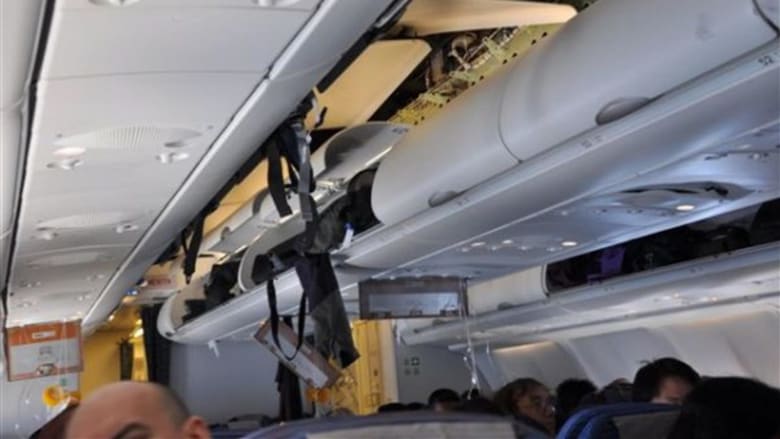
Over 100 people were injured, a dozen seriously when the plane pitched down and the cabin experienced negative 0.8g.

This is what the nose dives did to the cabin
Airbus has a long history of "issues" with the computerized control in their aircraft.  Post incident investigations typically blame the pilots (usually unconvincingly, at least for me) but this incident from 2008 shows that when everything is controlled by (or through) a computer, the computer can kill you.  The report said that one of the flight computers corrupted the avionics data, and the computer wasn't smart enough to realize that the data were whacky.

The way that I would rephrase that is that the software designers don't really understand how the software works, at least not all the time.  They can't say for certain whether the software will kill everyone onboard.

And this is the most sophisticated autopilot software ever built.  What's gone into self-driving cars is primitive by comparison.  There are millions of man-hours of development in the Airbus software, and what it is trying to do is arguably easier than what cars have to deal with - for example, there is no need for the sort of obstacle detection and avoidance that a self-driving car experiences.

RTWT.  I'm nowhere near comfortable entrusting my life to one of these experimental cars.

"Hold mah beer", Talladega edition

This guy set the bar high for a "hold mah beer" moment:
In one of NASCAR’s most bizarre episodes, Darren Crowder, a Birmingham local, found his way into the ceremonial Pontiac Trans Am before the May 1986 race. The car had apparently been left unattended near the front grandstand. Crowder, at the time age 20, pulled onto the famed oval and started turning laps. Since the race was minutes from its scheduled starting time, NASCAR only noticed something amiss when Crowder passed an official who correctly identified him as, uh, not the pace car driver. (The call, via team radio: "Who's that f***** in the pace car?")
Did a whole lap, at 100 mph.


Monday, May 21, 2018

Words in the Wind - A Brigid Guest Post

A young woman walks out to an old rural mailbox and pulls out a couple of letters, standing in the cold as she looks through them, for in her haste, she wears no coat. Her eyes are alight with hope, as she scans the postmarks, almost naked in their pleading.  But there is no letter from him today, no news that he is still safe.  Her eyes grow quiet, two shining gloves in which a world at war lurks in profoundly small scale.  The mailbox shuts and her hope draws itself in, like measured string being rewound into a spool

Thirty later, her children, one at the edge of the field, one away in a straight line about 30 yards away, connected only by two paper cups and a taut piece of kite string. One speaks, the other listens, and hears  "there are 4 of them to our two. But we have the water balloons!" The words are simple but they are personal, shared between brothers in arms, even if one is a sister.

Another thirty years later, miles apart, a simple message  "hi, it's me just landed, I'll call after I get to Dad's, stay strong."
How our methods of communication have changed over the years.  Not long ago, sitting behind me in a Thai restaurant, four 20-somethings in casual business attire, all texting or surfing, the server unacknowledged but for an order made without consulting the menu, not a single word between them as invisible food was consumed with invisible fingers and invisible thoughts.

Just the other day, I sat in the airport reading a classic novel, on paper, no e-reader, while all around me people are texting. Now there are times that a text is better than silence, a quick stop to let someone know you are safe, or that you care, but too often people are doing it at the expense of the actual written word.

What would the books on my shelves, or the one in the hand of the young lady seated across from me be, if simply summed up in text?

Deliverance - tourists XperENs local hospitality

Frankenstein - Science progress big FAIL w genRL public. Ptchforks say STBU.

War of the Worlds - LEgl aliens wnt evrtng 4 frE

Twilight -  join d undead az alternative 2 college

Pride and Prejudice -i longed 4 him i married him crp

Soylent Green - locals hav isUz w regional cuisine

Romeo and Juliet -  Dny thy fathR n refUZ thy name, o if thou wilt nt, b bt swrn my luv, I'll n lngr be a cpult,

The Manhattan Project -sum of aL fears comin 2 a rogue n8tN near U

The Audacity of Hope - DBEYR srsly

Bridge on the River Kwai - brits cn whistle despite stiff uppr lips

The whole way the world interacts, communicates, and connects has changed since our parent's age. In a trunk in Dad's attic I found those letters my Mom wrote my Dad during WWII, carefully tired with still taut ribbon, the handwriting faded, words that traveled thousands of miles to England and back, carried by mailman and ship, to gather dust that gets in his eyes when he talks of her. In those letters she is still with him, still young, more than just a shadow-bound to him with a shadow of ribbon.

Now, we instant message, we Skype, there's Facebook and web-mail and blogs, wherein the means of communication are many and the word "friend" has oft been reduced to an anonymous sign of popularity from total strangers.  ("Hi,  I'm Kim Jong-un, please LIKE me on Facebook!").  Maybe I'm alone in this, but to me, friendship is not something granted to random strangers simply because they wish to claim it, but to those who, through shared experience, through laughter and listening and time, become part of a complex life, on and off a computer.
,
Yet, this mass means of communication has its advantages, we know more of decisions being made that impact us, that threaten our way of life, even if much of it is twisted by the media.  We have to dig, dig hard for the truth, but at least the words flow mostly free, our view of the world, not just one radio show, or one newspaper dictating how we should think. From the lies, we have to glean the truth, but there are still so many avenues to get to the truth that previously were simply withheld.  There's also the sheer learning of it, so many things at our fingertips to explore, to share.

But in a world where we are constantly chirping and texting, too often,  very little is actually being said, reducing human emotions to punctuations as if somehow a smiley could convey the nuance of a heart.  I look at Dad's letters, then, and his letters now, the degradation of the handwriting a sign, painfully clear, that he is declining, soon to leave me.  But his words are still as sharp as his mind, even as his hand sometimes fails him.

He writes of the family and the "steelhead that got away",  words of humor, of inspiration, of compelling faith. Sheets of paper that over 30 years have charted a course for me through adulthood,  abiding strength still radiating from his descriptions of love and loss, the papers having a weight to them of his life. A weight that will keep me anchored.
He first started writing them when I went off college.   I'd read them on a train, for that is how I got back and forth to my home on the occasional weekend, not being able to afford a car and tuition.  As I traveled, I penned my letters back, my fears, my thanks for Dad's support.   How could I have imagined this world today, where such things are expressed in acronyms and emoticons.   How do you explain what it feels to live, to breathe, to fear, to fly, in exchanges briefer than epitaphs, as personal as commands?

All those years ago,  I'd sit in that car and write my trains of thought,  words flowing in sturdy motion and time, their spaces containing the heavy load of pride and longing,  fear and desire. The train barrels forward in steady progressions as moving clouds fly overhead and shafts of sunlight peer through sliding cars, into their depth. As others transmit through satellites and space, I watch the landscape from the viewpoint of the train. Structures of iron lace, the suddenness of buildings, clouds of morning mist all crossing my line of sight, my muscles straining with the curves through fog-shrouded landscapes, moving with the train, thundering through empty fields of past loss into meadows washed with light.

But now, 30 years later, I am writing these words on a computer, miles away from the one I'd most want to read them, the mailman driving past as I sip my coffee, no longer a troubadour for distant lovers, but simply the carrier of pizza coupons, junk mail, and bills. The computer sits in front of me, framed in the window like a stage, the words in my head now, like the beginning of thunder, as loud as a whisper, and as electric.

There are still paper and pen, solitary objects of unspoken promise, of thoughts that flow, but I do not have them here.  I have this, and whether short words or long, I'm speaking my heart.  As my fingers clatter against keys, the words pick up speed, splaying themselves out along the tracks going forward.  I am back on a train, running into the rain as the cars gain speed, waters cleaning the windows on which I look out on life.  I hurl words into the darkness of an upcoming tunnel and wait for their echo.
 - Brigid
Awesome retro Tech Pr0n

This is sweet:
The PiDP-11 is a modern replica of the PDP-11/70. 

Introduced in 1975, the 11/70 was top of the line in the famed PDP-11 range, and the very last system with a proper front panel. Tragically, DEC field service often removed the front panel in a later upgrade, leaving us staring at dull blank panels ever since..
​
The PiDP-11 wants to bring back the experience of PDP-11 Blinkenlights, with its pretty 1970s Magenta/Red color scheme. On a more modest (living room compatible) scale 6:10, with faithfully reproduced case and switches.
Awesome - using a Raspberry Pi to make a PDP 11.


Me, I want a VAX.

Washington Post catches up to Borepatch in 2012

Study: Authoritarian countries overstate their economic growth rates:
"I find that a 10 percent increase in nighttime lights is associated with a 2.4 percent increase in GDP in the most democratic countries and with a 2.9 percent to 3.4 percent increase in GDP in the most authoritarian ones," Martinez said. The most obvious explanation is that those countries are the most likely to fudge their GDP figures to make their political leaders look good.
It's a clever study, using nighttime lighting as observed from space as a proxy for economic activity.  Of course, we've know this for ages:
The most spectacular Intelligence failure of the Cold War was the failure to recognize the impending collapse of the Warsaw Pact in 1989, and the Soviet Union in 1991.  The CIA certainly reported on plenty of problems as the 1980s wound on towards International Socialism's rendezvous with destiny - as highlighted in this self-serving and mostly missing-the-point analysisfrom the CIA on its own reporting.  This analysis is entirely unsatisfactory, because it completely fails to account for how the USSR was ranked third or forth on the list of the largest World economies.

That wasn't just wrong, it was spectacularly wrong, and had enormous policy implications all throughout the 1980s.  All Western policy makers who used the CIA's analysis as the basis for policy found that they were equally (and equally spectacularly) wrong.

So how did the CIA get into this position?  By being very good at collecting data, but not so good at collecting the right data.  As near as we can tell from unclassified reports, the Agency had a decent grasp of the summary economic data as presented to the Central Committee.  The problem was that the data was bogus.

The Soviet economy was regimented, a rigid command and control system where those at the top set the direction and goals, and those in the factories tried to execute to the 5 year plan.  Factory managers who didn't execute to plan had troubles, and so there was a built in incentive to cheat.  Corners were cut, output was trimmed to where the plan was met with sub-standard, shoddy goods.  Or the numbers were simply made up, and the fraudulent data was sent up the chain.

Further massaging was done in mid level bureaus, because nobody wanted to be the guy who brought the bad news.  Essentially, the data deteriorated its way up the chain to the top, and nobody was very interested in double checking to see if the data as reported matched what had originally been collected.  You see, it wasn't in anyone's interest to do so, and it was very much in everyone's interest not to do so.
Sadly, the WaPo hasn't caught up to Borepatch from 2011, which has the really disturbing take on all of this monkey business:
China is building ten (!) brand new cities each year.  However, it's built with borrowed (leveraged) money, and so rents are high - so high that the cities are deserted.  The Great Mall Of China has 1 - that's one - store open.  There are 64 Million empty Chinese apartments.

It's not just city construction: China's much touted (by Thomas Friedman, and even Barack Obama) High Speed Rail network is supposedly an example of a "moon shot" project.  We have to "keep up with the Chinese".  Except the trains are ghost trains:
Here’s the latest from the South China Morning Post on the dismissal of the nation’s Railways Minister and the engineer in charge of the system’s R&D. Seems there were “severe violations of discipline,” which is usually code for corruption. The larger issue with the vast (16,000 kilometers planned by 2020) endeavor is that it isn’t, in fact, so appropriate to China’s needs. Rather, it may be another symptom of a bubble economy in which vast sums are misspent on underutilized assets. 
The high speed trains are wildly expensive, because the (Chinese government owned) rail network had to issue $300 Billion in bonds to build the network.  And so fares are very high, and people take the slower (but much less expensive) old trains.

But that $300 Billion gets added to China's GDP score.
Remember the $Trillion "Stimulus" program that didn't stimulate anything?  Does anyone know what we got for that money?  Can anyone name a single thing that was built with that money?  But a Trillion dollars got added to the GDP figures.

Economic data are mostly untrustworthy.  A little less so in the West, a little more so in other places.  We can speculate on an algorithm to describe this, based on the finding s of the study reported in the WaPo: the more central control over an economy that a state has, the less reliable the economic data will be.

Now think about how much control the Fed.Gov had over the economy in 1960, and how much control it has today.  What does out algorithm suggest for the veracity of the reported economic data?


To ask the question is to answer it.  Or you can check here - there are many ways to game the data, if the state is motivated.

Sunday, May 20, 2018

Clara Schumann - Piano Trio Op. 17

Image from Der Wik
Most composers throughout history have been men.  Clara Schumann's story tells us why.  She was the wife of composer Robert Schumann.

As you would expect from those times, he was better known than she, even though she was a musical prodigy from an young age.  But they had eight children together (only four of whom survived to adulthood), and she was the primary caregiver for them.  Her husband fell ill (perhaps bipolar disorder) and she became the family's primary caregiver, especially after his death in an asylum.

This left little time for composing.  As her husband wrote about her:
Clara has composed a series of small pieces, which show a musical and tender ingenuity such as she has never attained before. But to have children, and a husband who is always living in the realm of imagination, does not go together with composing. She cannot work at it regularly, and I am often disturbed to think how many profound ideas are lost because she cannot work them out.
Nevertheless, she ended producing a fair number of compositions.  You wonder what she might have created had she had a less hectic family life.

Saturday, May 19, 2018

That'll buff out


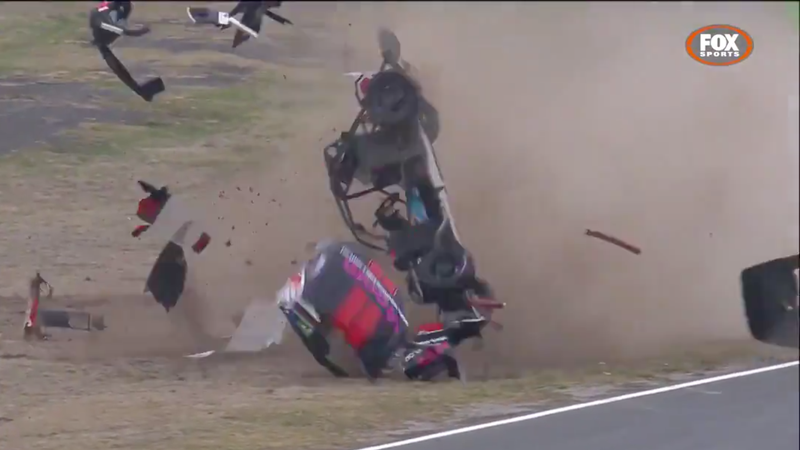
The driver walked away from the crash.  And his team was working overnight to get the car put back together for the next day's race (!).

It's high time for some Common Sense Press Control

The Media is all in for curtailing the our Second Amendment rights.  OK, then - maybe we should look at curtailing their First Amendment rights.

After all, this has a better chance of reducing school shootings than any of the gun control proposals that we've heard.  And their publications are commercial in nature - they make money on talking up the school shootings, which likely encourages more school shootings - which leads to higher ratings and more money for them.  Which is more important: Media profits or children's lives?

After all, we're constantly told that if it saves one kid's life than we should do it, amirite?

Go sign the petition.

Hal Ketchum - Hearts Are Gonna Roll

The 1990s saw a flowering of what is called neo-traditional country music, which quite frankly is perhaps my favorite era for the music.  Hank Ketchum was one of the artists riding this wave.  This song charted at #2 when it was released in 1994, but Ketchum's story is more interesting than just a record of his music.


In 1998 he was diagnosed with a neurological condition of his spine that made the entire left side of his body unusable.  Despite this, he relearned how to play guitar.  Adding to his ailments, he also suffers from multiple sclerosis.  Despite this, he is a master carpenter and toy maker, and also paints.

Four Seasons, by Hal Ketchum


Hearts Are Gonna Roll (Songwriters: Hank Ketchum, Ronny Scaife)
Ever since she was a baby
Settin' on her daddy's knee
Had him wrapped around her finger
Doing anything she pleased 
She had a way of getting what she wanted
But Daddy knew in his mind
The pretty soon the boys would come runnin'
It's just a matter of time before 
Hearts are gonna roll
Heads are gonna turn
Tears are gonna fall
A bridge is gonna burn
Hearts are gonna roll
Now she changes like the weather
Never stays in love too long
She'll take you to the limit
Just to leave you hangin' on 
Drop dead looks and a mind for trouble
That's all the girl's ever known
Leavin' behind a path of destruction
No matter where she goes 
Hearts are gonna roll
Heads are gonna turn
Tears are gonna fall
A bridge is gonna burn
Hearts are gonna roll
Hearts are gonna roll 
Don't fall under the spell of her eyes, boy
She's not looking at you
Take it from somebody who knows
She's movin' right one through

Friday, May 18, 2018

Do Gun Controllers even listen to themselves?

I guess not.


Quote of the Day: Brits and Yanks edition

The Czar of Muscovy ponders a fundamental disconnect between the opposite sides of The Pond:
One of the British princes is getting married to a former American, and thousands of Americans will be glued to the events in rapt fascination; the rest of us won’t remotely understand the appeal of this. Wasn’t despising royalty the whole point of 1776?
Meantime, the United States will feature some gun show which will be attended by a couple hundred British subjects out of thousands of American attendees; the British visitors will love putting their hands on new pistols and rifles, and happily debate the merits of one brand of ammunition over another. The rest of Britain will shake their heads in befuddlement. What’s with the fascination over firearms?
I confess that I do not understand the American fascination with Royalty, but that's just me.  The Queen Of The World, on the other hand, does like the glamor of the Court (although she - and I - finds Miss Markle's anti-Trump rants annoying and un-Royal).

Thursday, May 17, 2018

Researchers discover the obvious

They have discovered a "paradox" where people employed in more physically-demanding occupations don't benefit from the exercise:

But new research claims that those who are in more physically demanding jobs aren’t in a vastly better position. 
Researchers in the Netherlands claim that a ‘physical activity paradox’ exists, where exercise may only be good for you if it’s done outside of your job. 
Manual labourers may be physically active all day but that doesn’t actually help them. In fact, the research claims that it might actually increase their risk of dying early. 
‘While we know leisure-time physical activity is good for you, we found that occupational physical activity has an 18% increased risk of early mortality for men,’ says Pieter Coenen, public health researcher at UV University medical centre in Amsterdam.
Researchers apparently don't know that 8 out of the top 10 riskiest professions involve tough, manual labor.  Actually, maybe they do:
Professor Kay-Tee Khaw, professor of clinical gerontology at the University of Cambridge says: ‘Sedentary work compared to work that requires heavy physical activity is hugely confounded by education, social class and all the other associated behaviours. 
‘It is quite possible that very heavy labour may be associated with adverse health. It may also be that these occupations lead to higher accident rates and early mortality without the physical activity itself being the relevant factor which the authors do discuss and I am sure that we need to understand this better.’
But if you re-ran the numbers taking into account occupational mortality, you might not get a Press Release worthy result, amirite?  Bah.  The one thing that we can conclude from this study is that there is too much public grant money flowing to "Researchers".  As the Researchers might say (in any study they would publish), p < 0.05.


I'm too damned wordy

I mean, I have a whole tag here for "Decline of the Progressive West" with hundreds of posts and this guy goes and sums it up with this.


Wednesday, May 16, 2018

Progressives hate hate hate people in the Third World

We see this all the time.  Here is just the latest, from no less a Progressive Icon as the New York Times:
The number of air-conditioners worldwide is predicted to soar from 1.6 billion units today to 5.6 billion units by midcentury, according to a report issued Tuesday by the International Energy Agency. If left unchecked, by 2050 air-conditioners would use as much electricity as China does for all activities today.
If left unchecked.  Think about those words.  The implication is that all right-thinking Progressives should want to keep Third World, dark skinned people stuck in stifling heat and humidity.  Remember, these are the same people who so earnestly moan about how Global Warming will be so bad for everyone's health.

How about rejoicing that so many of our fellow human beings will be able to enjoy the comforts of a cooler house (and if you read the article, you will notice that stoves and refrigerators also get the tut tut treatment)?

Why shouldn't people want these creature comforts?  Remember, you get children's books from washing machines:


I keep thinking that my contempt for Progressives cannot get any deeper, but they keep coming up with new Bravo Sierra.  Maybe that's the only truly inexhaustible renewable resource.


"American Iron" moving to Thailand

Harley laying off 800 workers and closing Kansas City plant:
Harley-Davidson, the iconic American motorcycle company, is set to lay off hundreds of American workers at its Kansas City, Missouri factory while creating jobs in Thailand. 
After laying off nearly 200 American manufacturing workers last year, as Breitbart Newsreported, Harley-Davidson is expected to fully close its Kansas City manufacturing facility, leaving 800 workers out of work. 
Harley-Davidson executives say about 400 jobs will be sent to the corporation’s York, Pennsylvania manufacturing plant, but union workers allege their jobs are being sent overseas to Thailand.
Harley is not doing particularly well.  They have (so far) failed to attract younger riders, I expect because there are high quality alternatives at a much lower cost.  You're looking at $30k for a touring bike, and this is simply beyond the means of lots of younger riders.

And so cost cutting becomes imperative.  But it's sad to see such an iconic American brand struggle like this.

(via)

UPDATE 15 May 2018 20:55: Glen Filthie has some thoughts on Harleys and riders, and what riding is really about.  Recommended.

Tuesday, May 15, 2018

Suck it up, Buttercup


May is Motorcycle Safety Awareness Month


Good safety tips.

Germany's military may be weakest in Europe

Only 4 out of 128 Eurofighter Typhoons are combat ready.  And the rest of the military is even worse off:
Cost-cutting procurement strategies have caused problems elsewhere over the past year for the Bundeswehr:
  • The German Navy has had to refuse delivery of the first of its new class of frigates after the ship failed sea trials, and only five of the Navy's existing 13 frigates were capable of being deployed.
  • The last available German submarine was pulled out of service for repairs, as all the other submarines in the fleet sit in drydock or sit idle due to lack of replacement parts. (One of those submarines may now be back in service.)
  • The German Army was found to lack enough tanks and armored personnel carriers, or even enough basic equipment for soldiers, to fulfill its commitment to NATO's Very High Readiness Task Force at the beginning of 2019. While 105 out of 244 Leopard 2 tanks were called "ready for use," only nine could be fully armed for the VHRF.
  • Only 12 of 62 Tiger attack helicopters and 16 of Germany's 72 CH-53 cargo helicopters were available for exercises and operations last year; the rest were grounded for maintenance.
  • At any time over the last year, only three of the Bundeswehr Airbus A400M transport aircraft were ready to fly.
But never fear, the Bundeswehr remains confident:
And as Der Spiegel's Matthias Gebauer was told by a Bundeswehr source, "We can say with a good conscience that large parts of the [German armed forces] are mission ready, because there is currently no mission."
Can someone please help me understand why we still pay cash money to protect Europe?


Just how hard is it to communicate without NSA listening in?

I touched on this five years ago, and the answer then was "it's really hard but maybe possible if you're very, very careful".  In the last five years there have been a number of new tools introduced that may make this easier.  Perhaps more importantly, there is a growing tradecraft among leakers and the media that provides some useful techniques.

Robert Graham has a quite interesting article that touches on tools, techniques, and operational security that is worth your time. There's quite a lot of technology that can betray people who don't know how it works:
Photographs suffer the same problem: your camera and phone tag the photographs with GPS coordinates and time the photograph was taken, as well as information about the camera. This accidentally exposed John McAfee's hiding location when Vice took pictures of him a few years ago. Some people leak by taking pictures of the screen -- use a camera without GPS for this (meaning, a really old camera you bought from a pawnshop).
But the discussion on burner phones, tails, and open WiFi is interesting and useful.  It's still hard to hide your transmissions from prying eyes, but it may be a bit easier than it used to be.


Monday, May 14, 2018

Peter Grant's new book is out!

Peter Grant (aka Bayourenaissanceman) has his latest book out.  Get on over there.


Sunday, May 13, 2018

Homecomings - a B. Guest Post

For Mother's Day, a Chapter from Saving Grace - A Story of Adoption.  Saving Grace didn't get the literary fanfare that The Book of Barkley and Small Town Roads did (both won major literary awards) but  Dad was undergoing major surgery at the time and marketing was NOT my priority.  But it went on to be a #1 bestseller in 4 countries and was on Amazon outselling "I Know Why the Caged Bird Sings" by Maya Angelou which is just incredulous to me as that was an amazing literary piece.  I think the themes of animal and people adoption are universal.  I especially enjoyed writing it as I got to share more stories of my family, including my Dad and Mom, as well as work through, with words, the death of my beloved brother.  They are both very much missed today.

Chapter 3 - Homecomings

Thinking of my brother comes naturally whenever I’m driving. Because the story of Allen and me began with a car ride, the first with our mom and dad.

Mom and Dad grew up in Montana, playing together as children, marrying as soon as Dad got home from serving in the 8th Air Force, stationed in Great Britain. The only reminders of that relationship I have left are letters and pictures, carefully packed in a trunk that lay in the attic until my brother and I liberated it.

There are so many photos of an 8th Air Force Liberator flying among flak as thick as snowflakes, soaring desolate above land whorled with unrest, the craft solitary above the destruction that it would rain. There underneath the photos lies a stack of letters. Mom and Dad wrote to one another for four years while he was overseas, not returning Stateside once during that entire time. Reading them feels a little like eavesdropping, as you can almost hear the words as they formed---heartfelt, intimate. I opened one; it was just one single page, and I thought of the way their day stopped at the brink of it.

In these letters bridging the time and distance they had to be apart, there was talk of how much they missed one another; of how their families were faring; of good coffee and how Dad missed vegetables from the farm; of burning heat and a cold on the field that would murmur to your very bones. There was playful affection, there was unstated passion and stated promise. Some was in Mom's flowery script, the rest in Dad's meticulous, indomitable hand. "Is everyone there well?" Mom would ask, and Dad would reply that they were (though some were now only well beyond Lamentations). "How is the homestead?” Dad would ask, and Mom would reply, "Fine," not telling him that they were occasionally going hungry.

They spoke of the future, of their past. They did not speak of the aircraft that limped back to England only to crash on approach, their violent end felt through the ground like a vibration rather than heard. They did not speak of her working two jobs after her dad's death while logging, to support two younger brothers and her mom. So much spoken and unspoken, like two mourning doves calling back and forth across an endless summer---all now just held together by a blue silk ribbon.
Not all missives that went back and forth over the seas were good news. Just up the road from Mom's, the week after Pearl Harbor a neighbor stood by the mailbox with a piece of paper not even big enough to start a fire with, the envelope fallen to the ground as bland words exploded one by one and that family’s grieving began. There was only the notice, there was nothing to bury---though you don't need a wooden box to capture the form of courage and sacrifice.

I wonder how many millions of messages like that went out in old wars, not taking long to read, as there was no real time in it; not in that demarcation between the hope that someone lived, and that place where you knew that was no longer true,  when you wished that this moment existed only outside of time. There were only moments in which a written word hung in the air as if hopeful silence had been so long undisturbed that it had forgotten its purpose.

I look again at those letters Dad kept. The actual forming of the characters is uniform, flowing, like words pent up too long. The letters are sixty-some years old, powdery and delicate in my hand. But sixty years were just a moment ago for my dad, something as fierce and encompassing as war always standing out in his memory, no matter how many years distanced him from battle.

So he returned to her, they married, and my mom immediately became pregnant, only to go into labor many weeks too early. Their daughter lived only days, while Mom battled an infection that would leave her barren.

They were together, their dream for years. But although it was an abundant life---Mom working as a Deputy Sheriff, Dad getting his CPA license and finding a job with one of the big timber mills---their home was missing the sound of children.

So the long, sometimes painfully long process of adoption was begun. When it didn't happen immediately, they applied to be foster parents---however, they could get a child in their home, just to hear a child's laughter. I don't have all the details, but Allen and I came into their lives when we were very young.

Mom and Dad had intended on getting just one child, but having completed the paperwork, when they heard there were two of us there was no real discussion, only logistics. For they only had a child seat for one, for the three-hour drive home. My brother Allen, being the oldest, got the seat. They put me in a box.

Well, it was a large box, carefully padded with coats and a pillow, and lashed in tight to the back of the seat with a seat belt.
Still, years later I can hear my brother lean over with a grin on the re-telling of that story with "They liked me better!" and how we would laugh.

We came home to a post-war subdivision, houses popping up starting in the late ‘40s, with new streets like ours hubbing off them in the 1960's as the town prospered and people expanded their families in a time of peace and abundance.

Dad still lives there all these years later. Going home now to visit him as an adult I'm surprised how quiet it is outside; the kids all inside the local school, neighborhood moms, and dads both working much of the time these days. Off in the distance, the wail of a police siren. The ground is hard and knotted, the houses stare silently forward, not acknowledging anything that exists in their peripheral vision. The morning light falls down upon their steps in silence. That lack of sound does not seem odd, it is simply winter.

Dad slumbering in the back room, tiring easily at age 94, I sit in the chair by the picture window and look out at the same homes I saw as a child; and I think back to those glory days when Mom and Dad brought us home, how this whole neighborhood came alive. Mom's been gone many years; Dad outlived both her and my stepmom in this house. And although the family dynamic is different, the sounds of this home remain.

Especially during summer, the neighborhood took on another depth of sound. There was the bright, disorderly cry of lawnmowers firing up; the small tidy yards of an older neighborhood not taking all day to mow, but the precision of their care reflecting the owners’ pride in their homes. There were no homeowners association rules. One neighbor's bright purple door stood out at attention, but with the colorful flowers that normally adorned the front and the deep rosy hue of the brick, the color suited the house. There were a couple of kids on bikes, zooming up and down the sidewalks as off in the distance their dog barked for their return. Far away from the sound of church bells, there in the month of white lace and showers of rice, paced faithfully and serenely; like shafts of light among the soft green leaves, yellow butterflies dancing on the grass like flecks of the sun.

The sounds would continue into the evening: a summer shower off the lake releasing the scent of flowers into the damp air; crickets sawing away in the grass with an intensity you could almost feel as a tickle on the skin. There was the wave of a neighbor as he brought in the paper; the clink of a couple of glasses of Kool-Aid, sweet like nectar on the porch.

There was no formal neighborhood watch here, but we did look out for one another. Our parents noticed when the newspapers piled up at someone’s house and would check to make sure they were OK.  They paid attention to a strange car parked on the street, a teenage boy just stopping to visit with the pretty teenage girl down the road.

They would know who had a new child by the toys that sprouted in the yard like colorful flowers. Our moms would trade recipes and gossip over a fence, finding out who had been ill, who might need help with a new baby. For this wasn't just a neighborhood, this was a community---neighbor helping neighbor, the kids welcome at pretty much any home, stopping in on someone's mom if we needed a drink or the use of the bathroom.
Now, a lifetime later, the houses are the same but the neighborhood is not. I note the silent homes, a sign gone up for a quick sale, the owner has passed away; time-consuming not just courage but muscle and bone until nothing is left but a frail form draped in a white sheet, like a piece of furniture unused. We don't notice the exact time of leaving but can't help but speak of the remains. I note one house in disrepair, empty, likely a foreclosure; the factory's shutting down taking with it not just jobs but a lot of hope.

Ours was a good house to come home to, though; a place of refuge for two lost little birds.

As I sit in the quiet, a small sparrow blows onto the sill like a bright scrap of paper, his heart pumping in his throat faster than any pulse. He looks into the house, then away, then into the glass again as if listening, only to dart away as the clock chimes on the hour, then ceases. The chime fills the whole house. Perhaps it's just sound---or perhaps it's all time, grievance, and grief manifesting as sound for just one instant as planets and gears align. It's a moment wherein time seems to stop, the sparrow frozen on the sill. Only when that sound stops does time come to life, and by then the bird is gone.

The only sound now is that of breath and the tick of the old clock. I don't deliberately listen to it, the ticks seemingly beyond the realm of hearing; then in a moment, with that one tick your ears respond to, you are acutely aware of the long diminishing train of time you did not hear. How many ticks in this house in 50 years? How many after I am long gone? Yet I feel the presence of others that have lived here, for they perhaps aren't truly dead but simply were worn down by the minute clicking of small gears. The echo of those who sat in this room do not disturb me; they are part of this house. Just like the sound of wood, its creak one of murmuring bones; and the air that taps on ancient glass speaks of deep winds that witnessed more than time.
Dad resting quietly, I take a quick walk before making his dinner, after which we will call Allen to catch up before seeing him on the weekend. As the neighborhood ticks a slow and steady beat outside, there comes the rumbling of the trains, the tracks a half mile away carrying a sound on the air that is as comforting as childhood. I watch the movement that is static serenity and labored exhaust, a rhythmic click-click as it moves away through eternal trees, faded to thick sky, the train displacing air.

Shadows lengthening, I hurry back to the house. The tick of my watch and the sound of the train dissolve away as if running through another place, someplace far from where this life ended up. I approach the house I grew up in, the porch glistening with a sheen of ice, its empty lattice the front guard of circumstance waiting for summer flowerings.
I think of the inordinate ticks of chance it took to bring my brother and me to this home, through which we were so blessed to be here. In the air scented with trees, I ascend the steps, clutching the old key to the back door, there on a little ring with a train etched on it. In the growing dark, I don't really see it, but I feel it in my hand, clutching that little anchor to a life lived here long ago---a life unexpected but as welcoming as home. 

The house sighs as I open the door. I catch a glimpse of myself in the mirror, moving away from its reflection into the warmth, my form darting out of sight; the sound, tick-tock-tick-tock, a wisp of air that breathes life back into this home. - LB Johnson

Beverly Sills, La Traviata, and Mom

Saturday always meant the Texaco Metropolitan Radio Network on Saturdays.  No matter what she was doing, Mom would always tune in and listen while she was doing whatever was on her to do list. In the 1970s, this meant that Beverly Sills was heard around the house rather a lot.


And for good reason.  She was one of the great sopranos of the time.  She was also very popular beyond opera circles, no doubt due to her irrepressible personality (she was often referred to by her nickname, "Bubbles").  Here she is on the Muppet Show singing "Pigoletto".  I remember Mom particularly enjoying this episode.


It was a time when a much broader segment of the population would follow art.  When Sills retired from the Met in 1980, Carol Burnett sang a duet with Bubbles.  Of course it was televised.


It was a different world.  But Mom loved all this music.  Happy Mother's Day to all Moms out there.

Saturday, May 12, 2018

Friday, May 11, 2018

Happy 100th Birthday, Richard Feynman

Odd that Google didn't go a thingie for the day.  But not everyone forgot.

He was one of the physicists on the Manhattan Project, and in fact roommates with Spy and traitor Klaus Fuchs there.  Many people have heard of his safe cracking there, but he also liked to tweak the guards - to the point that he got arrested:


He also played bongos.  He was pretty good, actually:


But he saw through bureaucracies, which is why he was the only one that didn't get the wool pulled over his eyes on the Challenger Commission.  I'd love to have his opinion on Climate Science, but sort of think that I do:

Thursday, May 10, 2018

The Pan Am Clipper that flew around the world after Pearl Harbor

This is one heck of a flying story:
LAGUARDIA TOWER LAGUARDIA TOWER. THIS IS PAN AMERICAN CLIPPER NC18602 INBOUND FROM AUCKLAND NEW ZEALAND. DUE TO ARRIVE PAN AMERICAN MARINE TERMINAL LAGUARDIA IN SEVEN MINUTES. OVER.
It left San Francisco on 1 December 1941 bound for Auckland, NZ.  They were two days out from Hawaii when they heard of the Japanese attack, and the Pacific route back from New Zealand was closed.  Instead, they flew across Australia, Java,  Ceylon, Africa, Brazil and up to New York the "long way around".

Along the way they pushed the airframe far beyond what it was designed for.  The crew adapted to the problems, they avoided being shot down over Java or crashing on takeoff from the Nile.  Giants strode the Earth in those days.


Wednesday, May 9, 2018

How's all that UK Gun Control working out?

But I thought it was just us Cowboy Yanks that had a problem:
SCOTLAND Yard has sent out extra patrols in London after a blood-soaked Bank Holiday weekend in which a teenager was shot dead and boys aged 13 and 15 survived being blasted with a shotgun. 
Two more men were shot or stabbed and three were doused in acid as the capital's shocking violence claimed yet more victims.
London is turning into Chicago.  But Moms Demand Relevancy in no doubt relieved that more than half the casualties were stabbings and acid.

At least their top cop is honest:  'We are doing all we can to address this.'  Translation: when seconds count, the police are minutes away.

The Gun Control movement has blood on its hands.

The Uber self-driving car software decided to kill Elaine Herzberg

This is an ugly example of why I've been posting about the dangers of self-driving cars for so long:
The fatal crash that killed pedestrian Elaine Herzberg in Tempe, Arizona, in March occurred because of a software bug in Uber's self-driving car technology, The Information's Amir Efrati reported on Monday. According to two anonymous sources who talked to Efrati, Uber's sensors did, in fact, detect Herzberg as she crossed the street with her bicycle. Unfortunately, the software classified her as a "false positive" and decided it didn't need to stop for her.
A "False Positive" is when something is incorrectly classified.  A medical example is where your doctor tells you that you have cancer when you actually don't.  False positives are a huge problem in software engineering - anyone who has ever had your antivirus block something by mistake has direct experience with this.  Software that has too many False Positives is unusable.  Needless to say, software developers put a huge amount of effort into reducing False Positives.  The Ars Technical article describes this tradeoff pretty well:
Software designers face a basic tradeoff here. If the software is programmed to be too cautious, the ride will be slow and jerky, as the car constantly slows down for objects that pose no threat to the car or aren't there at all. Tuning the software in the opposite direction will produce a smooth ride most of the time—but at the risk that the software will occasionally ignore a real object. According to Efrati, that's what happened in Tempe in March—and unfortunately the "real object" was a human being.
That seems to be what happened here.  The Uber software developers put in a bunch of code that analyzed potential obstacles that have been identified, to see if the item is likely to be a False Positive.  It decided that Elaine Herzberg was a False Positive and ran her over.

There are certainly more situations like this hiding in the software algorithms.  Uber can no doubt improve this particular failure, but this is probably going to be an ad-hoc patch to their decision algorithm that won't address other similar situations.  We can't know how many of these patches to the decision tree will be possible before it collapses under its own weight.  Patching an algorithm can introduce new bugs and so it's not clear when the system will be safe enough to use.  If ever.


Spell checkers fix spelling mistakes, but introduce other ones - there's a whole Internet meme about unfortunate autocorrect mistakes.

And this discussion entirely ignores the problem of False Negatives, where the software simply misses something.  This is like the doctor saying that you don't have cancer when you actually do, or a self-driving car not understanding that a toddler is an obstacle.

Get ready for more situations like this one.  Nobody really understands how the software works, including the developers.

Still Life and Quantum Mechanics - A Brigid Guest Post


It was once said in an age-old axiom, that an object cannot occupy two positions at the same time. Yet now, with today's technology, it may be argued that it is just possible to do that. The number of places science can go is far greater than I ever believed, even growing up reading Clarke and Asimov at every turn. Most physicists today trying to unite Einstein’s theory of gravity with quantum mechanics focus on microscopic realms beyond the reach of any conceivable experiment. Perhaps the solution that eluded Einstein is much closer at hand, in the strange territory where quantum mechanics just barely emerges into the human world. And we could be in two places at once. Or occupying the same position at two different times. Or fervently wishing we could

You've all had days like that when simple things went awry, plans made that mattered little to you, mattered much to others, things said, bridges burned, moments that repeated themselves for weeks or months in your head. If only I'd done this, if only I'd said that. Moments in which you wish you could turn back on itself as if you've never been there. Moments that repeat themselves in your memory, minute by minute, wrong place, wrong time.

Things happen when it is time for them to happen they say, and those moments like this long ago likely were meant to be. Perhaps today is, as well. It's a sentimental notion, wishful thinking, or to some, a projection of some great plan by some divine power. But where would we be without wishful thinking? How much hard-bitten logic is there in the world? Would an electron have split with simply cold hard logic, and not a bit of wishful thinking by minds whose conceptions are beyond logic. How much hard reasoning is there really? Maybe somewhere out there in the world, there is a place where reason is never as comfortable as a familiar sweater, where thought is as flat as a glass of stale ale left forgotten on the counter when the phone rang.

There are people happy to live that way, who lie in quiet acceptance of what is thrust upon them. People who numb the reaches of their mind in the same way someone with chronic pain eases their movements with pharmaceuticals. That person thinks there could be more, that possibilities exist, but there is too much effort involved in the motivation to take them there. It would mean giving up what is safe, getting up, moving forward, and who knows if the outcome would be the best thing they ever experienced, or simply shed more light on a world they would prefer stay comfortably dim. Best to stay still, quiet, and in the dark, they say.

Certainly, such a place is safer; where no smudge of desire affects debate, prediction is not contaminated by untried theory and actions aren't clouded by concealed agendas. Still, it is a world flat and colorless as tap water. A world I don't want to live in.

I still have moments where the lone tear for things past come unbidden, yet in each day in me is an increased curiosity for the world around me and what I can take from it, even if reaching for it sometimes causes me to teeter on the edge of a precipice in which only my fate echoes. D.H. Lawrence wrote that in every year we pass an anniversary unaware. That of our own death.

I regularly visited that place. Authors such as Laurence Gonzales write about it in Deep Survival. Where we, as adventurers of the world, circle and circle, climbing faster and higher, up to that spot marked X. That spot that will mark their own demise, flirting with it, teasing, poking the bear. I've seen it enough to recognize and know when I need to stay, and when it's time to leave.

You can do the same in an ordinary life, you can fall off a ladder and break your neck on a lunch break, but we do that blindly. In a life fully lived we engage our fate deliberately, we speak the words we may later regret, but we have to say them. We engage life as an indefatigable opponent that others will wish to tiptoe by, so not to awaken it. We risk our necks, and we risk our hearts, both, cajoled by the spirit of adventure that whispers to us from the dark like a lover, with honeyed voice and strong arms that draw us out of our complacent sleep.

I look at the photos around me on the mantel. Behind a dogsled in Alaska, perched on the side of Mt. Rainer or Mt. Hood with friends, in the pilot's seat of a T-6, face flush from doing aerobatics, in one frame, a leaf plucked from the upper levels of an alpine slope. There's a photo of my only brother and my beloved dog Barkley, there before that month that took them both from me to sudden aggressive cancers. I look at pictures of the last 15 years, time spent alone, graduating from the academy, giving a lecture at a university, a dinner party for friends, Mexican train dominoes and much laughter and beer.   I look at more recent pictures, of paths taken, not always straight, but as pristine and intact as the road to glory itself. I look at other frames, vacated or new, awaiting new photos, noting those places to be filled by a heart that is. I am still an adventurer, I'm just an older, wiser explorer of the world, whose limbs and heart though tested still yearn for that last great adventure

I am two women, at the same place, at the same time. The woman here at the apex of life, and the young woman in the photos seeking untarnished dreams. Two women; the one that I have was, and the one that I am. That woman today,  green eyes wise with age, will hopefully look at pictures from the past,  remembering the woman that I brought me here to this day, hopefully, wiser than the young woman I was, but retaining all of the dreams.

For although many years of life have passed, here still lies ahead miles of water to drift down, if only in my dreams, endless chasms of sky to cross; horizons that will tilt and change, fueled by dreams that I will take on until I can no longer draw breath. Dreams that bring with them moments in which I feel the rush of air and catch the scent of warm breath on my face, entering into that other plane of being in which I see my whole life ahead of me, death still beyond it. Moments in which, in the rush of emotion, I am outside of my body. Outside, yet in, looking away, looking beyond, in a rush or pleasure so intense that I know, that even with that risk, I will chase that moment again. I am in two places, within my heart and outside of it, tasting, seeking, reaching up to touch that last crimp with the tips of my fingers, to climb past that X into the light.

I will never fully understand the science that can transport matter or the circumstances of quantum mechanics that allows for wonders that we can't conceive of. But I can grasp the wonder of my world, in a volcanic rock formed in the earth that holds in place letters from those long gone. In a dog collar laying in revered silence on a small wooden box. In a pressed leaf in a photo frame; a leaf once green, nature's compromise between life and poison, a pragmatic conformation to circumstance, retaining beauty even as it fades to dust.