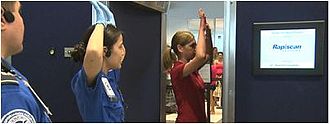
Three Transportation Security Administration agents who work at Miami International Airport were arrested on fraud charges.
According to investigators, Elizabeth Fuster, Josue Gonzalez and Labarrius Williams worked together to steal cash from passengers’ purses and bags while they were being screened at the airport, June 29.
The agents were removed after a TSA employee followed up on a complaint, watched surveillance video and shared findings with the police, who took immediate action and placed them under arrest on Thursday.
But remember, only government agents can be trusted with firearms.
Security guru Bruce Schneier has been saying for years that TSA is a total waste of money (c.f. the 90+% failure to detect phony bombs during testing), and that if he were put in charge of it he would give all the budget back to the treasury.
A reporter once asked security guru Bruce Schneier what he would do to make the TSA more effective. Schneier replied that if he had the agency's budget, he'd give it back. He added that only two things have improved airline safety after 9/11: strong cockpit doors and the passenger's realization that they have to fight to live. And yet airport security is worse now than it was then.
It seems that if you're willing to do a fair amount of leg work, this sort of silliness actually gets cleared up. So well done to Mr. Brown, and I guess to the TSA for making the skies safe for cuteness.
Mr. Brown makes a good point, that there's nothing to tell you that you're on the list, and need to grovel your way through the TSA's unhelpful web site to find the required form. You could plausibly claim that this is a security feature - if the special someone on the list actually were a terrorist, you wouldn't want to let them know.
Which ignores the issue that it's idiotic to have someone so dangerous that they shouldn't be allowed to fly, but not dangerous enough to arrest. That's a discussion for another day. Today, the issue is false positives, the erroneous report that someone or something matches a particular categorization, when they actually don't.
This is why you get a second opinion when your doctor tells you that you have a serious disease. Any diagnosis will be less than 100% accurate, and you don't want to go on an expensive and invasive regime if you're one of the 2% that don't actually have the disease.
An anonymous commenter left this, over in Brown's comments:
They efficiently shifted the cost of false positives to you.
If we really thought these folks were actually terrorists, we'd investigate them. A reasonable investigation involves a lot of effort - wire taps (first, get a warrant), stakeouts, careful collection of a case by Law Enforcement, prosecution. Probably a million dollars between police, lawyers, courts, etc - probably a lot more, if there's a trial. For each of the 700 [people in our thought experiment]. We're looking at a billion dollars, and this assumes a ridiculously low false positive rate.
There are on the order of a hundred thousand people in TSA's no-fly or watch databases. Not 700. If you investigated them all, you're talking a hundred billionbucks. So they turn the system off.
And that's actually the right answer. The data's lousy, joining lousy data with more lousy data makes the results lousier, and it's too expensive to make it work. How lousy is the data? Sky Marshals are on the No-Fly list. No, really. 5 year olds, too.
Actually, they haven't turned the system off. Rather, they've shifted the cost of the investigation to Mr. Brown and people like him.
From the TSA's perspective, this makes sense. From our perspective, it's annoying. It's double-plus annoying when there's nothing that tells you that you're likely a false positive in their system. There is, of course, a sure-fire way to reduce your chance of triggering a false positive in the TSA's system to zero. Guaranteed to work every time.
In “TSA: Taxes Spent Absurdly”, Becky Akers asks “How do you turn an industry that costs $700 million annually into one that eats $6 billion?” The answer turns out to be “Nationalize it, as Congress did airport screening after Sept. 11, 2001.” She goes on to note that “The TSA’s nearly 50,000 screeners have delayed, frustrated and harassed passengers at airport checkpoints from Maine to Hawaii. What they haven’t done after eight years and $48 billion is catch a single terrorist.”
Akers is certainly understating the cost of aviation security imposed after 9/11. At our little airport there is a state trooper employed to fingerprint student pilots. An average Massachusetts State Trooper, including pension, is paid over $200,000 per year. A couple of airport employees help with background checks, security education, and issuing badges. Until a student or renter gets a badge, which takes at least four weeks, the customer must be escorted by a flight school employee at a cost of perhaps $25 per hour. The customer who does a thorough pre-flight inspection of an airplane may take all of the profit out of the rental.
It all reminds me of this:
After World War I, the French were understandably nervous about a rematch. They built a hideously expensive set of fortifications from the Swiss border all the way to Belgium. Called the "Maginot Line", it was state-of-the-art for Trench Warfare. Unfortunately, les Boscheweren't interested in Trench Warfare, and France fell in 6 weeks as the Blitzkreig bypassed it.
The TSA spends truckloads of cash at every airport in the land - including, as Professor Greenspun points out, small, commercial ones. This is what they do. Their product is slowing passengers down. High-visibility security kabuki. Of course they haven't caught any terrorists. The terrorists are targeting other targets.
There are two things that have improved air safety since 9/11: real locks on the cockpit doors, and passengers who know they have to fight back. Nothing else has made any difference (with the possible exception of Air Marshalls, but they haven't stopped anyone so far). You may not have noticed, but baggage screening still isn't what it should be, and that problem would be solved if the TSA weren't allocating all their resources elsewhere.
Sort of like the French building forts instead of armored divisions.
None of this poor prioritization should come as a surprise. In other news, we hear that the California government is introducing new TV energy standards:
Energy regulators on Friday moved forward with a plan that could ban the sale of the most power-hungry televisions from California retail stores.The California Energy Commission released what it hopes will be the nation's first energy-efficiency requirements for the flat-screen TVs. A final vote on the regulation is expected in November.
What's wrong with this picture? California is broke. But they still have enough money to issue new regulations that will make things more expensive. And this isn't the first time.
My budget at work periodically gets cut, as business gets better or worse. These cuts force me to prioritize. If you're clever, you can do anything - you just can't do everything. Cut government 10% across the board, and you'd make a good down payment on health care, you know? Plus you'd do 10% less damage to the economy, with higher employment and tax levels that result.
It seems that if you're willing to do a fair amount of leg work, this sort of silliness actually gets cleared up. So well done to Mr. Brown, and I guess to the TSA for making the skies safe for cuteness.
Mr. Brown makes a good point, that there's nothing to tell you that you're on the list, and need to grovel your way through the TSA's unhelpful web site to find the required form. You could plausibly claim that this is a security feature - if the special someone on the list actually were a terrorist, you wouldn't want to let them know.
Which ignores the issue that it's idiotic to have someone so dangerous that they shouldn't be allowed to fly, but not dangerous enough to arrest. That's a discussion for another day. Today, the issue is false positives, the erroneous report that someone or something matches a particular categorization, when they actually don't.
This is why you get a second opinion when your doctor tells you that you have a serious disease. Any diagnosis will be less than 100% accurate, and you don't want to go on an expensive and invasive regime if you're one of the 2% that don't actually have the disease.
An anonymous commenter left this, over in Brown's comments:
They efficiently shifted the cost of false positives to you.
If we really thought these folks were actually terrorists, we'd investigate them. A reasonable investigation involves a lot of effort - wire taps (first, get a warrant), stakeouts, careful collection of a case by Law Enforcement, prosecution. Probably a million dollars between police, lawyers, courts, etc - probably a lot more, if there's a trial. For each of the 700 [people in our thought experiment]. We're looking at a billion dollars, and this assumes a ridiculously low false positive rate.
There are on the order of a hundred thousand people in TSA's no-fly or watch databases. Not 700. If you investigated them all, you're talking a hundred billionbucks. So they turn the system off.
And that's actually the right answer. The data's lousy, joining lousy data with more lousy data makes the results lousier, and it's too expensive to make it work. How lousy is the data? Sky Marshals are on the No-Fly list. No, really. 5 year olds, too.
Actually, they haven't turned the system off. Rather, they've shifted the cost of the investigation to Mr. Brown and people like him.
From the TSA's perspective, this makes sense. From our perspective, it's annoying. It's double-plus annoying when there's nothing that tells you that you're likely a false positive in their system. There is, of course, a sure-fire way to reduce your chance of triggering a false positive in the TSA's system to zero. Guaranteed to work every time.
Politics aside, it cannot possibly work - technically speaking. At least not "work" to keep guns out of the hands of terrorists. This post from nearly eight (!) years ago explains why.
And an added note: the Democrats aren't pushing the No-Fly list for gun bans. There are around 70,000 people on that list (including, at one time, the late Senator Edward Kennedy). Instead, they're pushing the Terrorism Watch List, which has on the order of a million people on the list. The number of people on there for no good reason (or for no reason at all) is certainly astronomical.
And so, to the motivations in play. Eric Raymond explained what was up a couple years back: Destroying the Middle Ground. The system and politics are corrupt, and the Agencies tasked with implementing the law will do so corruptly.
One of the biggest problems in Internet Security is getting the "False Positive" rate down to a manageable level. A False Positive is an event where your security device reports an attack, where there's no actual attack happening. It's the Boy Who Cried Wolf problem, and if it's too high, people turn the security off.
Apple had a hilarious ad that spoofed Vista's UAC security a while back. The security is so good that the whole system is unusable:
Surprise! Seems that identifying terrorists by mining a bunch of databases isn't any better:
A report scheduled to be released on Tuesday by the National Research Council, which has been years in the making, concludes that automated identification of terrorists through data mining or any other mechanism 'is neither feasible as an objective nor desirable as a goal of technology development efforts.' Inevitable false positives will result in 'ordinary, law-abiding citizens and businesses' being incorrectly flagged as suspects. The whopping 352-page report, called 'Protecting Individual Privacy in the Struggle Against Terrorists,' amounts to [be] at least a partial repudiation of the Defense Department's controversial data-mining program called Total Information Awareness, which was limited by Congress in 2003.
The problem is not so much one of technology, as it is of cost. Suppose you could create system where the data mining results gave you only one chance in a million at false positive. In other words, for every person identified as a potential terrorist, you were 99.9999% likely to be correct. This is almost certainly 3 or 4 orders of magnitude overly optimistic (the actual chances are likely no better than 1 in a thousand, and may well be much less), but let's ignore that.
There are roughly 700 Million air passengers in the US each year. One chance in a million means the system would report 700 likely terrorists (remember, this thought experiment assumes a ridiculously low false positive rate). The question, now, is what do you do with these 700 people?
Right now, we don't do anything, other than not let them fly. If they're Senator Kennedy, they make a fuss at budget time, and someone takes them off the list; otherwise, we don't do anything. So all this fuss, and nothing really happens? How come?
Cost. If we really thought these folks were actually terrorists, we'd investigate them. A reasonable investigation involves a lot of effort - wire taps (first, get a warrant), stakeouts, careful collection of a case by Law Enforcement, prosecution. Probably a million dollars between police, lawyers, courts, etc - probably a lot more, if there's a trial. For each of the 700. We're looking at a billion dollars, and this assumes a ridiculously low false positive rate.
There are on the order of a hundred thousand people in TSA's no-fly or watch databases. Not 700. If you investigated them all, you're talking a hundred billion bucks. So they turn the system off.
And that's actually the right answer. The data's lousy, joining lousy data with more lousy data makes the results lousier, and it's too expensive to make it work. How lousy is the data? Sky Marshals are on the No-Fly list. No, really. 5 year olds, too.
So the Fed.Gov sweeps it under the rug, thanks everyone involved for all their hard work, and pushes the "off" button.
As expected, the Slashdot comments are all over this:
I'd take their "no fly" list and identify every single person on it who was a legitimate threat and either have them under 24 hour surveillance or arrested.
The mere concept of a list of names of people who are too "dangerous" to let fly... but not dangerous enough to track... that just [censored - ed] stupid.
At least everyone's looking busy. The analogies to gun control pretty much write themselves.
I got the closest parking place to the terminal that I think I've ever had. Then a massive delay at security theater. And Southwest Business Select didn't get me TSA Pre. Bah.
Air travelers who don’t have firearms in their checked luggage
probably use a special Transportation Security Administration (TSA)
approved lock. What is a TSA approved lock? I’ll let the TSA’s very own Blogger Bob explain:
TSA has worked with several companies to develop locks
that can be opened by security officers using universal “master” keys so
that the locks may not have to be cut. These locks are available at
most airports and many travel stores nationwide. The packaging on the
locks indicates whether they can be opened by TSA.
In other words TSA approved locks are locks with an included backdoor
that can be used by TSA officers to access your luggage. I will take a
moment to note that the use of TSA approved locks is not lawful when firearms are in your checked luggage so those of us who do fly with them do not, and legally can not, use TSA approved locks.
Guess what happened with the TSA's backdoor key?
Golly gosh, let's all remember to thank the Republicans for this smoking crater of a failed Agency. And let's make sure to vote for some more Republicans so we can get even more!
Did you ever think you would see the day when the GOP front-runner
rarely uttered the words “freedom” and “liberty”?
Perhaps some Republicans can be accused of loving liberty and freedom
too much — or at least using those words as rhetorical crutches. Donald
Trump is not one of them. The current GOP presidential front-runner
rarely uses the words “freedom” or “liberty” in his remarks at all.
Yeah, well so what? Since when has the Republican Party stood for freedom and liberty?
USA Patriot Act rushed into law in 45 days after 9/11, containing a grab bag of power for the Police State - thank you, GOP.
NSA domestic surveillance using secret warrants in a secret court, started under a GOP administration. And this super spying couldn't prevent the Ft. Hood massacre or the Boston Marathon bombing. Thank you, GOP.
General Clapper perjured himself under oath before Congress denying domestic spying. He's still a free man man. Thank you, GOP.
The TSA gropes my junk every time I fly. The TSA was started under a Republican administration. Thank you, GOP.
Lois Learner is still a free woman. The GOP won't do anything about it, because they hate the Tea Party. Thanks, guys.
Republicans swept to control of Congress promising to repeal Obamacare, which tells me that I have to purchase as much of a product that I don't want as the Fed.Gov says. The GOP won't do anything about it. Thanks, guys.
At this point I'm about ready to vote Democrat. The GOP will still vote for all the things that will take away my freedom, but they will weep and rend their garments when they do. At least the Democrats will be happy when they cast their vote - may as well vote against the Congressional Theatre Troupe.
And nobody at National Review has the two brain cells it took to rub together to arrive at this conclusion? Good golly.
By now you've heard of the Amtrak derailment in Philadelphia. At least eight are dead and many more are hurt. I expect that this will soon fade from the news because unlike airplane crashes, train accidents seem not to get the 24/7 over hype that you get from, say, a Malaysia Air crash.
Passenger rail is a big problem, for several reasons: It's slower than air travel on all but a handful of routes (say, Boston city center to New York city center), and that's mostly because the TSA screening processes at airports add 60-90 minutes to the travel time. This even applies to new rail technologies, like Japan's new Tokyo-Osaka 500 kph mag lev line. It's less convenient than air travel - the train only goes where there are tracks (duh!) while the airplane can fly to any place with an airport. There are also many more departures by air than by rail, so the traveler will have many more options on when to go. Lastly, it's much less expensive. While rail ticket prices are competitive with air, they are heavily subsidized by government. After all "sustainability" means "as long as the grants keep coming".
Can you think of any other mode of transportation that is still around despite that it is slower, less convenient, more expensive, and no safer than an alternative? The question is why is it still here?
The answer is that rail projects give big shot politicians prestige projects where they can, say, entertain visiting big shots in the grand new terminal or on shiny new high speed trains. High speed rail (and Light Rail) take money away from other transport projects that would, say, help the poor (e.g. increased urban bus frequency) to flatter the egos of those feeding from the public trough. It's actually the best example I can think of why "Technocratic Government" (management by the highly educated) is a mirage. A true technocratic government would kill Amtrak subsidies tomorrow and allocate the funds to something that would provide real value.
LAS VEGAS — Black Hat USA — A
Transportation Safety Administration (TSA) system at airport security
checkpoints contains default backdoor passwords, and one of the devices
running at the San Francisco Airport was sitting on the public Internet.
Renowned security researcher Billy Rios, who is director of threat intelligence at Qualys, Wednesday here at Black Hat USA
gave details on security weaknesses he discovered in both the Morpho
Detection Itemiser 3 trace-explosives and residue detection system, and
the Kronos 4500 time clock system used by TSA agents to clock in and out
with their fingerprints, which could allow an attacker to easily gain
user access to the devices.
Device vendors embed hardcoded passwords for their own maintenance or other technical support.
Airport security? We have Top Men working on it. Top. Men.
There's quite an interesting discussions in the comments section to yesterday's post about self-driving cars. A number of people are clearly doing more thinking than the technologists and bureaucrats pushing this concept on a (mostly) unwilling public. It's worth your time to see what a good security brainstorming session looks like.
I want to expand on this here, because it seems that the biggest obstacles are not technical, but rather social. Here are some, in no particular order:
1. Self-driving cars will never be cool. The lure of the open road has left Americans spellbound for generations. The nerd playing X-Box 2025 will never be as cool as this, ever:
The Rebel lacks a cause, but meekly complies with all traffic ordinances. I think it's quite a serious mistake to bet against cool.
2. You can't get rid of non-self driving cars. Look at this car:
This car is not cheap, and more importantly is only driven infrequently as a hobby. So think about who owns a car like this - it's not some backwoods redneck, it's someone with serious wealth. If there's one thing that is abundantly clear it's that rich people don't take well to the Government taking away their hobbies. So the self-driving car systems will be forced to deal with non-self driving cars.
3. Government Agencies exist to collect power for the Government Agency. We can expect that they will be the biggest backers of mileage limits.
Make people fly more, so you will need more TSA screeners. The proof? TSA is already trying to get into the train travel and roadblock business.
None of these are technology objections, they are societal limitations on deploying a system that will live up to the billing. The system simply cannot improve road use, or mileage, or safety, because society won't let this happen.
My post from a couple days ago about the Army making a training facility that looks just like Middle America seems to have gotten some attention. In the past, I'd have given the benefit of the doubt to the Army. Now, I'm reserving judgement.
Quite frankly, I don't see this as being paranoid. And remember, I was trained to be paranoid by the finest minds in the Free World. However, after years of:
Hearing repeatedly that people who believe in what were not so long ago considered to be traditional American values are "potential terrorists"; and
Hearing repeatedly that, srlsy, people who velieve in what were not to long ago considered to be traditional American values are srlsy "potential terrorists"; and
Hearing that the NSA is collecting all the data on who you call, and who you email, and who you skype, and all the web sites you browse because you are a "potential terrorist";
... I simply no longer see any good reason to give Government Agents the benefit of the doubt. I actually think that a lot of them are trying to keep us safe. I actually think that many of them are doing what they think the country needs.
But I also look at the IRS targeting the Administration's enemies, and the Justice Department targeting journalists, and the ATF running guns to drug lords. And I haven't even scratched the surface of what's going on: INS traffic stops 100 miles from the boarder, TSA pat downs of Grandmothers and toddlers, "no knock" raids on the wrong houses. The bill of indictment is long indeed. The whole rotten lot of them look like they are maybe on the Other Side.
Maybe.
Are they? Five years ago I would have personally hand folded you a tin foil hat. Now? I'm not at all sure. Welcome to the New Normal. If you aren't wondering, you're not paying attention.
KASPERSKY SECURITY ANALYST SUMMIT 2014 -- Punta Cana,
Dominican Republic -- A widely deployed carry-on baggage X-ray scanner
used in most airports could easily be manipulated by a malicious TSA
insider or an outside attacker to sneak weapons or other banned items
past airline security checkpoints.
Billy Rios, director of threat intelligence at Qualys, here today said
he and colleague Terry McCorkle purchased a secondhand Rapiscan 522 B
X-ray system via eBay and found several blatant security weaknesses that
leave the equipment vulnerable to abuse: It runs on the outdated
Windows 98 operating system, stores user credentials in plain text, and
includes a feature called Threat Image Projection used to train
screeners by injecting .bmp images of contraband, such as a gun or
knife, into a passenger carry-on in order to test the screener's
reaction during training sessions. The weak logins could allow a bad guy
to project phony images on the X-ray display.
But fear not, Citizen. The TSA is staffed by professionals. And Government processes will ensure that the outcome is over determined:
"This reminded me a lot of voting machines. When you design these
government systems under procurement rules, you end up using old stuff.
No one is paying attention to updating it, so security is crap because
no one is analyzing it," says Bruce Schneier, CTO of Co3 Systems. "Stuff
done in secret gets really shoddy security ... We know what gives us
security is the constant interplay between the research community and
vendors."
Yeah, good luck with that here.
"These bugs are actually embarrassing. It was embarrassing to report
them to DHS -- the ability to bypass the login screen. These are really
lame bugs," Rios says.
Wonder if they're going to put him on the No-Fly list now.
An IBM shareholder is suing Big Blue, accusing it of hiding the fact
that its ties to the NSA spying scandal cost it business in China – and
wiped billions off its market value.
The Louisiana Sheriffs'
Pensions and Relief Fund has filed the suit in New York, claiming that
Big Blue "misrepresented and concealed" that its association with the
NSA caused Chinese companies and the Chinese government to abruptly stop
doing business with it, according to the shareholder's lawyers.
"When the company ultimately revealed the truth regarding the
collapse of its business in China, the price of IBM stock fell almost
$12 per share," the legal team said in a statement, while inviting other
shareholders to join the suit.
...
In the following days, IBM shares dropped 7.4 per cent to $172.86, wiping $15bn from its market capitalisation.
This isn't the first time this has happened. Remember Cisco's big earnings miss? This isn't the last we've heard of this sort of thing.
NSA has lost the security geeks in Silicon Valley. They look like they're fixin' to lose the big money types there as well. Neither of these events will help them, but they seem not to be smart enough to figure out that this is happening. But we'll know that it's having its impact when Senator Feinstein starts publicly complaining about the NSA. So far she's been on their side, but it shouldn't take too many of the big tech firms telling her that they're going to donate to someone else's campaign to get a different song played. The Congress is, if nothing else, coin operated.
And it's all for nothing. Literally, nothing has come out of this program in terms of stopping terror attacks (unless you believe NSA Director Alexander, which I don't). And in fact, nothing can come out of it:
Perhaps the NSA’s tests are more accurate than I have assumed.
Imagine, for the sake of argument, that the NSA’s tests have
astronomically high accuracy, with sensitivity and specificity of 98
percent. Then the NSA would be justified in spying if more than
65,300—think Portland, Maine or Lynchburg, Virginia—Americans were
terrorists.
Don’t forget that the TSA is only at 40 percent. The TSA also has an
easier job screening passengers and their bags. The NSA has a more
difficult job with snatching electronic snippets out of the ether. If
the NSA’s tests are merely as accurate as the TSA’s, the NSA would only
be justified in spying if more than 4.7 million Americans—the population
of South Carolina—were terrorists.
He has math and everything. You have to posit an absurdly large number of terrorists for this program to have any chance at all of catching them. The program does in fact seem to be effective in catching large Congressional appropriations, but that will be cold comfort to Senator Feinstein and her cohorts when all the Silicon Valley filthy lucre starts to dry up during campaign season.
The guys with the coins are mad enough to go to court. This will not end well for Ft. Meade.
According to revelations
about the QUANTUM program, the NSA can “shoot” (their words) an exploit
at any target it desires as his or her traffic passes across the
backbone. It appears that the NSA and GCHQ were the first to turn the
internet backbone into a weapon; absent Snowdens of their own, other
countries may do the same and then say, “It wasn’t us. And even if it
was, you started it.”
If the NSA can hack Petrobras, the Russians can justify attacking
Exxon/Mobil. If GCHQ can hack Belgacom to enable covert wiretaps, France
can do the same to AT&T.
BleachBit quickly frees disk space and tirelessly guards your privacy.
Free cache, delete cookies, clear Internet history, shred temporary
files, delete logs, and discard junk you didn't know was there.
Designed for Linux and Windows systems, it wipes clean a thousand
applications including Firefox, Internet Explorer, Adobe Flash, Google
Chrome, Opera, Safari,and more.
Beyond simply deleting files, BleachBit includes advanced features
such as shredding files to prevent recovery, wiping free disk space to
hide traces of files deleted by other applications, and vacuuming
Firefox to make it faster. Better than free, BleachBit is open source.
Seems like quite a good idea, even if you don't lean towards the tin foil hat side of the spectrum.
Tails is a live operating system, that
you can start on almost any computer from a DVD, USB stick, or SD card.
It aims at preserving your privacy and
anonymity, and helps you to:
use the Internet anonymously and circumvent
censorship;
all connections to the Internet are forced to go through the Tor
network;
leave no trace on the computer you are using unless
you ask it explicitly;
use state-of-the-art cryptographic tools to encrypt your
files, emails and instant messaging.
Off-the-Record (OTR) Messaging allows you to have private conversations
over instant messaging by providing:
Encryption
No one else can read your instant messages.
Authentication
You are assured the correspondent is who you think it is.
Deniability
The messages you send do not have digital signatures that are
checkable by a third party. Anyone can forge messages after a
conversation to make them look like they came from you. However,
during a conversation, your correspondent is assured the messages
he sees are authentic and unmodified.
Perfect forward secrecy
If you lose control of your private keys, no previous conversation is compromised.
Boy, the NSA sure has inspired the security guru community. Way to go, NSA!
Back in 2006, I -- and others -- explained how to print your own boarding pass and evade the photo-ID check, a trick that still seems to work. In 2008, I demonstrated carrying two large bottles of liquid through airport security. Here's a paper about stabbing people with stuff you can take through airport security. And here's
a German video of someone building a bomb out of components he snuck
through a full-body scanner. There's lots more if you start poking
around the Internet.
So, what's the moral here? It's not like the terrorists don't know
about these tricks. They're no surprise to the TSA, either. If airport
security is so porous, why aren't there more terrorist attacks? Why
aren't the terrorists using these, and other, techniques to attack
planes every month?
I think the answer is simple: airplane terrorism isn't a big risk. There are very few actual terrorists, and plots are much more difficult to execute than the tactics of the attack itself.
But hey, those citizens won't grope themselves. Mission Accomplished, G-Man!
A property of
that information reality is that 'meaning' is relative to other items of
info, and that any single item can change the interpretation of a big
set of facts. E.g., "Muslim, bought pipes, bought gun powder, visits
jihadi sites, attends the Mosque weekly, tithes ..." can be completely
changed in meaning by a fact such as 'belongs to the Libertarian Party',
even 'is a plumber, 'is a target shooting enthusiast'". This will
continue to be true no matter how much info the NSA gathers: it will be a
small subset of the information needed to answer the question 'possible
terrorist?'.
Thus NSA's
tradeoff of privacy vs security is inconsistent with reality: no matter
how much info they gather, no matter how sophisticated their filters,
they can never detect terrorists without a false positive rate so high
that there will be insufficient resources to follow up on them.
This has been known for a while. I actually posted on this five years ago:
There are roughly 700 Million air passengers
in the US each year. One chance in a million means the system would
report 700 likely terrorists (remember, this thought experiment assumes a
ridiculously low false positive rate). The question, now, is what do you do with these 700 people?
Right now, we don't do anything, other than not let them fly. If they're Senator Kennedy, they make a fuss at budget time, and someone takes them off the list; otherwise, we don't do anything. So all this fuss, and nothing really happens? How come?
Cost.
If we really thought these folks were actually terrorists, we'd
investigate them. A reasonable investigation involves a lot of effort -
wire taps (first, get a warrant), stakeouts, careful collection of a
case by Law Enforcement, prosecution. Probably a million dollars between
police, lawyers, courts, etc - probably a lot more, if there's a trial.
For each of the 700. We're looking at a billion dollars, and this assumes a ridiculously low false positive rate.
There are on the order of a hundred thousand people in TSA's no-fly or watch databases. Not 700. If you investigated them all, you're talking a hundred billion bucks. So they turn the system off.
This explains why the NSA program hasn't identified any actual terrorist attacks. In the midst of grabbing everyone's metadata, a couple of whackos who went to jihadi summer camp in Chechnya - and who the Russians told us to watch out for - waltzed some bombs into the Boston Marathon. The two links above will explain why the NSA will never catch this sort of stuff.
It also proves my theory that government (NSA) snooping isn’t about
finding terrorists because it can’t. It’s about digging up dirt on
political enemies, which is what secret police have ALWAYS been about.
The secret courts and double hush up National Security Letters sure fit the "Secret Police" mindset, too.
I've posted each year on this (check the archives). I don't think I will continue. My thinking has evolved. It used to be this:
But even such a war leads to losses such as we have just suffered. It
is in moments like this that we bow our heads in respect for those who
laid their sacrifice on the altar of our freedom.
But then we need to steel our resolve, and let our veins grow cold
again. This war isn't over yet. But it is, in every way imaginable,
just. Remember them, and their sacrifice, and what it was for.
Osama is dead. So's Saddam. The debt of 9/11 has been paid in blood. Vengence is sated.
The neocons got us into the business of nation building, and while that
may be a noble sentiment, it's a spectacular failure in Afghanistan.
It's a lesser failure in Iraq, no doubt made worse by the inepness of
the current administration, but a failure it is nonetheless. There
seems to be no stomach in any political party for doing what it would
take to actually succeed.
And so leaving the troops in harms way to die is criminal.It is in fact sickeningly cynical.
100% of the commenters on that last one agreed with me, as compared to half of the ones on the firs link. It's not guaranteed that vox populi is vox dei, but the data are what the data are. I'm uninterested in nation building dreams, just in how much American blood needs to be shed, and for what.
And quite frankly, how much of other countries' blood needs to be shed, and for what.
I get no coherent answers to these questions from the current Administration. Actually, I do, but the answers are what I read between the lines. They want hard foreign policy matters to go away, so they can get back to the work of fundamentally transforming America. Sorry, not impressed.
And so the exhortations that I get from the MSM, to support the TSA, or the NSA, or any of the Organs Of The State (so long as a Democrat is in 1600 Pennsylvania Ave) fall on skeptical ears. Even if I didn't think that the MSM were the tools of the Democratic Party, they'd fall on skeptical ears.
That, I think, is a proper homage to the dead of 9/11. None of this, of course, reflects on those dead. Et lux perpetua luceat eis, amen.
Stalin was the representative of the Free World. The Socialist World. But who knew that the statue of Karl Marx was so randy? The problem is that your Socialism sucked.
But remember that its the West that is uniquely evil. Strangely, it's a Good Thing that would never happen here.*
This is what's coming with the NSA-TSA-SWAT Totalitarian State will bring, and which will be cheerfully delivered by our corrupt MSM. Although who knew that Erich Hoenicher was into strip teast?
Notice the regret by "artists" for the fall of Communism around 25:20... Of course, my post is nothing but crude propaganda. Obama can't be re-elected, so there's no advantage here for the Progressives. Expect to see videos of girls praying to Hillary Clinton. That's the shiznit.** And Socialist Pokemon are awesome. And the emphasis on Women's rights and day care centers is even better than Socialist Pokemon. Because the State looks after the single moms. Good and hard. And the East German women's athletics team would never be subjected to steroid treatments that would change them forever. Oh, wait ...
I was at the mercy of the Stasi.
* This could only ever happen in the evil, Capitalist West. Oh, wait ...
We threw stones at the tanks. Hearing the sound of the tanks firing at you causes you to piss in your pants.
** Or so I'm told. Mostly by Ladys of a Certain Age.