In the eight years (and several hundred) classical music posts, it seems that I've never featured a Spanish composer. That's odd, because the late 19th century saw a flowering of music containing classical themes. Sibelius, Grieg, Smetana, Musorgski, Vaughan Williams: all embodied the music of their lands. And so with Sarasate.
He was the son of an Army band leader, and (like many of the composers we've seen here) showed musical aptitude at a very young age. He gave his first concert at age 8 and impressed a wealthy patron who financed his musical education which culminated at the Paris Conservatory. He was influential early on, as the Spanish flavor of his works quickly became popular.
Interestingly, he was quite famous in his day: Arthur Conan Doyle had Sherlock Holmes and Dr. Watson attend a concert by him, and Edith Wharton's The Age Of Innocence includes a scene with the main character being invited to a private recital by Sarasate.
This performance is by Julian Rachlin, Nikolaj Znaider, and Sophie Rachlin at the Tchaikovsky Conservatory, Moscow.
What makes our writing different is the way we were raised and grew up in the mountains.
- Joey Jones, Cumberland River Basist
The problem that I have with the "New" Nashville is that the music is basically produced by computer algorithm. Desperate for crossover hits (c.f. Taylor Swift), the music is homogenized and pasteurized and pureed until there's no country left in the music. Then a banjo is added back in.
No thanks. What's stripped out in that process is all traces of authenticity. It's gotten a lot harder over the last ten years to find interesting authentic country music. Fortunately, some of you pitch in to help out. A comment a couple months back from Miguel GFZ led me to this group which has authenticity like nothing I've heard in a long time.
Harlan, Kentucky is a little town in a valley between mountains. It's no stranger to country music - Steve Earle wrote "Harlan Man", Emmylou Harris sang "Goin' Back To Harlan", and more recently Brad Paisley covered "You'll Never Leave Harlan Alive". Like a lot of small towns in those mountains the town has seen hard times - the population was never big, and has dropped by 10% in the last ten years. It's the seat of Harlan County but there are only 1700 people or so who live there. But the people have their hopes and dreams, and their pride. That was on full display in 1973 strike against the Eastover Mining Company when shots were fired and blood flowed in the town.
The Queen Of The World is a Kentucky girl and said that Harlan used to be a place that you wouldn't go if you didn't know someone. It was rough back then, and folk stuck to themselves. She says it's changed a lot since then.
In 2011 the FX Network was producing a television show called Justified, set in Appalachia. The producers were in town and invited a local band to audition. In 24 hours, Cumberland River wrote this song which was featured on the show. It's not exactly country, and not exactly bluegrass, but it sounds entirely true to itself. That's a long way from Nashville, at least these days: 300 miles and a world apart.
Miguel, thanks for pointing these guys out.
Justified (Songwriters: Cumberland River)
They called this town bloody at one time in its life.
Just because that the simple man would not give up without a fight.
My mamma, she raised me and taught me wrong from right.
Daddy was a no count dog, done nothing but steal, cheat and lie.
Ain't it funny how destiny works out things in life like how I became a Law man.
I think thats Justified
Some people call me reckless but I dont give a damn.
They just see that im the law and forget ima Harlan man.
There was a time I worked down in the mine.
I got caluses on my hands.
Most people dont like my way----they just dont understand.
So if you got a problem with the way i live my life.
I can help you close your eyes.I think thats Justified
Before you cross that county line and break the law in my town.
Theres a few things you might wanna know before the deal goes down.
You may be in a hollar where you think you cant be found.
But dont you ever doubt it son cause ill always be around.
I wear a star on my chest and a 6 gun on my side.
Look out boy you just might be staring down the barrel of a 45.
Theres not a judge in this town that'll help you now.And I think thats Justified
When KGB archivist Vasili Mitrokhin (1922-2004) moved to the U.K. in 1992, he took with him 25,000 pages crammed with information about Soviet espionage activities going back to the 1930s. This trove, known as the Mitrokhin Archive, has provided the material for several books, beginning with The Sword and the Shield: The Mitrokhin Archive and the Secret History of the KGB (1999) by Mitrokhin and historian Christopher Andrew.
...
In 2001, Norway’s largest newspaper, VG, reported on a forthcoming book that would divulge previously unreported information about Labor Party politicians’ Cold War-era KGB ties; ten years later, in 2011, another major daily, Dagbladet, reported that the book’s publication had been stopped by Labor Party leaders – and that some former KGB spies were still employed in both the Foreign Ministry and Labor Party. The media establishment responded to this revelation, too, by trying to discredit it. The book was reportedly suppressed by Thorbjørn Jagland, a Labor Party pol and former Prime Minister who in 2001 was Minister of Foreign Affairs – and who was, as it happens, one of those named in the book as KGB informants. (Jagland, famous in the U.S. mainly as the man behind Barack Obama’s Nobel Peace Prize, is currently Secretary-General of the Council of Europe.)
(Bold is my emphasis - Borepatch)
Look, I don't have a problem with people who are leftist - that's most of my family, actually. But there's a difference when you take coin on the sly from your country's adversary, and maybe even suppress publication of that fact because you're a powerful politician who wants to avoid some embarrassment.
Yes, I'm beating this drum again, but it's the key point in the debate: the raw data (data as recorded) do not show much or any warming, but after the data are adjusted the record shows considerable warming. Interestingly, the primary way this is done is not by adjusting current temperatures upward, but by adjusting old temperatures downwards. This is a good overview of how that sausage is made:
The hubris of the Australian Bureau of Meteorology is on full display with its most recent remodelling of the historic temperature record for Darwin. The Bureau has further dramatically increased the rate of global warming at Darwin by further artificially lowering historic temperatures.
This begins by shortening the historical temperature record so that it begins just after the very hot years of the Federation drought. Then by changing the daily values: that is changing the observed measured temperatures to something else.
For example, on 1st January 1910 the maximum temperature recorded at the Darwin post office was 34.2 degrees Celsius.
A few years ago, the Bureau changed this to 33.8 degrees Celsius, cooling the recorded temperature by 0.4 degrees. In its most recent re-revision of Darwin’s climate history the temperature on this day has been further reduced, and is now just 32.8.
Remember, the scientific consensus is that the global average temperature increased by about a degree celsius during the 20th Century. Here we see that one degree celsius created out of thin air. And this happens repeatedly over the years for the same site, with the adjustments changing over time:
Environmental reporter for the Australian newspaper, Graham Lloyd, asked the Bureau why it had made such changes earlier in the week. A spokesperson is quoted in The Weekend Australian as follows:
“For the case of Darwin, a downward adjustment to older records is applied to account for differences between the older sites and the current site, and difference¬s between older thermometers and the current automated sensor.
“In other words, the adjustments estimate what historical temperatures would look like if they were recorded with today’s equipment at the current site.”
Yet this is a version of exactly the same reason given by the Bureau just six years ago for reducing the temperature on 1 January 1910 by ‘only’ 0.4 degrees.
Neither the equipment, nor the site has changed since ACORN-SAT Version 1 was published in 2012.
Nothing has changed at the weather site for a long time. Adjustments are almost always done because of station changes - different equipment or siting, for example. Doesn't apply here:
To be clear, the weather station has been at the airport since February 1941, and an automatic weather station was installed on 1 October 1990. A Stevenson screen was first installed at the post office site in 1894, and has always been used at the airport site.
So, why was the temperature dropped down by a further one degree for 1 January 1910 in the most recent revision – undertaken just a few months ago? There is no logical or reasonable explanation.
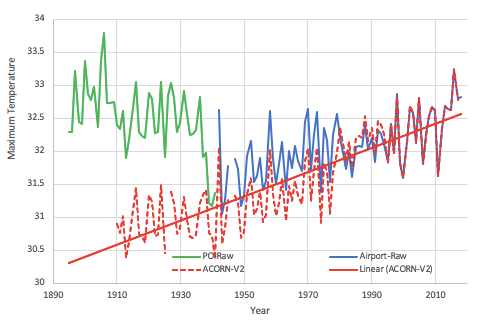
Nope. The gap between raw and adjusted data is striking. The green and blue lines on the graph are the raw data (note that the station was moved to the airport in 1941 which is the shift from green to blue). The red are the adjusted data.
Hard to get much of a warming signal there - there doesn't seem to be any increase during the green period and not much at all during the blue.
Let me say again: the 20th Century supposedly say 1° warming over the entire 100 years, and yet downward adjustments to old years add that or more. My opinion is that the data simply do not show much - or perhaps even any - warming.
I would love the Trump administration to conduct a serious audit of the data adjustment process, requiring site-by-site justification for adjustments. And then fire any scientist who makes changes once the adjustments are all approved. I'd also like to see Trump make NOAA publish unadjusted (raw) data as well, i.e. "20th Century temperatures increased by 1°C (adjusted); temperature increased by 0.1° (unadjusted)". At least then we would have a more honest discussion on the subject.
Here are some things that are all interesting, but none of which tipped the scales for a stand alone post.
Uber will not face criminal charges for Elaine Herzberg's death. The DA is still deciding about charges for the driver, who seems to have been streaming TV to her phone instead of looking at the road when the fatal crash happened. Uber has already settled for an undisclosed sum with Herzberg's family.
The pull quote from that article? An email from an Uber developer: "We shouldn't be hitting things every 15,000 miles." Gee, ya think?
I'm not a prepper but I now that some of you are. This is an interesting post on someone starting a garden with a view to long term SHTF survivability. Seed storage lifetime and time from planting to harvest are covered, along with how squash will cross into new types that may or may not be long term productive. It's probably not a lot of new info for hard core preppers but is a good quick introduction.
The great unpublished story about how oil exploration has been revolutionized (and killed "peak oil") has an unlikely angle: gravity. This is simply fascinating. It appears that we can "see" oil deposits wherever they are on the planet. Now this is the 21st Century that I had been promised.
It's in the comments, so you know that it isn't flattering. Or very intelligent. This is my favorite comment:
I believe these figures [abc.net.au] more than the nonsense from that Borepatch site, a site that's keen to list externalities like the cost of food when power goes up, but not when we burn the Earth's densest carbon sinks.
I'm entirely mystified as to what this means. It's formed similarly to English language grammar, but has no coherent content. "Externalities like the cost of food"? Huh? But I guess I'm keen to list this, though. Good tip.
The National Security Agency has quietly discontinued a controversial program put in place after the September 11 terrorist attacks that collected and analyzed millions of Americans' domestic calls and texts, according to a senior Republican congressional aide.
The NSA hasn't used the system in months, and the Trump administration might not seek to renew its legal authority, Luke Murray, the national security advisor for House minority leader Kevin McCarty (R-Calif.), said in a podcast Saturday.
Under a controversial national security policy put in place by the Patriot Act in 2001, the NSA had been collecting large amounts of metadata, the digital information that accompanies electronic communications. That information included what phone numbers were on the call, when the call was placed and how long it lasted, which was then saved in a database.
Right now this seems to be nothing but word of mouth, so I'm curbing my enthusiasm. However, if it's true then this is a big step forward for privacy.
We see this all the time with gun control - what possible justification can there be for "assault weapons" bans when these are used in one or two percent of gun crimes? And yet there's the never ending drumbeat of "Assault weapons are BAD, mkay?"
You cannot solve a problem if you don't understand the problem.
Silicon Graybeard has a long and information rich post about how the war on drugs is simultaneously keeping patients from being able to control chronic pain while making no headway at all in reducing opioid overdose deaths:
The problem, as usual, is that the Government regulators are starting from a bad assumption. They assumed today's junkie shooting contaminated fentanyl is yesterday's patient who started out on prescription drugs and got addicted that way. Only about 8% of people who receive prescription opioids develop addictions. 80% of addicts get started in other, less legal, ways.
Wrong assumptions lead to wrong law, and doctors are being threatened with their livelihoods by new regulations.
In my field of computer security there's a saying: sometimes its easier not to do something stupid than it is to do something smart. Issues are complicated, and data are often sparse. Fortunately, there's still a sense here that we don't know as much as we'd like to.
But not in the realm of public policy:
A study by Harvard’s Jeffrey Miron and others shows the government’s anti-opioid crusade has backfired and actually increased opioid addiction and overdose deaths:
Opioid overdose deaths have risen dramatically in the United States over the past two decades.… The opioid epidemic has resulted from too many restrictions on prescribing, not too few. Rather than decreasing opioid overdose deaths, restrictions push users from prescription opioids toward diverted or illicit opioids, which increase the risk of overdose because consumers cannot easily assess drug potency or quality in underground markets. The implication of this “more restrictions, more deaths” explanation is that the United States should scale back restrictions on opioid prescribing, perhaps to the point of legalization.
Again, issues are complicated and data are sparse. It is, once again, easier not to do something stupid than it is to do something smart. And yet here we are, mired up to our necks in stupid.
What SiGraybeard does not venture into is motivations. How is it possible for all of the Organs of the State to have produced a result that is not just worse than doing nothing, but probably worse than any other policy conceivable? After all, overdose deaths are skyrocketing, opioids are for sale on ever street corner in the land, the prisons are packed to overflowing, and patients are forced to live in excruciating pain for years. It's hard to come up with an outcome worse than this, and yet the War on Drugs persists.
Pournelle's Iron Law of Bureaucracy states that in any bureaucratic organization there will be two kinds of people":
First, there will be those who are devoted to the goals of the organization. Examples are dedicated classroom teachers in an educational bureaucracy, many of the engineers and launch technicians and scientists at NASA, even some agricultural scientists and advisors in the former Soviet Union collective farming administration.
Secondly, there will be those dedicated to the organization itself. Examples are many of the administrators in the education system, many professors of education, many teachers union officials, much of the NASA headquarters staff, etc.
The Iron Law states that in every case the second group will gain and keep control of the organization. It will write the rules, and control promotions within the organization.
The Drug Enforcement Administration has a bunch of folks who are trying to keep people from killing themselves with narcotics. They're in the first group. But the Iron Law says that they will not be the ones who end up running the Agency. Those will be from the second group - those who work to increase the power, scope, and budget of the DEA.
Note that keeping patients out of excruciating pain is not going to increase the power, scope, or budget of the DEA. And so it does not happen.
The idea that really smart policy, implemented by smart and dedicated public servants is one that we scoff at when it is proposed for gun control. It's right that we scoff, because it's no more plausible than Unicorns. It's a tale to comfort small children.
And so with the stupid War On Drugs. We're not going to get smart policy implemented by smart and dedicated public servants. The Iron Law explains everything that you need to know about why. It's long past time to declare victory and bring the troops home.
The Madhouse Effect How climate change denial is threatening our planet, destroying our politics, and driving us crazy
Free & open to the public | Refreshments served Can't attend in person? Watch it on Facebook live or on-demand on YouTube.Can't attend in person? Watch it on Facebook live or on-demand on YouTube.
Always good to see distinguished scientists calling their opponents "deniers" and then complaining that politics has been destroyed and it's driving him nuts. Remember, these are Very Distinguished Scientists™.
The 1930s saw Germany send us both its greatest scientific minds and its greatest artistic minds. Previn was one of those; born in 1930 in Germany, he was dismissed from the Berlin Conservatory in 1938 because he was jewish. His family ended in Los Angeles where one of his father's cousins was music director for Universal Studios. He was a prodigy and soon landed a job arranging music for television shows. His first was an episode of Lassie called The Sun Comes Up that when he saw the show many years later on reruns he remarked it was "the most inept score you ever heard."
But practice makes perfect, and he ended up nominated for eleven Oscars for best musical adaptation. He won four - and these were for serious films, including Gigi, Porgy & Bess, and My Fair Lady. During his long career he also collected eight Grammys.
Many of you will remember him as a composer, leading symphonies in Houston, Philadelphia, London, and Los Angeles. This was really my introduction to him, and I have a number of albums of him conducting one of these orchestras. He recorded quite a lot with his fifth wife, violinist Ann-Sophie Mutter, for whom he composed this violin concerto.
This piece is unique in the classical music posts that I've done here. There are very few selections from the 20th Century, and this (while written in the 20th) was not premiered until 2002 (the 21st Century). As you can imagine, I don't mostly care for modern classical music. However, I did want to highlight Previn's composition talent, which was serious. He wasn't just a conductor.
In fact, he was an incredibly versatile musician, working - and performing - professionally with many of the Jazz greats. He recorded with Ella Fitzgerald and Oscar Peterson, and this 1974 television show with Peterson is charming in part due to the lack of ego on display by both men.
His passing is something that I find sad. More than the passing of a man's life, he represents the passing of an age where entertainment still aspired to great heights even if those aspirations often fell short. That sense of art seems gone now, and we are all diminished.
Rest in Peace, Andre. Thanks for all the great music.
UPDATE 3 March 2019 12:24: Via Dwight (obits are his specialty, after all) we find this hilarious story from Previn's life: "Let's call Shostakovich." LOL.
In the last ten years here I've posted over 400 country music songs. Over the last couple of years it's gotten harder to come up with songs that I haven't posted. So I went off looking for lists, and stumbled across Rolling Stone's 100 Greatest Country Songs of All Time. Reading through it was surreal. Taylor Swift? Eric Church? Kacey Musgraves? What the hell?
It becomes apparent rather quickly that the list is more about political correctness and spreading the interest over a wide age group so as to ensnare as many people as possible. For instance, let's face it, there hasn't been a country song since the '80s that should be in the Top 25. For the most part, country music is old people's music -- no matter what Blake Shelton or Eric Church say. New country, bro-country, hick-hop, it's all just pop crap with a twang, and comes fully equipped with less depth than a wading pool.
But this led me to Fred Eaglesmith. A Canadian farm boy, he caught a freight train to western Canada (no joke) and founded a band called the Smoking Losers. I mean, what's not to like there? More importantly, this sounds like a fellow who has a bit more exposure to country music than the children who write for Rolling Stone.
Johnny Cash (Songwriter: Fred Eaglesmith?)
Well you sure do like Johnny Cash now Now that they've put him in the ground You hang his poster on your ceiling His songs give you a real good feeling You sure do like Johnny Cash now
Where were you in 1989? When it looked like Johnny was on the decline His career was fading And his shows weren't selling You were listening to heavy metal Well you sure do like Johnny Cash now You sure do like Johnny Cash now
Now that they've put him in the ground The radio station plays him all the time Too bad you hardly played him when he was alive But you sure do like Johnny Cash now Yeah you sure do like Johnny Cash now
And you sure did like when he sang the Nine Inch Nails When he looked like he was dying in that video You liked that did ya? He was givin' them the finger Too bad about all that religion But you sure do like Johnny Cash now But you sure do like Johnny Cash now But you sure do like Johnny Cash now
I actually liked Johnny's cover of "Hurt" but it's not the only song of his I ever bought (or posted). The point of this song is a good one - maybe the idiots at Rolling Stone should take a listen.
Congratulations to the Gillette marketing team for making it to Dilbert. I'd like to have a dollar for every copy of this that goes up on the wall somewhere at Gillette HQ.
RAF Squadron Leader Dick Churchill, last of the prisoners to break out of Stalag Luft III in the Great Escape, dead at 99. Longfellow was long dead before the war but he knew of men such as Churchill and his comrades, refusing to live as dumb driven cattle.
Boeing has built an autonomous military aeroplane that flies in formation with a manned fighter jet to ward off electronic warfare attacks. Reports say the craft could be modified to carry and use its own weapons.
The electronic warfare drone was built for the Royal Australian Air Force (RAAF) by the American aerospace conglomerate and is roughly the size of a traditional military fast jet, according to the Australian Broadcasting Corporation.
"Its primary purpose would be to conduct electronic warfare and reconnaissance missions, particularly in environments where it is considered risky to send manned aircraft," reported the Aussie state broadcaster.
A lot of people resist the idea of "smart gun" technology that the Police won't use, you should be suspicious of electric cars (coming soon in a Green New Deal near you!) if the Police don't drive them:
RIVERSIDE — A probationer who led Riverside police officers on a dangerous, high-speed pursuit in a luxury electric sports car was arrested after the plug-in car’s batteries died Sunday night, Feb. 17. The pursuit, which wound its way from Riverside’s Eastside neighborhood into Orange County, ended in a felony stop on the 91 Freeway.
The owner had an app on his phone that let him track the car's location in real time. He relayed this info to the Police, who kept the thief on the run until the car's battery died. Of course, the bad guy looks pretty much like what you'd expect:
Now it's great that the thief was caught but the point is that a lot of folks want to mandate the use of electric vehicles without really giving much thought for what people need or want. If these cars are such a great idea, why aren't Police cruisers battery powered?
Unless you buy it after an IED explosion, or going out like Quint in Jaws, death mainly hurts the friends and family.
No one ever woke up during a Code Blue and said "Ow!". They were over it, and generally speaking, long gone and well past caring at that point.
And if they've had their threescore-and-ten, or more, it isn't really necessary to "compartmentalize" their death; someday, it's going to be everybody's time.
The hard ones are the way-too-early ones, especially kids and infants. No one pulls the plug on those for an hour or more, because kids.
This is a long and thoughtful post, inspired by a post at OldNFO's place. I'd be interested in the opinions of Tacitus, a retired ER doc who is a sometimes commenter here.
Interestingly, I didn't find any of this very morbid. It did make me think of Dad's funeral, but that was (as you can imagine) intensely personal and so had a very different emotional component.